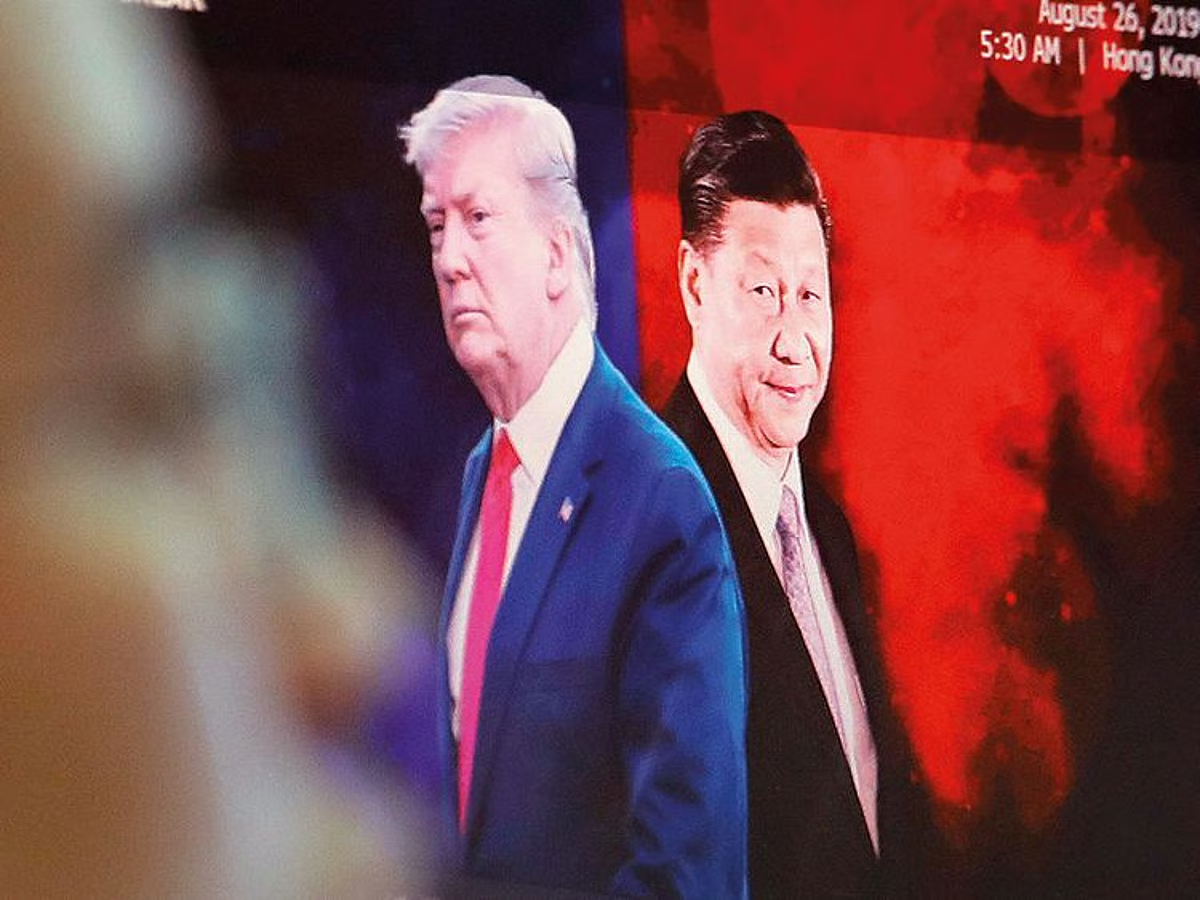

The AI race is intensifying between major world powers, with significant implications for global competition, economic growth, and technological innovation. According to Professor Sophia Kalantzakos, Global Distinguished Professor of Public Policy at NYU Abu Dhabi, the current era is characterized by hyper-competition between the US and China.
This rivalry is driving the development of artificial intelligence, with both countries vying for dominance in the “tech imperium.” The Paris 2015 consensus set two parallel tracks: greening the global economy through electrified transport and renewable energy, and advancing the fourth industrial revolution through global digitalization and dematerialization of the economy.
The AI Race: A Complex Competition
The AI race is not a straightforward competition, with different countries pursuing distinct strategies. Henrietta Levin, Senior Fellow at the Center for Strategic and International Studies, noted that the US is focused on developing artificial general intelligence (AGI), while China is prioritizing the application of existing AI technology to various sectors, including the economy and military.
China’s approach is driven by strong state backing, with President Xi Jinping’s concept of “new productive forces” framing AI as crucial to the country’s national rejuvenation and escape from the middle-income trap. In contrast, the US relies on its deep capital markets to support the development of AGI, a more ambitious and abstract goal.
Levin likened the AI landscape to a drawn-out space race, with successive milestones rather than a single finish line. However, some in Washington worry about a potential “lock-in” moment if one actor achieves a decisive breakthrough first.
Europe’s Emerging Role in AI Regulation
Europe is emerging as a regulatory power in the AI landscape, with significant implications for the development of common rules and standards. According to Kalantzakos, Europe is seeking to establish “guardrails” and ensure that citizens’ rights are protected, particularly with regard to privacy and the spread of misinformation.
Levin noted that digital sovereignty debates are already causing tension within the transatlantic alliance, despite the US and Europe being natural partners on AI governance. The risk of a “balkanisation of AI standards and regulation” is high, as political systems diverge on values and acceptable use.
The AI ecosystem remains heavily dependent on a single, fragile chokepoint: Taiwan’s TSMC, which produces high-end chips essential for AI development. Levin emphasized that peace and stability across the Taiwan Strait are necessary conditions for AI progress.
Middle East Seeks Agency in a Multipolar AI Order
Abdulla Al Khaja, Researcher at TRENDS Research and Advisory, said that Gulf states are proactively adopting AI to enhance their position in the international system, rather than simply choosing sides in the US-China competition. The UAE, for example, has launched a National AI Strategy 2031, while Saudi Arabia and Qatar are pursuing parallel initiatives around smart cities and AI-enabled governance.
As the AI race continues to unfold, the next expected step is the establishment of clearer regulations and standards. The outcome will depend on the complex interplay between major world powers, including the US, China, and Europe. The path forward is uncertain, and the global community will be watching key developments, including the implementation of national AI strategies and the evolution of international cooperation on AI governance.