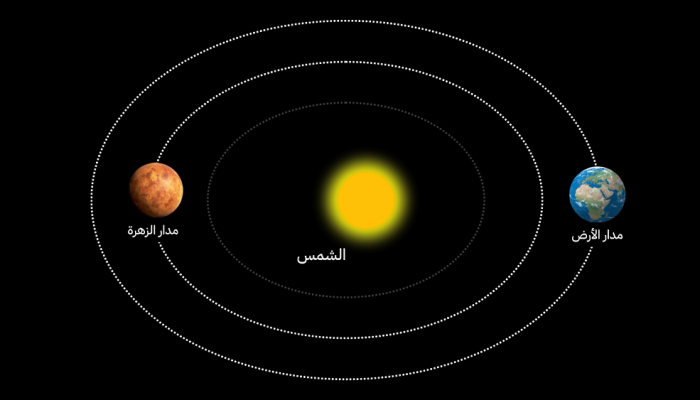

Venus will reach a significant astronomical event known as superior conjunction with the Sun on Tuesday at 9:10 PM Oman time. This alignment, where the Sun sits between Earth and Venus, will see the planet pass almost directly behind the Sun from our perspective. The Oman Astronomical Society has confirmed this timing, offering insights into this fascinating celestial occurrence and what it means for observing the “evening star.”
Understanding the Venus Superior Conjunction
A superior conjunction occurs when Venus appears to move from being a morning star to an evening star, or vice versa. According to Wisal Salim Al Hinai, Vice Chair of the Community Communication Committee at the Oman Astronomical Society, this particular conjunction marks the point in Venus’s orbit where it is farthest from Earth – an estimated 255.8 million kilometers. This distance makes Venus temporarily invisible to observers on Earth.
What Does Superior Conjunction Mean?
Essentially, during a superior conjunction, the order of the planets from our viewpoint is Earth, then the Sun, and finally Venus. This positioning places Venus on the opposite side of the Sun, effectively blocking its light and making it difficult to observe. It’s a key transition in Venus’s 584-day orbital cycle, a regular pattern of movement that astronomers closely monitor.
Venus: A Bright Neighbor
Venus is often called Earth’s sister planet due to its similar size and composition. However, despite these similarities, Venus boasts a remarkably different environment. It’s also incredibly bright, consistently ranking as the third brightest object in the sky after the Sun and Moon. This brightness is due to its highly reflective cloud cover.
Like our Moon, Venus exhibits phases – appearing as a crescent, gibbous, or full disk – as it orbits the Sun. These phases are observable through telescopes and provide concrete evidence of its revolution around our star. Observing these phases is a rewarding experience for amateur astronomers and reinforces our understanding of planetary motion.
The Disappearance and Re-emergence of Venus
Al Hinai explained that Venus shone brightly as a morning star for much of 2025. However, it began to fade from view in late November as it drew closer to the Sun’s glare. Now, it’s at its closest apparent proximity to the solar disk, rendering it unobservable with the naked eye or even standard telescopes. This is a natural part of its cycle.
Following the superior conjunction, Venus will gradually move westward, increasing its angular separation from the Sun each day. By mid-February, it will re-emerge in the evening sky after sunset. Over the following months, it will once again become the brightest object in the night sky after the Moon, offering stunning views for stargazers. This re-emergence is eagerly anticipated by astronomy enthusiasts.
Scientific Significance of the Event
While the Venus superior conjunction itself isn’t directly visible, it provides valuable scientific insight. It allows astronomers to refine their understanding of the relative motions of the inner planets – Mercury and Venus – and their changing positions in our solar system. Precise calculations and observations during these events help validate and improve our models of planetary orbits.
Additionally, studying these conjunctions contributes to our broader knowledge of the dynamics within the inner solar system. Understanding these movements is crucial for predicting future planetary alignments and potential impacts on space weather. The event also serves as a reminder of the complex and beautiful choreography of the planets.
Looking Ahead: Observing Venus in the Evening Sky
Al Hinai encourages astronomy enthusiasts to keep an eye on the western horizon in the coming weeks, anticipating Venus’s return to the evening sky. The reappearance of Venus will be a spectacular sight, and a great opportunity for observation and astrophotography. Remember to use appropriate eye protection when observing near the Sun, even when Venus is not directly visible.
The superior conjunction of Venus is a fascinating reminder of the dynamic nature of our solar system. It’s a celestial event that, while invisible to the naked eye at its peak, offers significant scientific value and a beautiful promise of a bright evening star returning to grace our skies. Keep looking up and exploring the wonders of the universe!