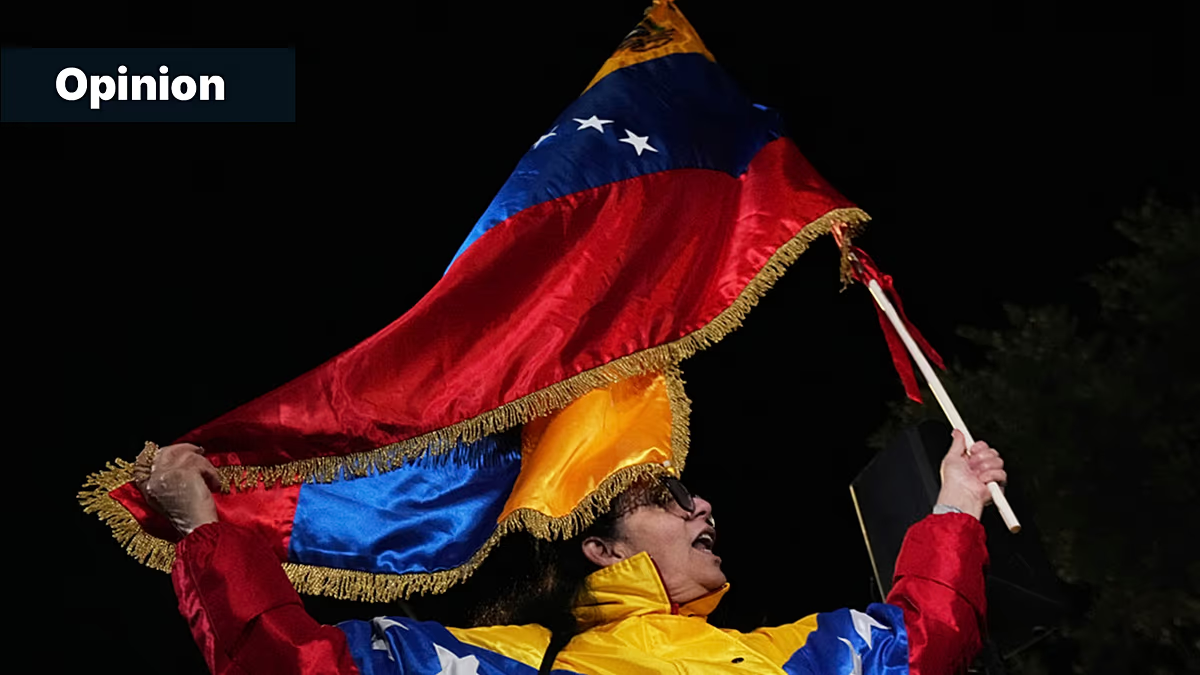

The recent U.S. indictment of Venezuelan President Nicolás Maduro and his wife on drug trafficking charges has sparked international debate, raising complex questions about national sovereignty and the legitimacy of intervention in another country’s affairs. French National Assembly deputy Sébastien Chenu argues that while Maduro’s actions are reprehensible, the manner of addressing them – specifically, actions violating Venezuela’s territorial integrity – sets a dangerous precedent. The situation highlights a growing tension between international law and perceived moral obligations, particularly as global powers re-evaluate their foreign policies.
Chenu, representing the National Rally party, has been a vocal critic of Maduro’s regime. However, he emphasizes that the principle of sovereignty is paramount, and its erosion poses a threat to all nations, including France. This stance reflects a broader concern within some political circles regarding the increasing willingness of external actors to bypass established international norms.
The Dilemma of Sovereignty in International Relations
The core of the debate centers on the concept of national sovereignty – the idea that a state has supreme authority within its own borders. According to international law, interference in the internal affairs of another nation is generally prohibited. The U.S. action, while aimed at a leader accused of serious crimes, is viewed by some as a violation of this principle.
However, the situation is complicated by the widely documented human rights abuses and economic mismanagement under Maduro’s leadership. Millions of Venezuelans have fled the country due to the crisis, creating a significant humanitarian challenge for neighboring nations. This has led some to argue that the severity of the situation justifies intervention, even if it technically breaches international law.
Chenu acknowledges the illegality of the U.S. action under international law, but questions its legitimacy given Maduro’s authoritarian rule. He draws a parallel to concerns within France regarding the perceived erosion of its own sovereignty within the European Union, arguing that a weakening of national authority globally ultimately harms all countries.
France’s Position and Focus on National Interests
France, a permanent member of the UN Security Council and a nuclear power, is uniquely positioned to navigate these complex geopolitical waters. Chenu stresses the need for France to prioritize its own security and national interests, advocating for a significant increase in defense spending. He points out that France’s defense budget, currently at approximately 2.06% of GDP, is considerably lower than its historical average of 6.1% in 1960.
Additionally, Chenu calls for a more assertive French diplomacy, emphasizing the importance of a strong and independent voice on the international stage. He echoes the sentiment of former President Charles de Gaulle, stating that “France has no friends, it has only interests.” This suggests a shift away from multilateralism and towards a more pragmatic, self-reliant foreign policy.
The situation in Venezuela also underscores the importance of addressing the root causes of instability, such as drug trafficking and authoritarianism. While Chenu doesn’t explicitly outline a proposed course of action for France, his comments imply a need for a nuanced approach that balances the principles of international law with the realities of a changing world order. The ongoing conflict in Ukraine, for example, has demonstrated the limitations of international law in the face of aggression, prompting a re-evaluation of security strategies across Europe. The Council on Foreign Relations provides ongoing analysis of global conflicts.
The debate surrounding Maduro’s indictment and the broader implications for national sovereignty are likely to continue. As global powers grapple with increasingly complex challenges, the tension between legal obligations and perceived moral imperatives will remain a central theme in international relations. Observers should watch for further developments in the U.S. legal proceedings against Maduro and how France responds to this evolving situation, particularly in relation to its own defense and diplomatic initiatives.