
Belgium’s Foreign Minister Maxime Prévot has sharply criticized the United States’ renewed interest in acquiring Greenland, calling President Trump’s approach “incomprehensible and unnecessarily hostile.” The escalating rhetoric from Washington, including threats of force and a digitally-generated image of Trump planting a US flag on the island, has sparked concern among European leaders and raised questions about transatlantic relations. This latest development comes as the World Economic Forum in Davos is overshadowed by the dispute.
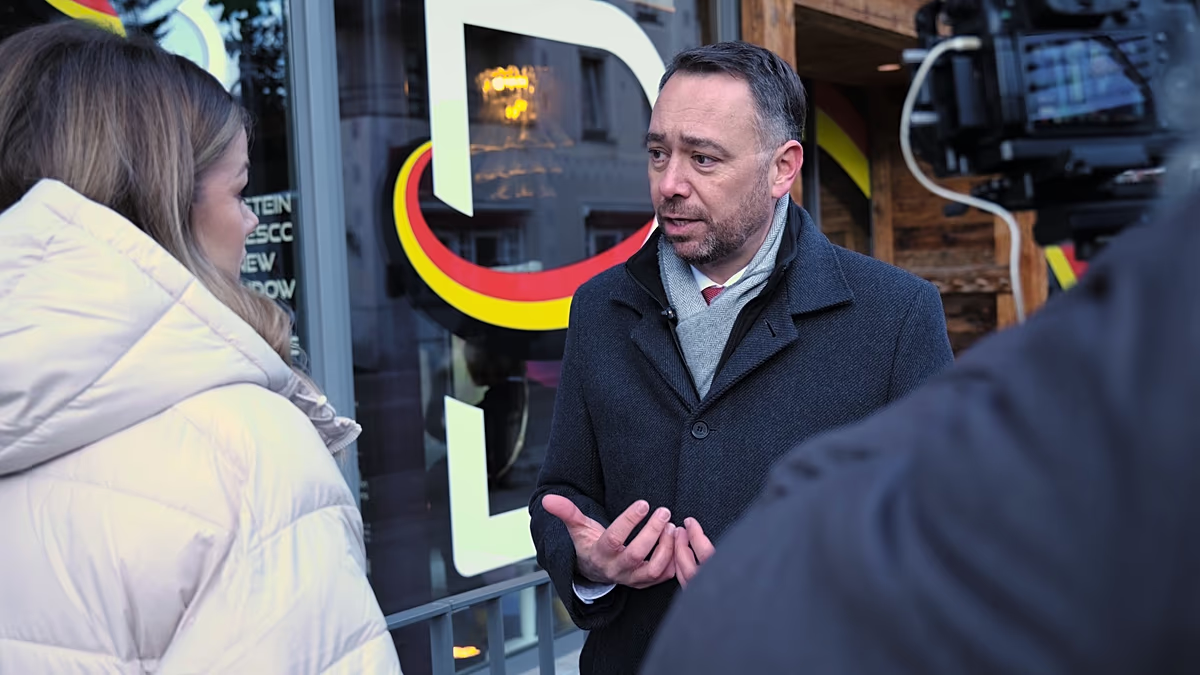
Speaking to Euronews at Davos on Tuesday, Prévot dismissed the idea of the US taking control of the territory. The US has argued that control over Greenland is “imperative” for national security, citing increased activity by Russian and Chinese vessels in the Arctic region. However, Prévot stated there is “no rational explanation” for disregarding the concerns of European allies.
US Bid for Greenland Faces European Opposition
President Trump first floated the idea of purchasing Greenland in 2019, a proposal that was quickly rejected by Danish Prime Minister Mette Frederiksen as “absurd.” Now, he has escalated the situation, not ruling out a forceful takeover and threatening a 10% import tax on goods from eight European nations that oppose the acquisition. This move has prompted an emergency summit among EU leaders to determine a unified response.
Prévot acknowledged the US security concerns regarding the Arctic, noting a pre-existing partnership through the Greenland Defence Agreement. This agreement allows the US military to operate on the island and could potentially be expanded. “It’s not necessary to take, in an aggressive and old-style manner, any square kilometres of Greenland,” he said, adding that the US actions represent a “red line” for European countries.
Tariff Threats and Potential Retaliation
The threatened tariffs have created a scramble within the European Union to formulate a cohesive strategy. One option under consideration is the deployment of the EU’s Anti-Coercion Instrument (ACI), a powerful trade mechanism that could restrict access to the single market for the US. However, there is internal debate about using such a drastic measure.
Many EU members are prioritizing diplomatic solutions and seeking to de-escalate tensions with the US. They believe that engaging in a trade war would be detrimental to both sides. Prévot echoed this sentiment, stating that avoiding an escalation is “crucial” and that a “reasonable solution” must be found in the coming weeks. Euronews provides further coverage of the interview.
Despite the criticism, Prévot expressed hope for a pragmatic resolution. He believes that the ongoing meetings at Davos, including a planned discussion with “the various parties” involved in the Greenland issue, present an opportunity to reset the tone and find a mutually acceptable path forward. Belgium’s Prime Minister Bart De Wever and King Philippe are also present at the forum and will contribute to conveying this message.
European leaders have been quick to support Denmark and Greenland in the face of US pressure. They argue that the deployment of European military personnel to the Arctic is a demonstration of commitment to regional security, not an “anti-American act” as suggested by the US. This increased presence is intended to address the security concerns raised by the US, but through cooperation rather than coercion.
The situation highlights growing tensions in the Arctic, a region of increasing geopolitical importance due to climate change and the opening of new shipping routes. The US, Russia, China, and other nations are all vying for influence in the area, and the dispute over Greenland is a symptom of this broader competition. The Council on Foreign Relations offers in-depth analysis of the Arctic region and its strategic significance.
EU leaders will convene in Brussels on Thursday for an extraordinary summit to finalize their approach to the situation. The outcome of this meeting will be critical in determining the future of the dispute and the overall state of transatlantic relations. Observers will be watching closely to see whether the EU prioritizes dialogue or opts for a more assertive stance through the use of trade measures.
As the situation unfolds, the focus will remain on de-escalation and finding a diplomatic solution that respects the sovereignty of Denmark and Greenland while addressing legitimate US security concerns. The coming weeks will be crucial in shaping the future of the Arctic region and the relationship between the US and its European allies.