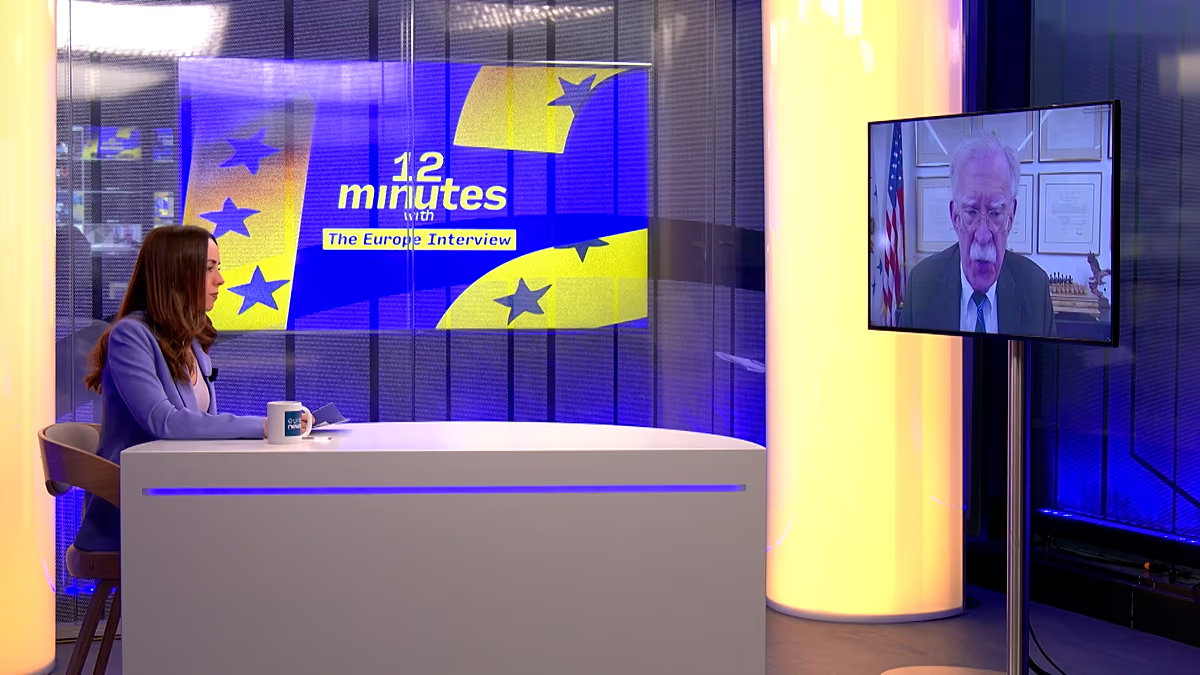

Former U.S. National Security Advisor John Bolton has asserted that military intervention in Iran could be crucial in altering the current political landscape, and that a change in the Iranian regime is essential for regional stability. In an interview with Euronews, Bolton suggested that targeted strikes by the U.S. are likely, following recent statements from former President Trump regarding a “strong response” to ongoing unrest within the country. The comments come amid heightened tensions and concerns about potential escalation in the Middle East.
Bolton, who served under President Trump from 2018 to 2019, identified potential strategic targets within Iran, including facilities belonging to the Islamic Revolutionary Guard Corps (IRGC), the Basij militia, and the Iranian Navy, as well as sites related to Iran’s nuclear and ballistic missile programs. He believes such action would signal support for the Iranian opposition and demonstrate international resolve against the current government’s repression of protests.
The Case for Intervention in Iran
According to Bolton, the current Iranian government is at a particularly vulnerable point, potentially the weakest it has been since the 1979 Islamic Revolution. He argues that regime change in Iran is not merely desirable, but a “absolute prerequisite” for achieving lasting peace and security in the Middle East and preventing the proliferation of terrorism and nuclear weapons. This stance reflects Bolton’s long-held hawkish views on Iran, advocating for a firm approach to counter its regional influence.
The possibility of U.S. military action has raised concerns about potential retaliation. Analysts suggest that American bases in countries like Saudi Arabia and Qatar could be targets if conflict were to erupt. This potential for a wider regional conflict underscores the gravity of the situation and the need for careful consideration of all options.
Criticism of European Strategy
Bolton also criticized the approach taken by European leaders towards Iran, stating they have done “much of anything” to effectively weaken the current regime. While the European Union has imposed sanctions and is considering further measures, Bolton believes a more proactive stance, including increased support for the Iranian opposition, is necessary. He suggested providing resources and communication channels to help opposition groups coordinate more effectively.
Bolton’s Assessment of Trump’s Foreign Policy
The former National Security Advisor offered a scathing review of President Trump’s overall foreign policy record, assigning it a grade of “two or three” out of ten. He characterized Trump’s decision-making as “complete disaster” in some instances, lacking a coherent grand strategy and relying instead on transactional, ad-hoc approaches.
This lack of strategic vision, Bolton contends, led to inconsistencies and reversals in policy, potentially undermining the United States’ credibility and causing difficulties with Trump’s own political base. He pointed to the situation in Venezuela as another example of a failed policy, where the Maduro regime remains in power despite previous U.S. efforts to support the opposition. The Council on Foreign Relations provides further background on U.S.-Iran relations.
Bolton contrasted the current situation in Venezuela with what he believes should be the U.S. approach, referencing Trump’s past tweets encouraging the Iranian opposition to “take control of your institutions.” He argued that a similar message and support should be directed towards Venezuela’s opposition to facilitate a change in leadership.
The situation remains fluid, with the potential for further escalation dependent on the actions of both the U.S. and Iran. Observers will be closely watching for any concrete steps taken by the Biden administration in response to the ongoing unrest and Bolton’s calls for a more assertive policy. Continued monitoring of diplomatic efforts and regional developments is crucial to understanding the evolving dynamics surrounding Iran and the broader Middle East.
For ongoing updates and analysis on this developing story, stay tuned to trusted news sources and consider exploring resources from think tanks specializing in Middle Eastern affairs.