



Political tensions are escalating after Turkish forces shot down two unmanned aerial vehicles (UAVs) entering its airspace over the Black Sea in recent days. The first UAV was downed over Ankara on Friday, December 15th, while the second was discovered in a field near Balıkesir on Saturday. These incidents occur amidst heightened activity in the Black Sea region, raising concerns about regional security and potential miscalculation.
The Turkish Ministry of National Defence (MND) stated that it warned both Russia and Ukraine following the detection of the first UAV. According to the MND, the drone appeared to be out of control and posed a threat, prompting its interception and destruction by F-16 fighter jets. The second vehicle discovered near Balıkesir is suspected by local authorities to be of Russian origin, though official confirmation is pending.
Concerns Rise Over Turkish Airspace Violations and UAV Security
The downing of these UAVs has spurred questions about the effectiveness of Turkey’s radar and air defense systems. Namık Tan, a CHP Istanbul deputy and former ambassador, questioned whether the system was sufficient to detect and intercept drones approaching the capital and critical defense infrastructure. However, the Ministry of National Defence swiftly refuted these claims.
The MND emphasized that Turkish airspace is continuously monitored through a layered system incorporating radar, early warning capabilities, electronic warfare measures, and interceptor aircraft. They affirmed that the process surrounding the Ankara incident was “successfully managed and finalised,” and that assertions of weakness in the air defense system are unfounded. The debris from the first UAV was scattered across a wide area, making complete recovery and analysis challenging, the ministry also noted, but search and investigation efforts are ongoing.
Black Sea Activity and Regional Instability
The Turkish government has expressed increasing concern over escalating activity in the Black Sea, particularly recent attacks on commercial vessels. These attacks have indirectly impacted Turkish interests, with some ships linked to Turkish companies being targeted. President Recep Tayyip Erdoğan has repeatedly condemned these actions and urged restraint from all parties involved.
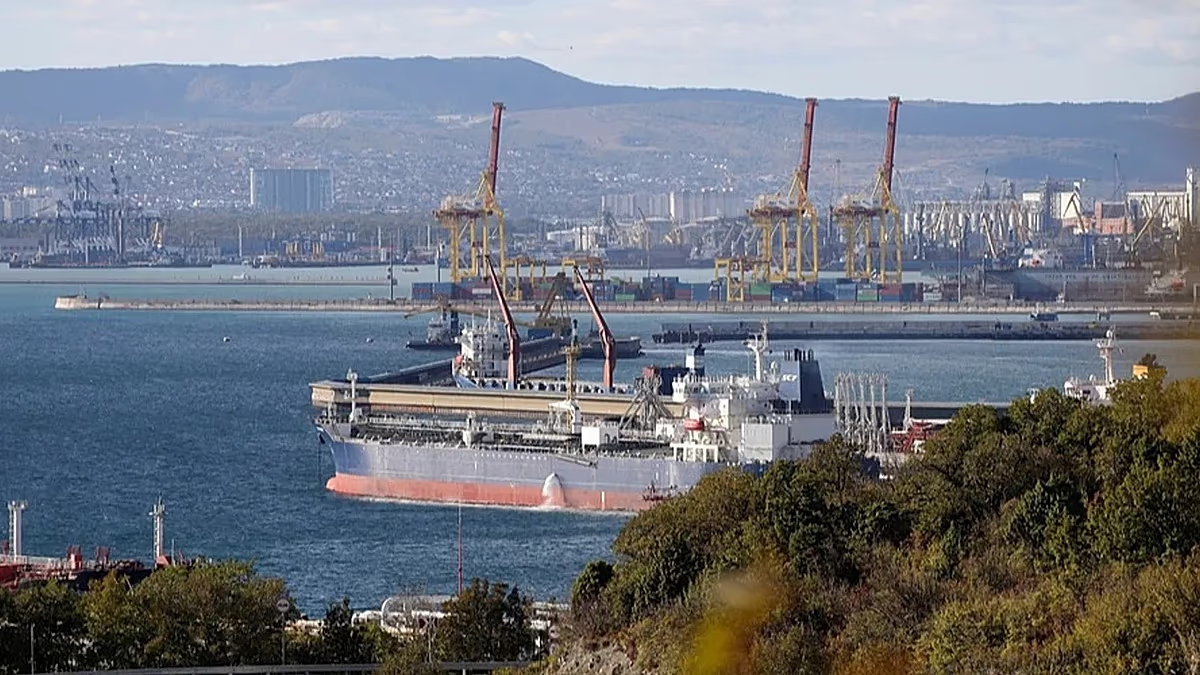
In late November, the VIRAT and KAIROS oil tankers, believed to be part of Russia’s shadow fleet, were attacked. Turkish teams were instrumental in rescuing personnel from those vessels. Early December brought another incident, with the MIDVOLGA-2 tanker, carrying sunflower oil, sustaining damage in the Black Sea, approximately 130 kilometers from the Turkish coastline.
More recently, on December 12th, a Panama-flagged passenger and cargo ship, the ‘CENK T’, owned by Turkish company Cenk Ro-Ro, was hit by a Russian missile while anchored in the port of Odessa, Ukraine. The Cenk T operates regular voyages between Turkey and Ukraine, serving both passenger and freight transport needs. These incidents highlight the broader risks to maritime traffic in the region and underscore Turkey’s position as a key actor in efforts to de-escalate tensions.
Turkey has maintained a delicate balancing act throughout the ongoing war between Russia and Ukraine, seeking to preserve relations with both sides while also upholding international law and protecting its own national interests. This incident adds a layer of complexity to this already challenging diplomatic situation.
What to Watch For
The investigations into the origin and purpose of the downed UAVs are expected to continue, potentially shedding light on the increased reconnaissance activities in the Black Sea. Further escalation could prompt Turkey to take additional measures to secure its airspace. Monitoring the responses from both Russia and Ukraine, and any further incidents impacting commercial shipping, will be critical in assessing the evolving security landscape in the region. Continued vigilance and diplomatic efforts will be essential to prevent miscalculation and maintain stability in the Black Sea.