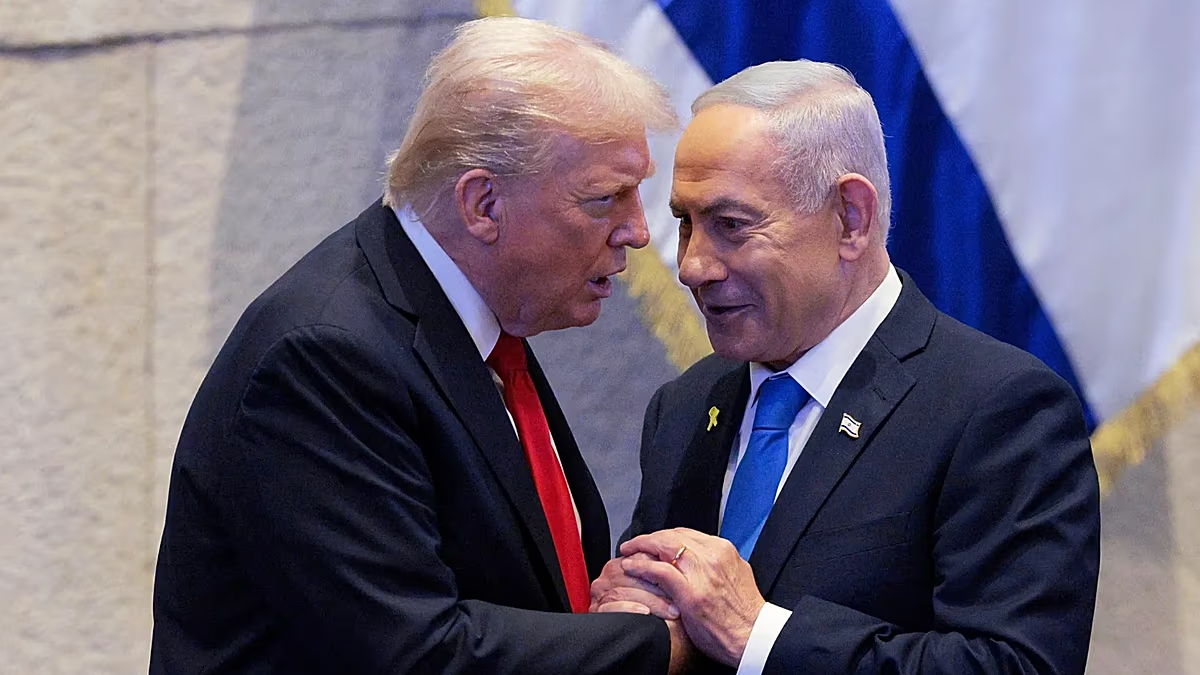

A crucial meeting is scheduled between US President Donald Trump and Israeli Prime Minister Benjamin Netanyahu on Monday, focused on bolstering a fragile Gaza ceasefire and navigating the complexities of a potential second phase. Washington aims to inject new momentum into the agreement, which is showing signs of stalling despite initial successes. The talks will take place at Trump’s Mar-a-Lago estate in Florida, as concerns mount over the long-term viability of peace in the region.
The meeting comes as the initial phase of the ceasefire, brokered by the US, has largely held since its inception in October, coinciding with the second anniversary of the Hamas-led October 7 attack. However, progress towards a more comprehensive resolution has slowed, with both Israel and Hamas accusing each other of violations. International pressure is increasingly focused on Israel to facilitate further advancements in the peace process.
The Complexities of the Gaza Ceasefire’s Second Phase
The second phase of the initiative centers around Trump’s 20-point plan, already endorsed by the UN Security Council. This plan outlines an ambitious, yet challenging, vision for ending Hamas’ control over Gaza and establishing a more stable future for the territory. The plan’s implementation requires navigating significant logistical and political hurdles.
Central to the second phase is the establishment of a ‘Board of Peace,’ chaired by Trump, to oversee the reconstruction of Gaza under international supervision. This board would operate with a two-year, renewable mandate from the United Nations. The members of the Board of Peace were anticipated to be announced by the end of the year, but an announcement may be delayed until next month.
Rebuilding Gaza and Establishing Security
The plan envisions a demilitarised Gaza, rebuilt with international assistance. A “technocratic, apolitical” committee, comprised of Palestinians, would be responsible for the day-to-day administration of the territory, operating under the oversight of the Board of Peace. A key component is the creation of an ‘International Stabilisation Force’ to ensure security and prevent the re-emergence of Hamas’ military capabilities.
Additionally, the plan calls for the normalisation of relations between Israel and Arab nations, potentially paving the way for Palestinian independence. However, achieving these goals requires addressing deeply entrenched disagreements and building trust between all parties involved. The humanitarian situation in Gaza, following extensive damage from recent conflicts, also presents a major challenge.
Beyond Gaza, the discussion is expected to include Iran’s nuclear program. Trump has repeatedly asserted that US strikes in June “completely and fully obliterated” Tehran’s nuclear capabilities. However, Netanyahu maintains that the threat persists and is advocating for further military action. This divergence in perspective adds another layer of complexity to the talks.
Recent diplomatic efforts have included meetings between US Mideast envoy Steve Witkoff, Jared Kushner, and officials from Egypt, Qatar, and Turkey – all key mediators in the ceasefire negotiations. These discussions, held in Florida, aimed to address concerns and identify potential solutions to overcome the current impasse.
Netanyahu’s visit to Mar-a-Lago marks a continuation of a close relationship with Trump, having previously met with the former president at the White House shortly after his second term began and again in July 2024. This in-person meeting is the first since Trump’s trip to Israel in October to commemorate the start of the initial ceasefire phase.
The success of the second phase of the Gaza ceasefire hinges on the willingness of all parties to compromise and engage in good-faith negotiations. The international community will be closely watching the outcome of Monday’s meeting for signals of renewed commitment to a lasting peace. Further developments regarding the Board of Peace and the implementation of Trump’s 20-point plan are expected in the coming weeks. For more information on the ongoing situation, you can refer to Reuters’ coverage of the Middle East.
Analysts suggest that the Israeli-Palestinian conflict resolution will require sustained diplomatic engagement and a commitment to addressing the underlying causes of the conflict. The peace process remains delicate, and any misstep could jeopardize the progress made thus far.