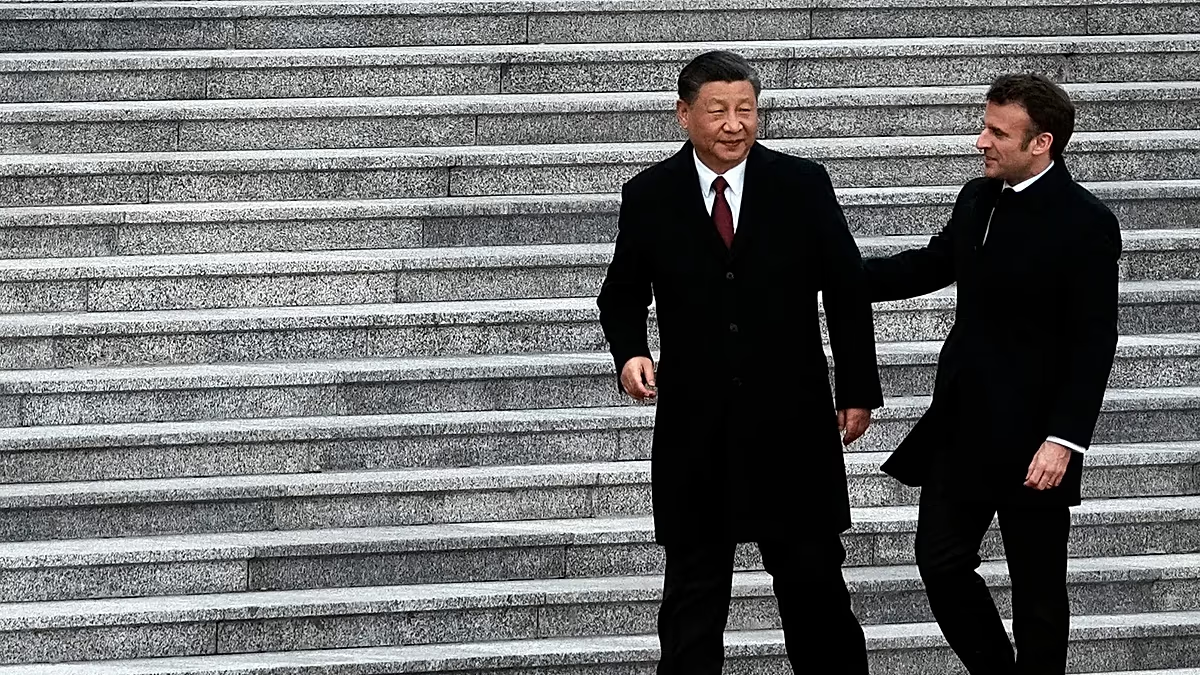

French President Emmanuel Macron is embarking on a crucial state visit to China from December 3rd to 5th, aiming to bolster Sino-European relations and address pressing global challenges. The trip comes at a sensitive time, as the European Union seeks to rebalance its significant trade deficit with China and persuade Beijing to reassess its support for Russia amidst the ongoing conflict in Ukraine. Economic cooperation and strategic dialogue are expected to dominate the agenda during the high-level meetings.
The visit is strategically timed, with both France and China set to hold key positions on the global stage in 2026: France will host the G7 summit, and China will chair the Asia-Pacific Economic Cooperation (APEC). This positioning underscores the importance of developing a robust dialogue and finding common ground on trade and geopolitical issues. According to the Élysée, Macron will function as an envoy for the entire EU, reporting back to member states and the European Commission following his talks.
Macron’s Mission to Rebalance Sino-European Relations
A primary focus of Macron’s visit is the widening trade gap between the EU and China, which reached €305.8 billion in 2024. This imbalance is causing concern within European industries, which are facing weak demand in the Chinese market. The EU views China as a partner, competitor, and systemic rival, a complex relationship Macron aims to navigate during his meetings.
While a direct discussion about rare earths is unlikely, trade disputes – such as recent Chinese investigations into EU pork and dairy products – will be addressed. Paris is pushing for “reciprocal commitments,” seeking a shift in Chinese policy toward increased domestic consumption and reduced exports. In return, the EU is prepared to consider boosting its own production and reducing reliance on imports, aiming for more “sustainable growth,” a source at the Élysée stated.
Innovation and Investment Opportunities
Investment and innovation will be prominent themes throughout Macron’s visit. China has emerged as a global leader in technological advancement, particularly in areas like artificial intelligence, battery technology, and drone manufacturing, and is actively seeking to expand its global footprint. While France isn’t the primary gateway for Chinese investment into Europe, significant investment has occurred in strategic sectors such as chemicals, automotive, and energy.
Macron is expected to advocate for “sharing the gains of innovation,” especially as EU member states debate potential restrictions on technology transfers to Chinese companies. The argument, as presented by the Élysée, is that after decades of globalization benefiting China, collaborative innovation can now offer mutual advantages. A delegation of French CEOs accompanying the president will be actively exploring market access opportunities in China.
Geopolitical Concerns: Ukraine and Taiwan
Beyond economics, Macron will address critical foreign policy issues, specifically the wars in Ukraine and tensions surrounding Taiwan. He will meet with Xi Jinping as the United States attempts to broker a potential peace deal between Ukraine and Russia, aiming to ensure European interests and Kyiv’s sovereignty are protected.
European leaders are increasingly concerned about China’s continued support for Russia, which they believe provides a lifeline to Moscow, including supplying a significant portion, reportedly 80%, of the components needed for weapons production. Macron is anticipated to reiterate the responsibility of China, as a permanent member of the UN Security Council, to uphold global peace and security. For more information on the conflict, see the Council on Foreign Relations’ Ukraine page.
Tensions over Taiwan are also expected to be a key topic. China claims Taiwan as a breakaway province, and recent statements from Japanese officials – including designating any attempt to blockade or invade Taiwan as an “existential matter” – have heightened concerns. Beijing reacted with fury to these remarks, imposing economic countermeasures on Japan. Macron will likely emphasize the EU’s long-standing position on Taiwan: non-recognition of its sovereignty and opposition to any changes to the status quo.
As this high-stakes visit concludes, the world will be watching closely to see if Macron can navigate these complex issues and pave the way for a more balanced and productive relationship between Europe and China. The outcomes of these discussions will undoubtedly have significant implications for global trade, geopolitical stability, and the future of international cooperation.