
The recent detention of former EU foreign policy chief Federica Mogherini in Belgium on suspicion of fraud has reignited scrutiny of the stalled investigation into the European Parliament corruption scandal, often referred to as “Belgiangate.” Three years after initial raids shocked Brussels, key figures remain uncharged and a trial appears years away, raising questions about the pace and complexities of the legal proceedings.
Mogherini, who previously led the EU’s diplomatic service and served as rector of the College of Europe, was questioned alongside two others regarding alleged procurement fraud, corruption, and conflicts of interest linked to an EU-funded diplomatic training program. She has since resigned from her post at the College of Europe. This development comes as the investigation into alleged foreign interference in the European Union continues to face significant hurdles.
Brussels Rocked by Parliament Sting: The “Belgiangate” Investigation
The initial investigation, launched with raids across Brussels on December 9, 2022, centered on allegations that Qatar, Morocco, and Mauritania attempted to influence decisions within the European Parliament through bribery. Belgian authorities reported discovering approximately €1.5 million in cash during the raids, including €600,000 at the home of former Italian MEP Antonio Panzeri and €150,000 at the residence of Greek MEP Eva Kaili.
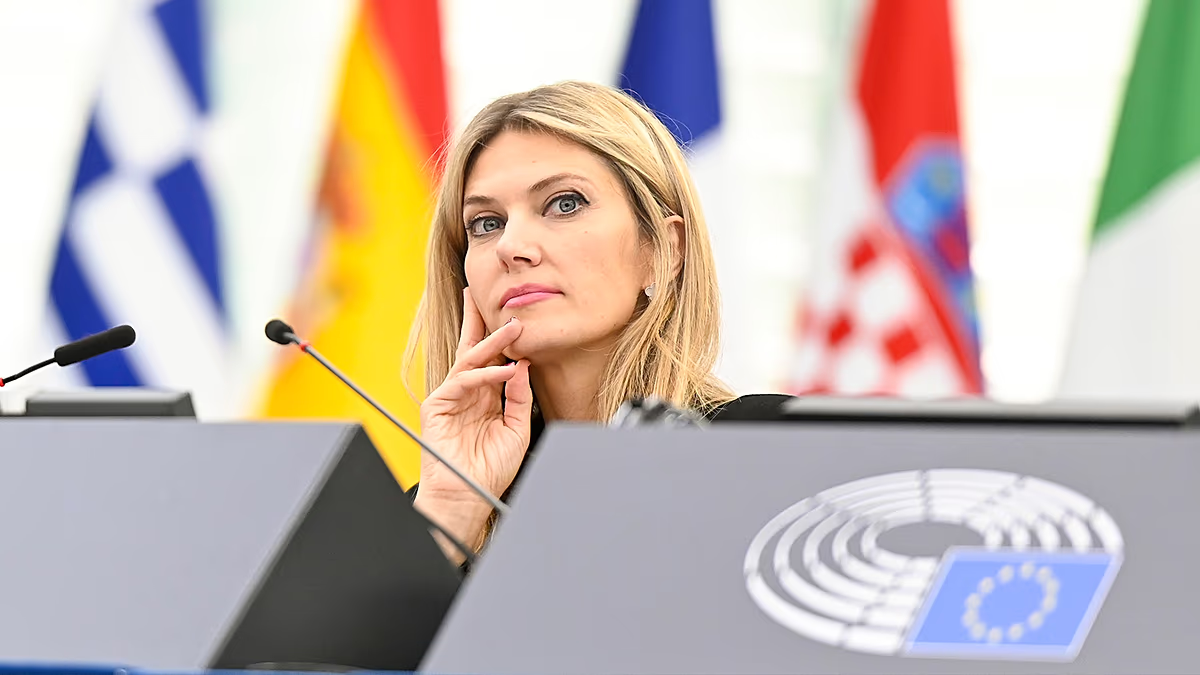
Kaili, who was also a vice president of the European Parliament at the time, became the public face of the scandal. She spent four months in pre-trial detention followed by house arrest with an electronic bracelet, all while maintaining her innocence. She is currently charged with participation in a criminal organization, corruption, and money laundering.
Her partner, Francesco Giorgi, a parliamentary assistant and former aide to Panzeri, admitted to accepting bribes but claimed Kaili was not directly involved in the alleged scheme. He is the father of Kaili’s daughter.
A Web of Allegations and Procedural Challenges
The core allegation is that the three countries sought to influence parliamentary resolutions, specifically aiming to quell criticism of Qatar’s human rights record and secure easier visa access for Qatari citizens. Both Qatar and Morocco have denied these accusations. The investigation has been plagued by procedural challenges and accusations of misconduct, contributing to the significant delays.
Panzeri agreed to cooperate with prosecutors in January 2023 in exchange for a reduced sentence, promising to reveal the identities of those he allegedly bribed. However, defense lawyers have repeatedly questioned his credibility and the validity of his confession.
A major setback occurred in June 2023 when investigating judge Michel Claise was forced to recuse himself after it was revealed his son had business ties to the son of Marie Arena, a Belgian MEP who was later charged in the scandal. Defense teams argued Claise should have disclosed this conflict earlier and that Arena was deliberately shielded from immediate indictment.
Arena was charged with participation in a criminal organization in January, but not with corruption or money laundering. Police reportedly found €280,000 in cash at her son’s home, according to Belgian media reports.
Intelligence Review and Legal Disputes
In September 2024, a Brussels judge ordered Committee R, the independent body overseeing Belgian intelligence, to review the legality of methods used by the Belgian security service, VSSE, during the investigation. This decision, described as “extraordinary” by Kaili’s lawyer Sven Mary, raised concerns about the scope and legality of intelligence gathering. Euronews provides further coverage of this development.
Defense lawyers also highlighted that Belgium’s penal code did not criminalize foreign interference until April 2024 – a year and a half after the initial raids. Prior to this amendment, only military espionage was prosecutable.
Kaili has also alleged mistreatment during her detention, claiming she was subjected to “medieval” conditions, including prolonged solitary confinement and inadequate provisions. These claims have been disputed by Belgian prosecutors.
Where Does the Investigation Stand?
The case remains in a complex legal limbo. The Brussels Chamber of Indictment recently began reviewing the legality of the investigation, with hearings involving over 20 parties. Prosecutors have requested the lifting of parliamentary immunity for additional MEPs, including Elisabetta Gualmini and Alessandra Moretti of Italy’s S&D group.
Currently, at least ten individuals face charges, including former MEPs Panzeri, Cozzolino, and Marc Tarabella, lobbyist Niccolò Figà-Talamanca, and Luca Visentini, the general secretary of the International Trade Union Confederation. Despite the numerous charges and extensive investigation, a trial is not expected to begin before late 2026.
Kaili, who did not seek re-election in 2024, now resides in Italy and Greece, where her assets were frozen following her arrest. The ongoing legal battles and the recent detention of Federica Mogherini underscore the far-reaching implications of this European Parliament corruption scandal and the challenges in holding those allegedly involved accountable. Follow developments in this case as it continues to unfold and potentially reshape the landscape of EU governance.