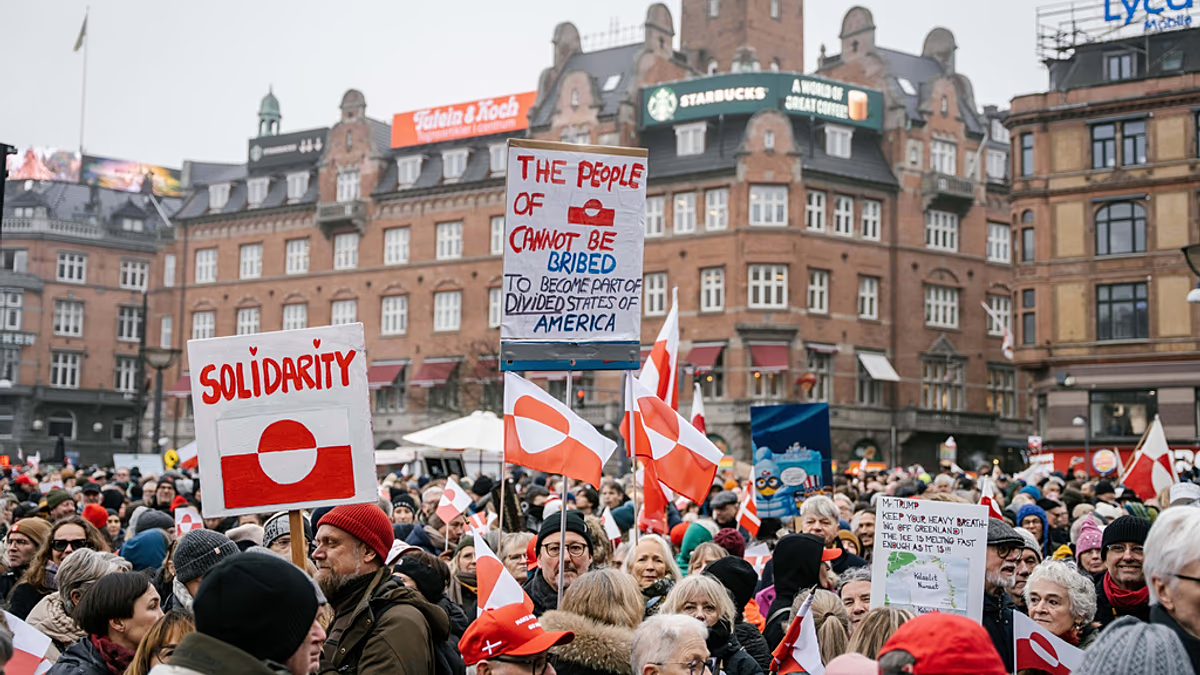

Thousands protested across Denmark and Greenland on Saturday against US President Donald Trump’s renewed interest in acquiring Greenland, an autonomous territory of Denmark. Demonstrations took place in Copenhagen, Nuuk, and several other Danish cities, fueled by concerns over sovereignty and self-determination. The protests followed Trump’s recent suggestion that he “may put a tariff” on countries opposing a potential US takeover of the mineral-rich island.
The demonstrations coincided with a visit from a bipartisan US Congressional delegation seeking to de-escalate tensions. While the Trump administration has framed the issue as one of security and economic opportunity, many Greenlanders and Danes view the prospect of acquisition as a violation of international law and a threat to their autonomy. The protests underscore growing international concern over the US president’s unconventional foreign policy approach.
Growing Opposition to a US Greenland Takeover
Protesters in Copenhagen, waving Danish and Greenlandic flags, gathered outside city hall and the US embassy, chanting “Kalaallit Nunaat!” – the Greenlandic name for the island. Similar rallies were held in Nuuk, the Greenlandic capital, and other cities throughout Denmark. Organizers, including the association Uagut, emphasized the importance of respecting Greenland’s democratic processes and fundamental rights.
According to Uagut chairwoman Julie Rademacher, the demonstrations aim to foster unity and address the anxieties caused by recent events. “When tensions rise and people go into a state of alarm, we risk creating more problems than solutions,” she stated. Demonstrators marched to the US consulate in Nuuk, carrying Greenlandic flags to symbolize their resolve.
Concerns Over Self-Determination and International Law
A recent poll conducted in January 2025 revealed that 85 percent of Greenlanders oppose joining the United States, with only six percent in favor. This strong opposition highlights the deep-seated desire for self-governance among the Greenlandic population. Organizers of the Nuuk protest stressed the importance of respecting Greenland’s right to self-determination and upholding international legal principles.
“We demand respect for our country’s right to self-determination and for us as a people,” added Avijaja Rosing-Olsen, another organizer. “This is not only our struggle, it is a struggle that concerns the entire world.” The issue has sparked debate about the limits of presidential power and the importance of respecting national sovereignty.
NATO Allies Respond to US Pressure
Meanwhile, US Senator Chris Coons, leading the Congressional delegation, asserted that there is no immediate security threat to Greenland justifying the Trump administration’s stance. He was responding to claims from Trump advisor Stephen Miller that Denmark was unable to adequately defend its Arctic territory. Coons emphasized the need for increased investment in Arctic security, but within the framework of existing alliances.
European NATO members are demonstrating their commitment to defending Greenland’s sovereignty through a military exercise. France’s armed forces minister, Alice Rufo, stated that the exercise is intended to signal to the United States and the world that NATO allies will defend their territories. Britain, Finland, Germany, the Netherlands, Norway, and Sweden are also participating, sending small numbers of military personnel. Denmark has extended an invitation to the United States to join the exercise.
The situation remains fluid, and further diplomatic efforts are expected to address the concerns raised by both Greenland and Denmark. The outcome of these discussions will likely shape the future of US-Danish relations and the geopolitical landscape of the Arctic region. Observers will be watching closely for any further statements from President Trump and the response from Greenlandic and Danish leaders as the debate over Greenland continues.