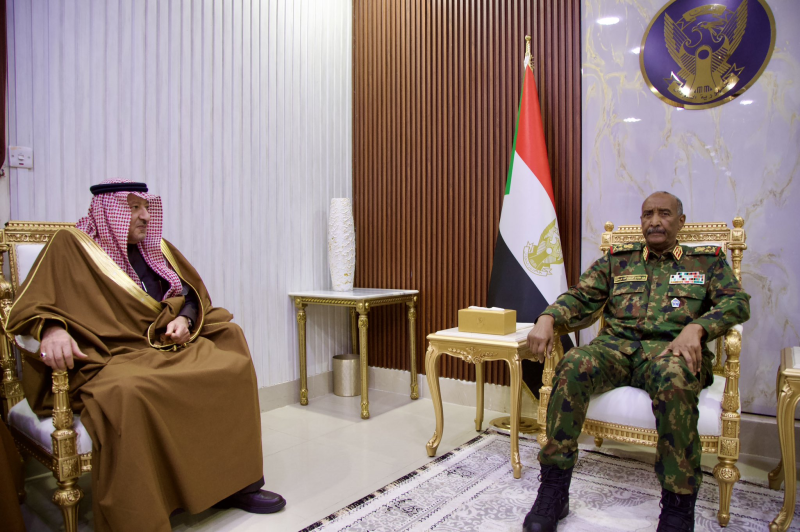

PORT SUDAN — Sudanese army chief Abdel Fattah Al-Burhan met with Saudi Deputy Minister of Foreign Affairs Waleed Al-Khuraiji on Wednesday in Port Sudan to discuss the ongoing conflict and potential paths toward peace. The meeting signaled continued Saudi Arabian efforts to mediate an end to the fighting that erupted in April, impacting regional stability and humanitarian conditions within Sudan. Discussions centered on halting hostilities and securing the nation’s future.
The talks took place amid escalating violence and a worsening humanitarian crisis across much of Sudan, particularly in the Darfur region. Both the Sudanese Sovereign Council and the Saudi Foreign Ministry released statements confirming the meeting and outlining the key topics addressed. The location of the meeting, Port Sudan, is significant as it remains under the control of the Sudanese Armed Forces (SAF) and is a key logistical hub.
Saudi Arabia’s Role in the Sudan Crisis
Saudi Arabia has been a prominent actor in attempting to resolve the conflict in Sudan since its outbreak. The kingdom, along with the Intergovernmental Authority on Development (IGAD) and the African Union, has been spearheading diplomatic initiatives to bring the warring parties – the Sudanese Armed Forces (SAF) led by Al-Burhan and the paramilitary Rapid Support Forces (RSF) led by Mohamed Hamdan Dagalo – to the negotiating table. According to the Saudi Ministry of Foreign Affairs, the discussions with Al-Burhan focused on achieving peace in a way that preserves Sudan’s unity and legitimate institutions.
The current conflict stems from a power struggle between Al-Burhan and Dagalo, who were previously allies in a 2021 coup that derailed Sudan’s transition to civilian rule. Disagreements over the integration of the RSF into the regular army and the timeframe for establishing a fully civilian government ultimately led to the outbreak of hostilities in Khartoum and quickly spread to other parts of the country. The fighting has resulted in thousands of deaths and millions of displaced people.
Humanitarian Impact and Regional Concerns
The United Nations reports a dire humanitarian situation throughout Sudan. Access to essential services like healthcare and clean water is severely limited, and food insecurity is increasing rapidly. The conflict has also triggered a massive influx of refugees into neighboring countries, including Chad, South Sudan, and Egypt, straining their resources and potentially destabilizing the region. The escalating number of internally displaced persons (IDPs) also poses a significant challenge.
The international community is increasingly concerned about the potential for the conflict to escalate into a protracted civil war. Several ceasefires brokered by international mediators have collapsed, and both sides have been accused of violating international humanitarian law. The situation in Darfur is particularly alarming, with reports of widespread ethnic violence and atrocities. The ongoing fighting makes delivering aid incredibly dangerous.
Meanwhile, the meeting also addressed preparations for the upcoming Saudi-Sudanese Strategic Coordination Council. Sudanese media outlets indicate this council aims to strengthen bilateral ties and coordinate efforts on issues of mutual concern. This suggests a long-term Saudi commitment to Sudan, extending beyond immediate conflict resolution.
In contrast to the diplomatic efforts, military operations continue in various parts of Sudan. The SAF has focused on defending key government installations and attempting to regain control of areas seized by the RSF, while the RSF has made gains in Darfur. Successfully establishing a durable ceasefire remains the primary obstacle to any meaningful progress toward a political solution.
Additionally, the role of external actors is complex. Various regional and international powers have interests in Sudan, and their involvement – or lack thereof – could significantly impact the trajectory of the conflict. The United States has imposed sanctions on companies linked to the RSF, and has advocated for a swift return to civilian rule.
The Sudanese people face immense challenges. Beyond the immediate threat of violence, they are grappling with economic collapse, a breakdown of essential services, and a loss of hope for a peaceful and democratic future. The outcome of the current crisis will have profound implications for the country’s stability and its role in the region. The need for a comprehensive political settlement that addresses the root causes of the conflict is widely acknowledged.
The Saudi Ministry of Foreign Affairs reaffirmed its commitment to seeing security and stability return to Sudan, and to upholding its territorial integrity, reflecting the desires of the Sudanese population. This commitment is seen as crucial by many observers, given Saudi Arabia’s influence in the region and its historical ties with Sudan.
Looking ahead, the next crucial step involves sustained and inclusive negotiations between the SAF and the RSF. The precise format and timeline for these talks remain uncertain. However, the convening of the Saudi-Sudanese Strategic Coordination Council could provide a platform for further dialogue and a more structured approach to resolving the conflict. Continued international pressure on both parties to abide by a ceasefire and protect civilians will also be essential. Observing the level of commitment from both Sudanese factions and external mediators will be key to determining whether a path towards lasting peace in Sudan can be forged.
The potential for further escalation, particularly in Darfur, and the ever-worsening humanitarian situation remain significant concerns regarding the future of Sudan.