
Get ready to look up! On January 10, 2026, the magnificent planet Jupiter will be at its closest and brightest for the year, a celestial event known as opposition. The Oman Astronomical Society has announced this spectacular display, offering a fantastic opportunity for stargazers across Oman and beyond to witness the gas giant in all its glory. This Jupiter opposition promises stunning views, even with the naked eye, and is a must-see for astronomy enthusiasts.
What is Jupiter Opposition?
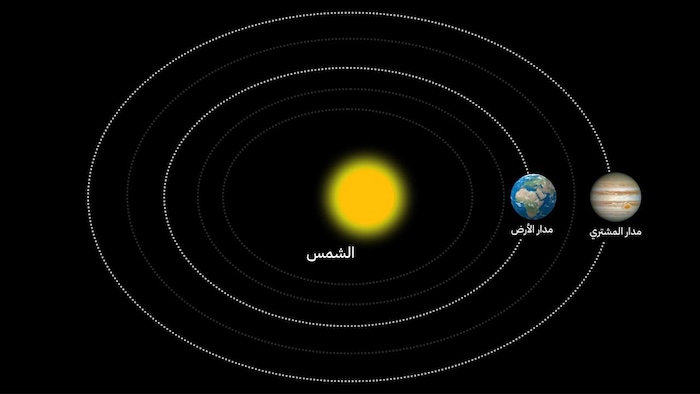
Opposition occurs when an outer planet, like Jupiter, appears directly opposite the Sun from Earth’s perspective. Mukhtar bin Saif Al-Saidi, Head of Astronomical Programs at the Oman Astronomical Society, explains that this alignment isn’t just a visual phenomenon; it’s when Jupiter reaches its closest approach to Earth for its entire orbit. This proximity, approximately 633 million kilometers, dramatically increases its brightness and apparent size in our night sky.
Understanding the Alignment
Imagine Earth and Jupiter racing around the Sun. Earth, being closer, completes its orbit much faster. When Earth “laps” Jupiter, and both planets are on the same side of the Sun but at different distances, we experience opposition. This alignment means the Sun, Earth, and Jupiter are essentially in a straight line, with Earth in the middle. This specific opposition will occur at exactly 12:34 PM local time on January 10, 2026.
Observing Jupiter in the Omani Sky
For observers in Muscat, Jupiter will be exceptionally well-placed for viewing. It will rise at 5:29 PM and set at 6:54 AM the following morning, reaching its highest point in the sky around midnight. With an apparent magnitude of –2.8, it will be one of the brightest objects visible, easily spotted without any equipment. However, even a small telescope or binoculars will reveal a wealth of detail.
What You Can See
Jupiter, the largest planet in our solar system, is a gas giant, meaning it doesn’t have a solid surface. Through a telescope, you’ll be able to observe its iconic cloud bands, swirling patterns of ammonia and water ice. Perhaps the most famous feature is the Great Red Spot, a massive storm that has been raging for centuries. Additionally, you can observe Jupiter’s four largest moons – Io, Europa, Ganymede, and Callisto – known as the Galilean moons, which appear as tiny points of light orbiting the planet. These moons are constantly changing positions, offering a dynamic view each night.
Jupiter’s Significance and Future Visibility
Beyond its visual appeal, Jupiter plays a crucial role in the stability of our solar system. Its immense gravity acts as a “shield,” deflecting or capturing comets and asteroids that might otherwise pose a threat to Earth. This protective function helps maintain the orbital stability of other planets as well. Al-Saidi aptly refers to it as “the solar system’s shield.”
Currently residing in the constellation Taurus, Jupiter will be visible in the eastern sky after sunset. It will gradually move westward throughout the night, remaining visible for several months. However, its brightness will slowly diminish as it approaches solar conjunction on July 29, 2026, when it passes behind the Sun from our perspective. This makes January 2026 the prime time for observation.
The Orbital Dance and Future Oppositions
It’s important to note that Jupiter oppositions aren’t random events. They occur roughly every 13 months due to the differing orbital periods of Earth and Jupiter. Earth completes one orbit around the Sun in approximately one year, while Jupiter takes around 12 years. This difference in orbital speeds leads to these periodic alignments. Understanding these planetary alignments helps astronomers predict and prepare for these spectacular celestial events.
The study of gas giants like Jupiter provides valuable insights into the formation and evolution of our solar system. Furthermore, observing Jupiter’s atmosphere and moons can help us understand the potential for life beyond Earth.
This upcoming opposition of Jupiter is a remarkable opportunity to connect with the cosmos and appreciate the wonders of our universe. Whether you’re an experienced astronomer or a curious beginner, be sure to look up on January 10, 2026, and witness this breathtaking spectacle. Consider joining a local astronomy club or attending a stargazing event to enhance your experience and learn more about the planets and stars above.