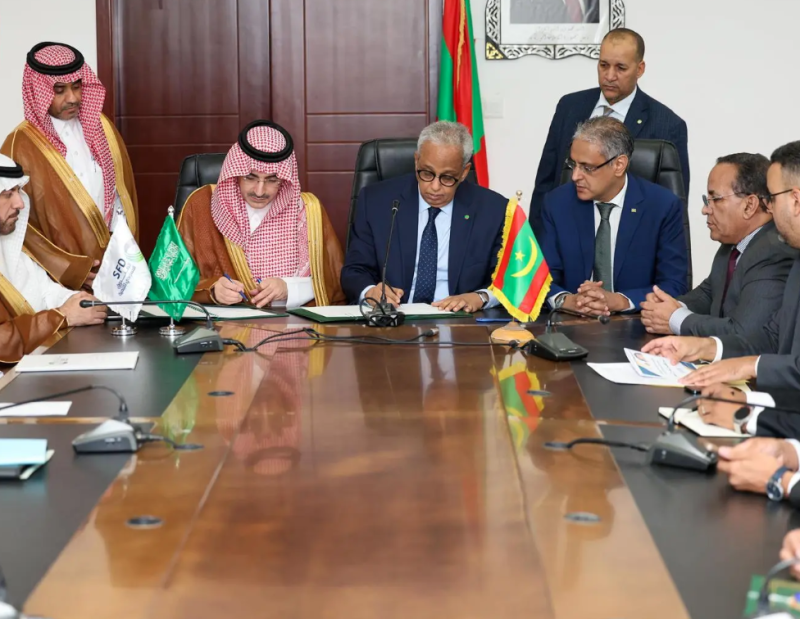

Nouakchott, Mauritania – Saudi Arabia is bolstering infrastructure development in Mauritania with over $160 million in concessional loans, focused on expanding access to clean water and reliable electricity. The funding, provided through the Saudi Fund for Development (SFD), was formalized during a visit by SFD CEO Sultan Al-Murshid to Mauritania this week, marking a continuation of decades-long development cooperation between the two nations. The projects aim to improve the quality of life for hundreds of thousands of Mauritanians.
The cornerstone for a significant drinking water supply project for the city of Kiffa was laid on Tuesday, sourced from the Senegal River. This initiative, financed by a $100 million loan, was inaugurated in the presence of Mauritanian President Mohamed Ould Cheikh El Ghazouani and Saudi Ambassador to Mauritania Dr. Abdulaziz Al-Raqabi. Simultaneously, a $60 million agreement was signed to support an electricity interconnection project with Mali and the development of solar power stations.
Expanding Water Access in Mauritania
The Kiffa water project is designed to address a critical need for potable water in the region. According to the SFD, the project will benefit over 500,000 people across 25 villages and residential communities. This will be achieved through the construction of over 250 kilometers of water pipelines, reducing reliance on potentially unsafe water sources and mitigating the risk of water-borne diseases.
Addressing Water Scarcity
Mauritania, like many countries in the Sahel region, faces significant challenges related to water scarcity. Climate change and population growth are exacerbating these issues, placing increased strain on existing resources. The Senegal River is a vital source of water for both Mauritania and Senegal, and sustainable management of this resource is crucial for regional stability. The new infrastructure aims to improve water security for a substantial portion of the population.
However, challenges remain in ensuring equitable access to water across the country. Geographical disparities and infrastructure limitations continue to hinder widespread availability. The Mauritanian government, with support from international partners like the SFD, is working to address these inequalities.
Strengthening Energy Infrastructure and Regional Connectivity
The $60 million loan for the Mauritania–Mali electricity interconnection project represents a significant investment in regional energy infrastructure. The project will expand transmission and distribution networks by 1,373 kilometers, originating in Nouakchott. This expansion will supply power to 150 villages and communities and include the construction of 11 substations with a total capacity of 600 megawatts.
The Ministry of Energy and Petroleum anticipates that over 480,000 people will benefit from improved access to electricity. This increased access is expected to stimulate economic activity, improve healthcare services, and enhance educational opportunities. Additionally, the development of associated solar power stations aligns with Mauritania’s commitment to diversifying its energy sources and reducing its carbon footprint.
A Long-Standing Partnership
The SFD’s involvement in Mauritania dates back to 1979, demonstrating a long-term commitment to the country’s development. To date, the Fund has provided nearly $1 billion in concessional loans and grants, supporting 31 projects and programs across various sectors, including education, healthcare, and agriculture. This sustained investment highlights the strong diplomatic and economic ties between Saudi Arabia and Mauritania.
Meanwhile, Mauritania is actively seeking to attract foreign investment in its energy sector, particularly in renewable energy sources. The country possesses significant solar and wind energy potential, which it aims to harness to meet its growing energy demands and promote sustainable development. The government has implemented policies to encourage private sector participation in the renewable energy market.
During his visit, Al-Murshid met with several Mauritanian ministers, including those responsible for economic affairs, equipment and transport, and energy and petroleum, to discuss further strengthening development cooperation. These discussions focused on identifying new areas for collaboration and streamlining project implementation processes. The meetings underscored the mutual commitment to achieving sustainable development goals.
The next phase of these projects will involve detailed engineering designs and procurement processes. Construction of the water pipelines and electricity infrastructure is expected to commence in the coming months, with completion timelines dependent on logistical factors and weather conditions. Monitoring the progress of these projects and assessing their impact on local communities will be crucial in evaluating their long-term success. Future collaboration will likely focus on capacity building and ensuring the sustainability of the newly established infrastructure.