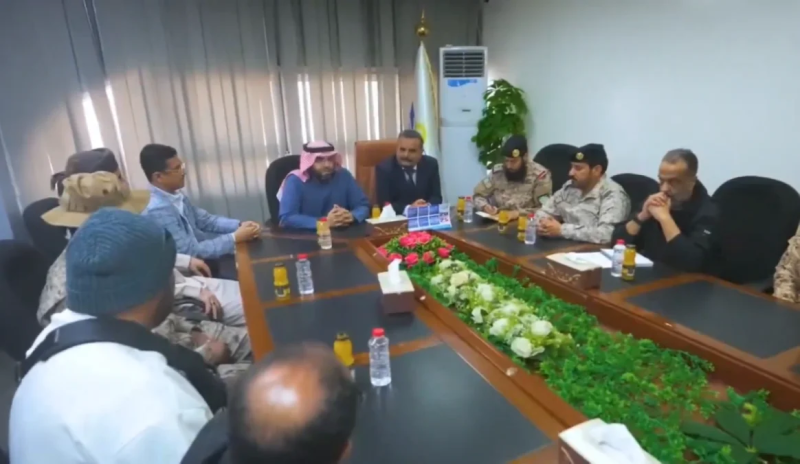

A Saudi security and military delegation, led by Falah Al-Shahrani, advisor to the commander of the Joint Forces of the Coalition to Support Legitimacy in Yemen, arrived in Aden on Monday, signaling continued support for the internationally recognized Yemeni government. This visit to Aden, the interim capital, is the first of its kind since the government regained control of the strategic port city last year. The delegation’s presence aims to bolster coordination and oversee organizational changes within Yemeni security forces.
The Homeland Shield Forces, affiliated with the Yemeni government, confirmed the visit via social media, stating it is part of ongoing arrangements coordinated by the Saudi-led Joint Forces. The arrival underscores Saudi Arabia’s commitment to stabilizing the region and assisting Yemen in establishing a unified military command. This development follows recent political shifts within southern Yemen, including the dissolution of a separatist council.
Saudi Delegation Visits Aden Amidst Security Restructuring
The Saudi delegation’s visit comes at a critical juncture as Yemen attempts to consolidate security forces under a unified command structure. Rashad Al-Alimi, head of the Yemeni Presidential Leadership Council, recently announced the formation of the Supreme Military Committee, operating under the authority of the Coalition to Support Legitimacy Forces. This committee is intended to oversee and integrate various military formations throughout the country.
Recent Political Developments
Prior to the delegation’s arrival, the Southern Transitional Council (STC) announced its dissolution on Friday. This decision followed unsuccessful attempts by the STC to assert control over the southern governorates of Hadramout and Al-Mahrah, areas with significant oil reserves. The STC had previously pursued a path towards greater autonomy, and even separation, for southern Yemen.
The dissolution of the STC is widely seen as a concession to the central government and Saudi Arabia’s efforts to maintain a unified Yemen. However, the underlying tensions and aspirations for self-governance within the south remain a complex issue. Analysts suggest that the STC’s members are likely to be integrated into the new Supreme Military Committee, potentially mitigating future challenges.
The situation in Yemen has been fraught with conflict since 2014, when Houthi rebels seized control of the capital, Sanaa, and ousted the internationally recognized government. This led to a Saudi-led military intervention in 2015, aiming to restore the government and counter Iranian influence in the country. The conflict has resulted in a severe humanitarian crisis, with millions of Yemenis facing food insecurity and displacement.
Focus on Organizational and Field Arrangements
The primary objective of the Saudi delegation is to oversee organizational and field arrangements within the Yemeni security apparatus. This includes assessing the capabilities of existing forces, identifying areas for improvement, and ensuring effective coordination between different units. The delegation will likely focus on streamlining command and control structures, enhancing training programs, and addressing logistical challenges.
According to reports, the visit will also address the integration of various armed groups into a unified national army. This is a crucial step towards establishing long-term stability and preventing the resurgence of conflict. The process of integration is expected to be complex and require careful negotiation and compromise.
The presence of the Saudi delegation in Aden is a tangible demonstration of the Coalition’s ongoing commitment to supporting the Yemeni government. Saudi Arabia has provided significant financial and military assistance to Yemen throughout the conflict, and this visit reinforces its role as a key player in the country’s future. The delegation’s oversight is intended to ensure that aid and resources are utilized effectively and contribute to lasting security.
The security situation in Aden itself has been precarious, with frequent attacks targeting government officials and infrastructure. The city serves as a vital hub for humanitarian aid and economic activity, making its stability paramount. The Saudi-led efforts to strengthen security forces are aimed at protecting the city and its residents from further violence. The broader goal is to create a secure environment conducive to political dialogue and economic recovery.
The formation of the Supreme Military Committee and the Saudi delegation’s visit represent a significant shift in the dynamics of the Yemeni conflict. The move towards a unified military command is intended to reduce fragmentation and enhance the government’s ability to defend its territory. However, the success of this initiative will depend on the willingness of all parties to cooperate and prioritize the national interest. The ongoing Yemen conflict has created a complex web of alliances and rivalries, making consensus-building a formidable challenge.
Looking ahead, the next crucial step will be the full operationalization of the Supreme Military Committee and the implementation of the agreed-upon security arrangements. The committee is expected to present a comprehensive plan for integrating the various military formations within the next few months. The effectiveness of this plan will be a key indicator of the progress towards a lasting resolution to the conflict. Continued monitoring of the situation in southern Yemen, particularly the response of former STC elements, will be essential.
The international community will also be closely watching the developments in Yemen, hoping that these steps will pave the way for a broader political settlement. The United Nations has been actively involved in mediation efforts, and a renewed push for negotiations is expected in the coming weeks. The ultimate goal remains to achieve a comprehensive ceasefire and address the underlying causes of the conflict, including political grievances and economic disparities.