

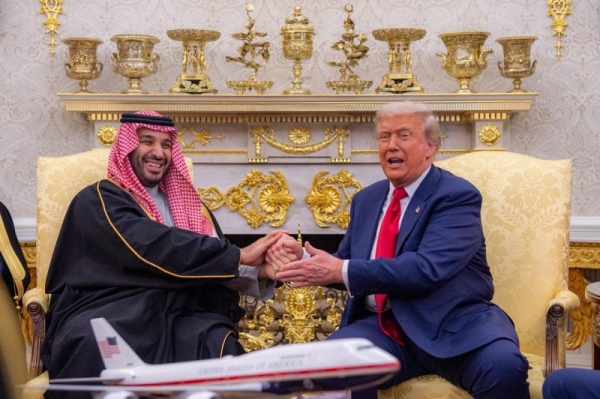

Saudi Crown Prince Mohammed bin Salman and U.S. President Donald Trump reaffirmed the strong alliance between their nations during a meeting at the White House on Tuesday, with a significant focus on bolstering economic ties and pursuing a path toward a two-state solution for the Israeli-Palestinian conflict. The visit underscored Saudi Arabia’s commitment to strengthening its relationship with the United States, despite recent attempts to create distance. A key outcome of the discussions was a pledge of nearly $1 trillion in Saudi investments within the U.S.
The meeting, held in Washington D.C., highlighted shared interests in regional stability and economic cooperation. Both leaders emphasized the importance of addressing the ongoing Palestinian issue and fostering peace throughout the Middle East. The announcement of increased Saudi investment signals a renewed confidence in the U.S. economy and a deepening strategic partnership.
Strengthening the U.S.-Saudi Relationship
The Crown Prince emphasized the enduring nature of the Saudi-U.S. partnership, stating it has spanned decades and represents a “historic day” for its future. He directly addressed concerns about potential strains in the relationship, asserting Saudi Arabia’s continued dedication to collaboration with Washington. This commitment was further demonstrated by the substantial investment pledge.
According to the Crown Prince, Saudi investments in the United States are projected to reach almost $1 trillion, representing the largest investment expansion in the history of the bilateral relationship. These investments are expected to support and empower key sectors within the U.S. economy, fostering growth and creating opportunities. The specific sectors targeted for investment were not immediately detailed, but are expected to span multiple areas of mutual interest.
Economic Cooperation and Defense
Beyond investment, the two countries discussed expanding economic cooperation in various fields. President Trump announced the U.S. would approve the sale of F-35 fighter jets to Saudi Arabia, characterizing the Kingdom as a “strong and important ally.” This decision reflects a continued commitment to Saudi Arabia’s security and regional defense capabilities.
Additionally, President Trump indicated potential for a civilian nuclear agreement with Saudi Arabia, signaling a willingness to explore further collaboration in advanced technologies. This development could have significant implications for the region’s energy landscape and geopolitical dynamics.
The Pursuit of a Two-State Solution
A central theme of the discussions was the need to advance a credible path toward a two-state solution to the Israeli-Palestinian conflict. Crown Prince Mohammed bin Salman reiterated the importance of establishing a clear plan to resolve the issue, emphasizing Saudi Arabia’s desire for peace for all parties involved. He noted ongoing efforts with the United States to facilitate progress.
While details of the proposed plan remain undisclosed, the Crown Prince’s statement underscores Saudi Arabia’s active role in seeking a resolution to the long-standing conflict. This aligns with broader regional efforts to de-escalate tensions and promote stability. The Israeli-Palestinian conflict remains a complex issue with numerous obstacles to overcome.
The Crown Prince also addressed regional issues, expressing a positive outlook on the possibility of reaching a peace agreement with Iran. This statement suggests a willingness to engage in dialogue and explore avenues for de-escalation in the region, potentially easing geopolitical tensions. Regional stability is a key priority for both Saudi Arabia and the United States.
President Trump echoed the sentiment of a strong alliance, describing the Crown Prince as a close friend and an “impressive man.” He praised King Salman and highlighted the positive trajectory of the relationship between the two countries. Trump also thanked Saudi Arabia for its existing investments in the U.S. and expressed optimism about reaching the $1 trillion target.
Looking ahead, the implementation of the investment pledges and the development of a concrete plan for a two-state solution will be key areas to watch. The specifics of the F-35 sale and potential civilian nuclear agreement will also be subject to further scrutiny and congressional review. The evolving dynamics in the Middle East and the ongoing negotiations between Saudi Arabia, the United States, and other regional actors will continue to shape the future of this critical partnership.