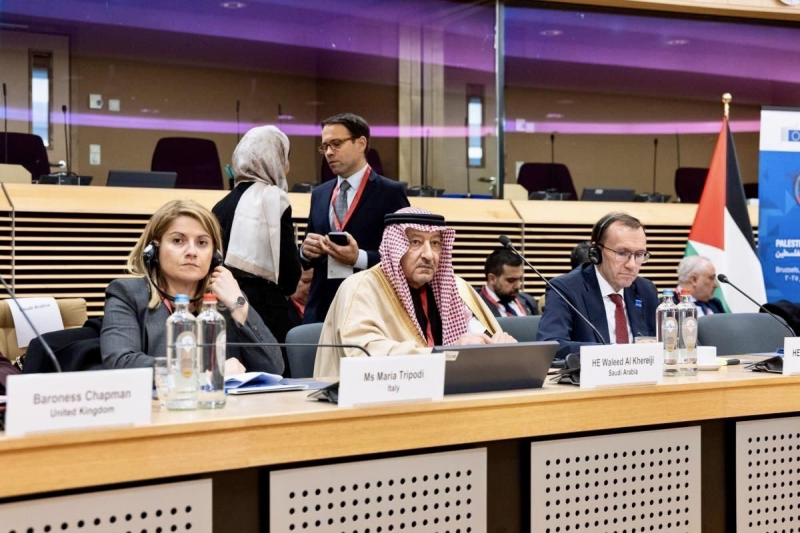

Saudi Arabia has urged the international community to prioritize the financial stability of the Palestinian Authority and to facilitate the immediate release of withheld Palestinian tax revenues. The call came during a meeting of the Ad Hoc Liaison Committee (AHLC) for donor countries in Brussels on Thursday, as global efforts refocus on post-ceasefire Gaza and renewed discussions for a two-state solution. Saudi officials emphasized the critical need for sustained support for the Palestinian people amidst ongoing political and economic challenges, including the Palestinian Authority’s fiscal crisis.
Deputy Foreign Minister Eng. Waleed Al-Khuraiji delivered the Kingdom’s message, advocating for an end to what he described as coercive measures imposed by Israel on the Palestinians. He linked the release of funds and cessation of restrictions to creating a more stable environment conducive to reconstruction and achieving a lasting peace. The meeting followed the recent UN Security Council resolution 2803, endorsing a comprehensive peace plan proposed by the United States, and a ceasefire in Gaza.
The Urgent Need to Stabilize the Palestinian Authority
The Palestinian Authority faces a severe financial shortfall, exacerbated by the withholding of clearance revenues – taxes collected on behalf of the Palestinians by Israel. These revenues represent a significant portion of the PA’s budget, vital for funding public services like healthcare and education. According to reports from the Palestinian Ministry of Finance, the ongoing delays in transferring these funds have crippled the PA’s ability to operate effectively.
Saudi Arabia has taken a leading role in addressing this crisis, initiating the Emergency Coalition to Support the Financial Stability of the Palestinian Authority. This coalition, partnering with Spain, Norway, France and others, aims to provide immediate financial assistance to the PA to cover essential expenditures. Al-Khuraiji stated the Kingdom views bolstering the PA as essential to preventing a further deterioration of the humanitarian situation.
Gaza Reconstruction and Coordination
While the cessation of hostilities in Gaza offers a window for recovery, substantial challenges lie ahead. Saudi Arabia expressed firm backing for Egypt’s comprehensive Gaza reconstruction plan, which is also endorsed by the Arab League, the Organization of Islamic Cooperation, and the European Union. The plan outlines a multi-phased approach to rebuilding infrastructure and restoring vital services.
However, Saudi officials stressed that reconstruction efforts are impossible without a durable security framework. They called for a complete withdrawal of Israeli forces from Gaza and the deployment of an international stabilization force to guarantee the safety of aid workers and the civilian population. Early recovery will also depend on unrestricted access for humanitarian organizations, a point frequently raised by the UN and other aid agencies.
Saudi Arabia Maintains Support for a Two-State Solution
The Kingdom reaffirmed its long-held position in favor of a two-state solution, with an independent Palestinian state based on the 1967 borders and with East Jerusalem as its capital. This stance aligns with international consensus and previous UN resolutions regarding the Israeli-Palestinian conflict. Al-Khuraiji reiterated the importance of unifying Palestinian institutions under the leadership of the PA to strengthen its governance and effectiveness.
Meanwhile, Saudi Arabia voiced concern over escalating violence in the West Bank, specifically condemning increasing attacks by settlers against Palestinians. The Kingdom warned that such actions undermine peace efforts and contribute to a climate of instability and resentment. These concerns are shared by numerous international bodies, including the United Nations Human Rights Office, which has documented a significant rise in settler violence in recent months.
The deputy foreign minister also underscored the need for continued support to strengthen Palestinian security capabilities. He praised the work of the European Union in training Palestinian police forces, as well as the significant contributions made by Egypt and Jordan in this area. A robust and effective Palestinian security force is seen as vital for maintaining order and preventing further escalation of violence. This is linked to broader regional security concerns and the stability of Jordan and Egypt, both key allies of Saudi Arabia.
Additionally, Al-Khuraiji cautioned against the creation of parallel tracks to the AHLC, emphasizing the committee’s central role in coordinating international aid and political efforts related to the Palestinian economy. He stressed the importance of a unified and cohesive approach to avoid fragmentation and ensure maximum impact. Divergent approaches could dilute resources and hinder progress towards a sustainable resolution.
Looking ahead, the success of the Emergency Coalition and the implementation of the Gaza reconstruction plan will be key indicators of international commitment to the Palestinian people. The next several weeks will likely focus on securing pledges from donor nations to fulfill the financial needs outlined in Egypt’s plan, which estimates rebuilding costs in the billions of dollars. Monitoring the situation in the West Bank and efforts to de-escalate violence will also be crucial, as will ongoing diplomatic efforts to secure a lasting ceasefire and resume meaningful negotiations towards a two-state solution. The timeline for these developments remains uncertain, and depends on the willingness of all parties to engage constructively and prioritize the needs of the affected populations.
The long-term viability of the Palestinian state also depends on addressing the underlying economic challenges. Sustainable development, job creation, and access to markets are essential for building a resilient and prosperous future for the Palestinian people. Saudi Arabia’s commitment to supporting the PA’s financial stability is a crucial step in that direction.