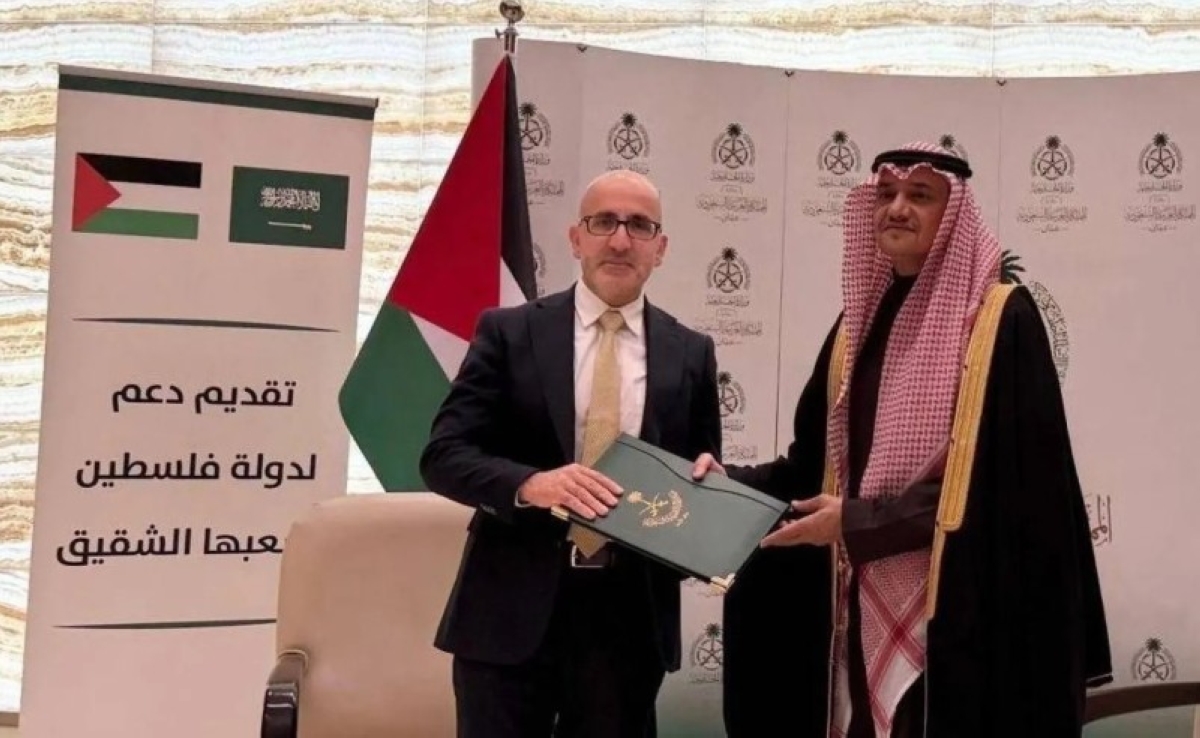

Saudi Arabia has pledged $90 million in financial assistance to the State of Palestine, a contribution presented to Palestinian officials in Amman, Jordan, on Monday. This support, part of the Kingdom’s ongoing commitment for 2025, aims to bolster the Palestinian government’s financial stability amidst persistent economic hardship. The aid is intended to address critical needs and reinforce the resilience of the Palestinian population.
The funds were formally presented by Saudi Ambassador to Jordan, Prince Mansour bin Khalid, to Palestinian Minister of Planning and International Cooperation, and Acting Minister of Finance, Estephan Salameh. The ceremony took place at the Saudi Embassy in Amman, signaling the Kingdom’s continued diplomatic engagement with the Palestinian Authority. This financial injection comes at a time of heightened tensions and economic strain in the region.
Saudi Arabia’s Support for Palestine: A Continuing Commitment
The $90 million in aid represents a significant contribution to the Palestinian budget, which has faced substantial deficits in recent years. According to the Palestinian Ministry of Finance, the shortfall is largely due to declining international aid and deductions made by Israel from tax revenues collected on behalf of the Palestinians. These deductions, often justified by Israel as security measures, have further exacerbated the financial crisis.
Prince Mansour emphasized that the Saudi leadership views this assistance as crucial for enabling the Palestinian government to meet its obligations to its citizens. He specifically highlighted the importance of supporting vital sectors like healthcare and education, areas consistently identified as priorities by the Palestinian Authority. This aligns with Saudi Arabia’s broader strategy of providing humanitarian relief and developmental assistance to Palestine.
Recent Diplomatic Efforts
This financial support is occurring alongside increased Saudi diplomatic activity focused on the Israeli-Palestinian conflict. Saudi Arabia recently co-chaired, with France, a high-level International Conference on the Peaceful Settlement of the Palestinian Question and the Implementation of the Two-State Solution. This conference resulted in wider international recognition of the State of Palestine and renewed support for a two-state framework.
The Kingdom has long been a vocal advocate for Palestinian statehood and the resolution of the conflict based on internationally recognized parameters. This position is rooted in its historical ties to the Palestinian cause and its role as a key player in the Arab world. The recent diplomatic push signals a renewed effort to translate this advocacy into concrete progress.
Minister Salameh expressed gratitude for the Kingdom’s consistent support, both financially and politically. He specifically noted the detrimental impact of recent Israeli policies on the Palestinian economy and how the Saudi contribution would help alleviate the resulting crisis. The Palestinian Authority has repeatedly called for international intervention to address what it describes as unfair economic practices.
Salameh also acknowledged the personal commitment of King Salman and Crown Prince Mohammed bin Salman to the well-being of the Palestinian people. He stated that the ongoing assistance is deeply appreciated and vital for maintaining basic services and economic stability. The Palestinian leadership views Saudi Arabia as a crucial ally in its pursuit of self-determination.
The provision of this aid is also significant in the context of broader regional developments. The normalization of relations between Israel and several Arab states has led to questions about the future of the Palestinian issue within the regional landscape. Saudi Arabia, while pursuing its own strategic interests, has maintained that any normalization with Israel must be contingent on progress towards a just and lasting resolution of the Palestinian question. This commitment to Palestine underscores that position.
Furthermore, the aid package is expected to contribute to ongoing humanitarian efforts in the West Bank and Gaza Strip. The United Nations Relief and Works Agency for Palestine Refugees in the Near East (UNRWA) has repeatedly warned of funding shortfalls that threaten its ability to provide essential services to Palestinian refugees. While this aid is directed to the Palestinian Authority, it is anticipated to indirectly benefit vulnerable populations served by organizations like UNRWA. The situation in Gaza remains particularly precarious, with limited access to resources and ongoing infrastructure challenges.
The long-term impact of this financial support will depend on a variety of factors, including the overall political and security situation, the continued flow of international aid, and the Palestinian Authority’s ability to effectively manage its resources. The effectiveness of the aid will also be influenced by Israel’s policies regarding revenue transfers and movement of goods and people. Monitoring these factors will be crucial in assessing the true benefit of this contribution.
Looking ahead, the Palestinian Authority will likely continue to seek financial assistance from Saudi Arabia and other international donors. The next major deadline for the Palestinian budget is the end of the year, and further support will be needed to address the ongoing deficit. The evolving political landscape and the potential for renewed negotiations between Israel and the Palestinians will also be key factors to watch in the coming months. The future of Saudi Arabia’s Palestine policy remains closely tied to these developments.