


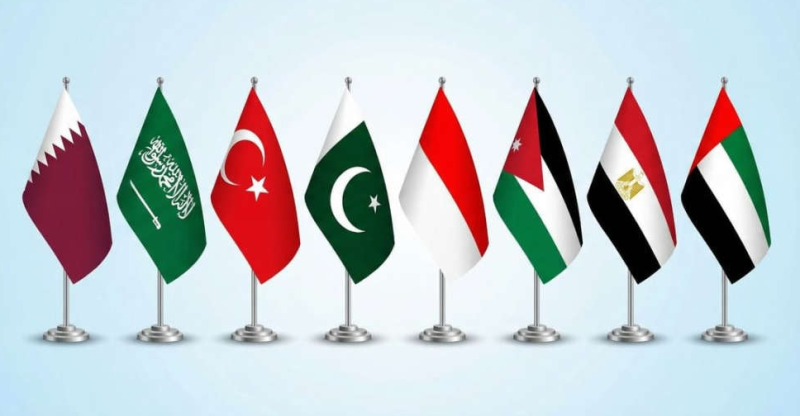

RIYADH — A coalition of eight nations – Saudi Arabia, Turkey, Egypt, Jordan, Indonesia, Pakistan, Qatar, and the United Arab Emirates – have announced their participation in the United States-led Board of Peace, an initiative focused on achieving a lasting resolution to the Gaza conflict. The move, revealed in a joint statement, signals a unified front from key regional and global players backing President Trump’s peace efforts. This development comes as international pressure mounts for a sustainable ceasefire and long-term stability in the region.
The foreign ministers of the participating countries formally accepted an invitation from President Trump to join the Board, with each nation now preparing to finalize the necessary legal procedures for full accession. Egypt, Pakistan, and the United Arab Emirates had previously indicated their intent to join. The Board’s mandate centers on implementing a “Comprehensive Plan to End the Gaza Conflict,” which has received endorsement through United Nations Security Council Resolution 2803.
Strengthening the Board of Peace: A Regional Commitment
The formation of the Board of Peace and the subsequent joining of these nations represents a significant attempt to move beyond traditional diplomatic approaches to the Israeli-Palestinian conflict. The initiative aims to address the immediate humanitarian crisis in Gaza while simultaneously laying the groundwork for a future Palestinian state. According to the joint statement, the participating countries reaffirmed their unwavering support for President Trump’s leadership in this endeavor.
The “Comprehensive Plan” focuses on three core objectives: establishing a durable cessation of hostilities, facilitating the extensive reconstruction of Gaza, and fostering a just and lasting peace predicated on the Palestinian people’s right to self-determination and statehood, all within the framework of international law. This plan seeks to create a secure and stable environment for all countries and populations in the Middle East.
Historical Context and Previous Peace Efforts
Past attempts at brokering peace in the region have faced numerous obstacles, including deep-seated mistrust, political divisions, and the complex security concerns of all parties involved. The Oslo Accords in the 1990s, for example, initially offered a promising path towards a two-state solution, but ultimately stalled due to ongoing violence and disagreements over key issues like borders and settlements. The Trump administration previously attempted to mediate a peace agreement, but those efforts also failed to gain traction.
This new initiative differs in its emphasis on a comprehensive approach that integrates security, humanitarian aid, and political negotiations. The involvement of countries like Indonesia and Pakistan, which have historically played a role in mediating regional disputes, adds a new dimension to the peace process. The inclusion of Qatar, a key mediator with Hamas, is also considered strategically important.
The Role of UN Security Council Resolution 2803
UN Security Council Resolution 2803, adopted in late 2023, provided a crucial framework for the Board of Peace’s mission. The resolution called for an immediate and sustained ceasefire in Gaza, as well as unimpeded humanitarian access for aid organizations. It also emphasized the importance of a two-state solution based on the 1967 borders, with Jerusalem as the capital of both Israel and Palestine.
However, the implementation of Resolution 2803 has been challenging, with continued clashes and restrictions on aid deliveries. The Board of Peace aims to overcome these obstacles by leveraging the collective influence and resources of its member states. The success of the Board will depend heavily on its ability to translate the principles of the resolution into concrete actions on the ground.
The decision by these nations to join the Board of Peace also reflects a growing consensus on the need for a regional solution to the Gaza conflict. Many believe that lasting peace cannot be achieved without the active participation and support of key Arab and Muslim countries. This collaborative approach is seen as a departure from previous, largely US-led, mediation efforts.
Analysts suggest that the involvement of Saudi Arabia and the UAE, both of which have recently normalized relations with Israel, could be particularly influential. These countries have the economic and political leverage to encourage both sides to make concessions and engage in meaningful negotiations. The normalization agreements, however, have also been met with criticism from some quarters, particularly among Palestinians who fear they will undermine the pursuit of a viable state.
The timing of this announcement is also noteworthy, occurring amidst ongoing diplomatic efforts to secure a prisoner exchange between Israel and Hamas. These negotiations, mediated by Qatar and Egypt, are seen as a potential stepping stone towards a broader ceasefire agreement. The Board of Peace could play a role in consolidating any gains made through these indirect talks.
The next step involves the formal signing of the accession documents by each participating country, a process expected to be completed within the coming weeks. The Board of Peace is then anticipated to convene its first official meeting to discuss a detailed implementation plan for the “Comprehensive Plan.” Key uncertainties remain regarding the willingness of all parties – including Israel and Palestinian factions – to fully engage with the Board and its proposed solutions. The evolving political landscape in both Israel and the Palestinian territories will also be a critical factor to watch.
The long-term impact of the Board of Peace on the Middle East remains to be seen. However, its formation represents a renewed commitment to finding a peaceful resolution to the Gaza conflict and a potentially significant shift in the dynamics of regional diplomacy. Further developments, including the Board’s composition, leadership, and specific initiatives, will be closely monitored by the international community.
The success of this initiative will also be measured by its ability to address the underlying causes of the conflict, including the ongoing occupation of Palestinian territories, the blockade of Gaza, and the lack of a credible path towards Palestinian statehood. The Board’s focus on regional stability will be crucial in navigating these complex challenges.