
RIYADH – The foreign ministers of Saudi Arabia, Egypt, Jordan, the United Arab Emirates, Indonesia, Pakistan, Türkiye, and Qatar have jointly issued a strong statement rejecting any forced displacement of Palestinians from the Gaza Strip. The diplomatic push comes amid heightened concerns regarding potential Israeli actions at the Rafah Border Crossing and the ongoing humanitarian crisis in Gaza. The ministers emphasized the need for a comprehensive solution to the conflict, rooted in international legitimacy and the two-state solution.
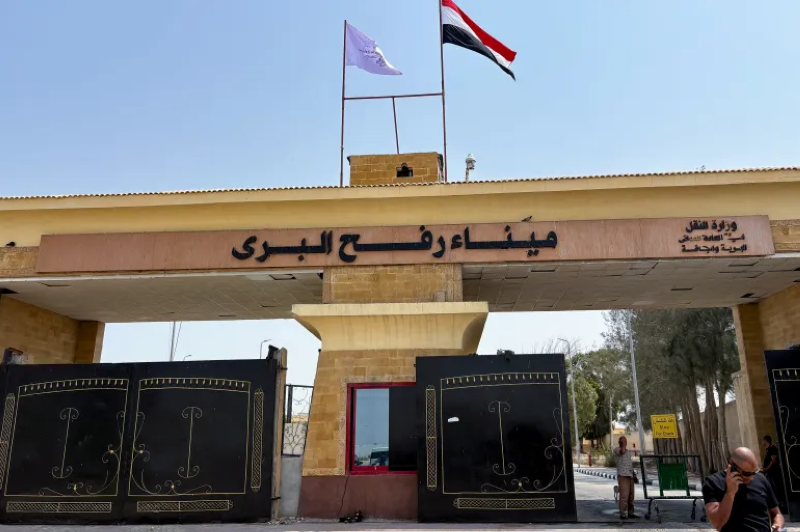
The joint statement, released today, directly addresses recent Israeli discussions about opening the Rafah crossing for one-way transit, effectively pushing Palestinian residents into Egypt. Officials fear this could lead to a mass exodus, exacerbating the already dire situation for civilians in Gaza. The coordinated response highlights a unified Arab and Muslim position on the issue.
International Concerns Over Potential Displacement in Gaza
The primary concern voiced by the ministers centers on the preservation of Palestinian self-determination and the rejection of demographic changes imposed by force. They assert that compelling Palestinians to leave their homes constitutes a violation of international law and undermines the prospects for a lasting peace. This stance aligns with widespread international opposition to forced displacement, often considered a grave breach of humanitarian principles.
The statement also referenced the “Gaza Plan” proposed by former U.S. President Donald Trump, though its interpretation differs markedly. While acknowledging Trump’s stated commitment to peace, the ministers stress the necessity of fully adhering to its provisions ensuring the Rafah crossing remains open for two-way passage, vital for humanitarian aid and the movement of people. However, the broader Trump Plan remains highly controversial.
The Rafah Crossing and Humanitarian Aid
Maintaining access through the Rafah crossing is crucial for delivering much-needed assistance to the 2.3 million residents of Gaza, where infrastructure has been heavily damaged and access to essential services is severely limited. The ministers called for the unrestricted entry of humanitarian aid, emphasizing the urgent need to alleviate civilian suffering. Restrictions on aid delivery have been a consistent point of contention between Israel and international organizations.
According to the UN, the humanitarian situation in Gaza continues to deteriorate, with widespread food insecurity and limited access to healthcare. The ministers’ call for early recovery and reconstruction efforts is seen as a necessary step towards stabilizing the region and providing a semblance of normalcy for the Palestinian population. This will require substantial international investment and a sustained ceasefire.
The statement pointed to United Nations Security Council Resolution (UNSCR) 2803, adopted in December 2023, as a key framework for addressing the crisis. UNSCR 2803 calls for the urgent and scaled-up provision of humanitarian assistance to Gaza, but its implementation has been challenging. The ministers reaffirmed their readiness to work with the United States and other stakeholders to ensure full adherence to the resolution.
The ministers also addressed the future governance of Gaza. They voiced support for the Palestinian Authority resuming its responsibilities in the Strip, a move intended to establish a more stable and secure environment. This requires a complex negotiation process and addressing underlying political divisions between Palestinian factions. The long-term viability of such a transition remains uncertain.
The coordinated statement from these influential Islamic nations places further pressure on Israel to avoid actions that could escalate the conflict or create a humanitarian catastrophe. It also underscores the commitment to a two-state solution, a framework that has been repeatedly endorsed by the international community but has faced significant obstacles to implementation. The current impasse focuses on questions of borders and security arrangements.
Meanwhile, diplomatic efforts are underway by other regional and international actors to secure a lasting ceasefire and negotiate a prisoner exchange. These discussions are complex and fraught with challenges, as both sides have expressed firm red lines. Despite these difficulties, the international community continues to advocate for a peaceful resolution to the conflict in Gaza.
The statement’s reference to the “lines of 4 June 1967” – effectively the pre-Six-Day War borders – reaffirms a long-held Arab position on the parameters of a future Palestinian state. Establishing such a state with East Jerusalem as its capital remains a core demand of the Palestinians and a key element of the internationally recognized two-state solution. Achieving this goal requires addressing the status of Israeli settlements in the West Bank.
The next step will likely involve further diplomatic outreach to Israel and continued coordination among the signatory nations. Whether this collective pressure will be sufficient to influence Israeli policy remains to be seen, and follow-up statements or meetings are anticipated in the coming weeks depending on the evolving situation in Gaza and surrounding areas. The success of these efforts is contingent on a willingness from all parties to engage in meaningful negotiations and prioritize the well-being of civilians.