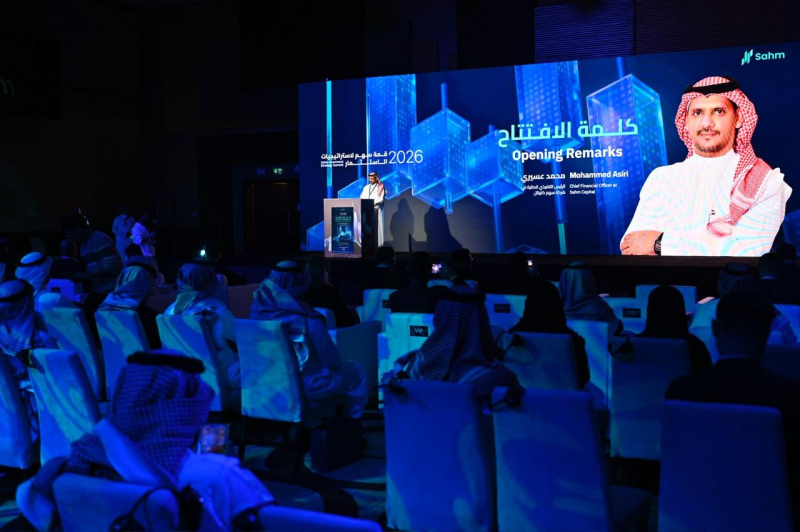

Riyadh recently hosted the inaugural Sahm Investment Strategy Summit, bringing together over 200 investors, policymakers, and financial industry representatives to discuss the future of capital markets in Saudi Arabia. The event, organized by fast-growing fintech firm Sahm Capital, focused on leveraging technology and regulatory developments to expand wealth creation opportunities within the Kingdom, aligning with the goals of Vision 2030. Discussions centered on navigating global economic shifts and capitalizing on Saudi Arabia’s accelerating growth.
Held under the theme “With Sahm, Own the Top,” the summit featured insights from leaders at the Capital Market Authority (CMA), Saudi Tadawul Group, and the Financial Academy, alongside international organizations like Nasdaq and the Arab Federation of Capital Markets. The gathering underscored the increasing prominence of fintech companies and retail investment in the region’s evolving financial landscape. Sahm Capital’s rapid expansion highlights the growing demand for accessible investment tools in Saudi Arabia.
The Future of Capital Markets in Saudi Arabia
Sahm Capital’s own growth is demonstrative of this trend. Chief Financial Officer Mohammed Asiri reported the company surpassed one million users within its first year and maintained approximately 70% year-over-year user growth in the second. This success, Asiri stated, is driven by continuous innovation in trading tools and the incorporation of social-trading features, which are reshaping retail investor engagement.
However, Saudi Arabia’s financial development isn’t occurring in isolation. Rami El Dokany, Secretary General of the Arab Federation of Capital Markets, provided a global macroeconomic outlook, anticipating a complex environment through 2026. He identified easing U.S. inflation, potential interest rate cuts, and rising geopolitical tensions as key factors influencing global investment strategies.
Navigating Global Economic Headwinds
El Dokany outlined strategic investment pillars for this environment. These included diversification into emerging markets, bolstering fixed-income allocations, increasing investment in gold as a safe haven asset, and proactively positioning for growth within sectors driven by Artificial Intelligence (AI). This advice anticipates a shift towards more resilient and forward-looking investment portfolios.
Meanwhile, a domestic perspective was offered by Dr. Adnan Abo Alhaija, Associate Professor of Finance at Alfaisal University. He emphasized the momentum of Saudi Arabia’s economic transformation under Vision 2030, noting the interconnected growth of key sectors like tourism, entertainment, technology, and renewable energy.
Vision 2030 and Economic Diversification
These sectors are attracting international expertise and fostering new revenue streams, strengthening the Kingdom’s role as a regional and global economic hub. This diversification is a central component of Vision 2030’s aim to reduce reliance on oil revenues and build a more sustainable, knowledge-based economy.
Digital transformation also took center stage during the summit. Discussions covered the disruptive potential of blockchain technology, tokenization, and AI within financial markets, alongside the increasing adoption of quantitative and data-driven investment approaches. This focus reflects global trends and Saudi Arabia’s commitment to embracing technological advancements in its financial sector.
Panel sessions involving industry and regulatory bodies explored modernization of market infrastructure, evolving regulatory frameworks, and the expanding influence of both institutional and individual investors. The need for continued collaboration between these stakeholders was a recurring theme, to ensure stable and inclusive growth of the investment landscape.
Participants widely agreed that Saudi Arabia’s robust economic fundamentals and ongoing reforms position its financial markets for significant expansion in 2026. Innovation and widening access for investors are expected to continue driving this evolution, creating new opportunities for both domestic and international participation in wealth management.
Looking ahead, the implementation of further regulatory refinements and the continued rollout of innovative fintech solutions will be crucial. The impact of global geopolitical events and the pace of AI adoption remain key uncertainties. Observers will be closely watching the Kingdom’s progress in attracting foreign investment and achieving the ambitious goals set forth in Vision 2030.