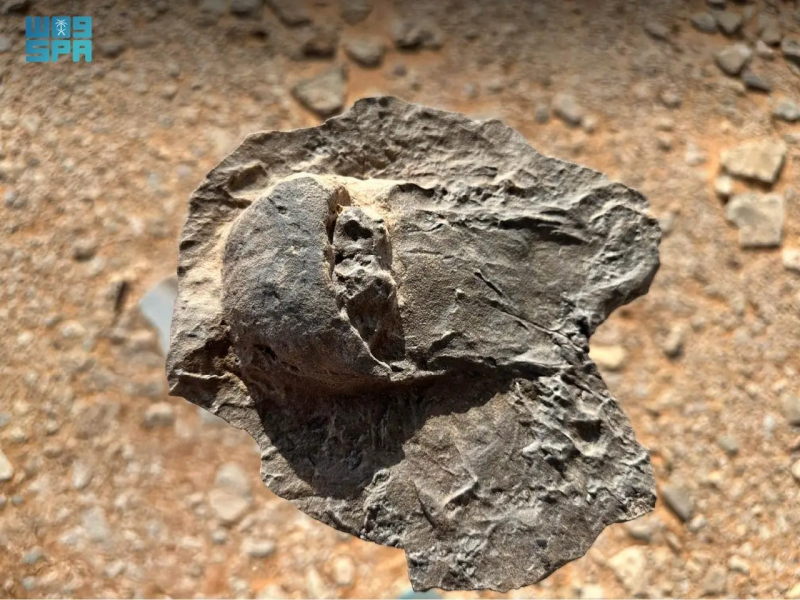

The Royal Commission for AlUla (RCU) has announced the documentation and upcoming international publication of a remarkable scientific discovery: exceptionally well-preserved horseshoe crab fossils dating back to the Middle Ordovician period, roughly 465 million years ago. Unearthed in the AlGharameel Nature Reserve in AlUla, Saudi Arabia, these fossils offer unprecedented insight into the early evolution and behavior of these ancient marine creatures. The research, published in the peer-reviewed journal Gondwana Research, reinforces AlUla’s growing reputation as a significant hub for paleontological and geological studies.
The discovery, made in collaboration with Flinders University, centers around fossils substantially larger than others found from the same timeframe. This find is particularly noteworthy due to the unusual way the crabs were preserved – consistently found upside down, with surrounding trace fossils suggesting attempts to right themselves. According to the RCU, this unique preservation offers a rare window into the behavioral patterns of organisms from this ancient era.
Unearthing AlUla’s Ancient Past: The Significance of Horseshoe Crab Fossils
Horseshoe crabs, often referred to as “living fossils,” have remained remarkably consistent in their morphology for hundreds of millions of years. Studying their fossil record is crucial for understanding the evolution of arthropods and the conditions of ancient marine environments. The AlUla fossils, predating many previously known specimens, contribute critical data to this field of research.
The research team linked the fossils’ preservation to intense seasonal storms that impacted shallow coastal areas during the Ordovician period. Geological analysis indicates these storms were frequent and powerful, likely creating conditions conducive to rapid burial and fossilization. This suggests these ancient horseshoe crabs congregated in these vulnerable coastal zones, potentially for breeding or feeding.
A New Species Emerges
The fossils represent a species previously unknown to science. Dr. Russell Bicknell, leading the research from Flinders University, and his team undertook two phases of investigation to analyze the specimens. The initial phase focused on documenting the discovery and preliminary analysis.
A second research phase, scheduled for completion in the first half of 2026, will involve the collection of additional samples and a more in-depth study of the morphological characteristics of the new species. This will pave the way for a formal scientific classification and a fuller understanding of its place in the evolutionary tree, offering new perspectives on paleontological discoveries in the region. The collected specimens are currently housed within the RCU’s museum collections.
Implications for Understanding Earth’s History
This find expands knowledge of the paleoenvironment of what is now Saudi Arabia. During the Ordovician period, the area was covered by a relatively shallow sea—a critical component of the ancient Gondwana supercontinent. The presence of these large marine fossils provides further evidence of the rich biodiversity that existed in these prehistoric waters.
The RCU highlights the importance of continued scientific exploration in AlUla. Previously, the region was not widely recognized for its fossil wealth, but a series of recent discoveries, including dinosaur footprints and other marine life remains, are changing that perception. The initiative is part of wider efforts to promote sustainable tourism and cultural heritage protection alongside scientific advancement.
The commitment to scientific research extends beyond simply uncovering fossils. The RCU is actively involved in building research infrastructure, fostering international collaborations, and developing educational programs centred around AlUla’s natural heritage. This integrated approach aims to position AlUla as a leading destination for geological research and scientific tourism. This work is attracting increased attention from the international scientific community.
Additionally, the accurate documentation and preservation of these fossils will contribute to a broader understanding of the Ordovician extinction event—one of the largest mass extinction events in Earth’s history. The environmental conditions leading up to and following this event are crucial for understanding the resilience and adaptability of life on Earth. The AlUla fossils could provide crucial clues.
Looking ahead, the RCU expects to finalize the scientific classification of the new horseshoe crab species by mid-2026. Further analysis of the sedimentary layers surrounding the fossils may reveal additional insights into the paleoenvironment and the events that led to their preservation. Future excavations in the AlGharameel Nature Reserve and other areas in AlUla are also planned, though the timing and scale of these ventures have not been publicly disclosed. Ongoing research will be central to assessing the full extent of AlUla’s paleontological potential.