
The Royal Commission for Riyadh City (RCRC) has approved a significant expansion of the Riyadh Metro, awarding a contract for the design, construction, and completion of an 8.4-kilometer extension to the Red Line. This project aims to improve public transport connectivity in Saudi Arabia’s capital, linking King Saud University to the developing Diriyah Gate area. The expansion will involve both underground and elevated sections and include five new stations.
The contract award, announced recently, signifies continued investment in Riyadh’s infrastructure as part of the Saudi Vision 2030 plan. Construction is expected to take approximately six years. The extension is designed to accommodate increasing ridership on the metro, which began operations in late 2023 after significant delays, and support the rapid growth and development occurring within the city.
Expanding the Riyadh Metro Network
The Red Line extension represents a key phase in completing Riyadh’s ambitious public transport project. According to the RCRC, the expansion will bolster the city’s urban transport ecosystem, connecting central hubs with residential areas and important facilities. This focus on integration aligns with broader goals to reduce reliance on private vehicles and encourage sustainable mobility options throughout the capital.
This project is part of a wider effort to modernize transportation within Riyadh, addressing growing concerns over traffic congestion and air quality. The initial phase of the Riyadh Public Transport Project, which includes the Bus Rapid Transit (BRT) system alongside the metro, received its official inauguration in November 2023 by King Salman. The metro was envisioned as the backbone of this larger network.
Details of the Red Line Extension
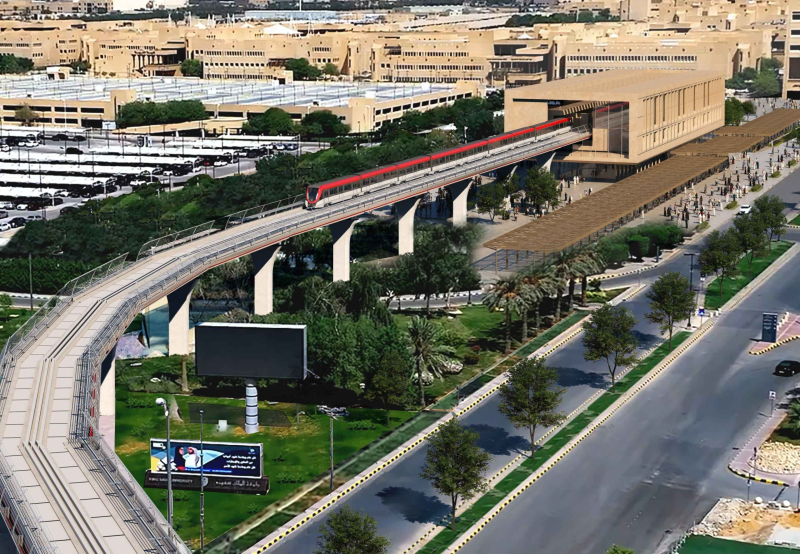
The 8.4-kilometer extension will be comprised of 7.1 kilometers of deep underground tunneling and 1.3 kilometers of elevated tracks. This approach balances minimizing disruption to existing infrastructure and optimizing cost-effectiveness. The varying track types also will allow efficient handling of terrain and passenger flow.
Five new stations are planned along the Red Line expansion. Two stations will serve the King Saud University campus — one dedicated to the medical city and health colleges and the other to the main university concourse. Three further stations will be located within the Diriyah area, a historic district undergoing substantial redevelopment. One of the Diriyah stations is specifically planned as a future interchange with Line 7 of the Riyadh Metro.
The Diriyah Gate Development, a major tourism and cultural project, is anticipated to draw significant numbers of visitors to the area. The extended Red Line will provide direct access to this destination, easing traffic and promoting accessibility for both tourists and residents. This aspect of the project highlights a strategic pairing of public transit and major development initiatives within Riyadh.
According to Eng. Ibrahim Al-Sultan, Minister of State and CEO of the RCRC, the Red Line extension responds directly to the demand for public transportation observed since the metro’s launch. The metro has already carried over 173 million passengers, demonstrating widespread public adoption and signalling the need for increased capacity.
The expenditure for the project has not been publicly disclosed yet. However, similar metro projects in the Gulf region have involved costs of several billion dollars per line, suggesting a substantial investment. The economic impact of the Red Line extension is expected to be significant, creating employment opportunities during construction and boosting economic activity in the surrounding areas.
The development also underscores Saudi Arabia’s broader diversification efforts, moving away from a sole reliance on oil revenues. Large-scale infrastructure projects like the Riyadh Metro contribute to a more resilient economy and strengthen the country’s position as a regional hub for trade, tourism, and investment. The expansion reinforces the commitment to creating a modern and sustainable city.
Transportation officials are also studying potential future phases of expansion for the Riyadh Metro, considering routes to other growing areas of the city and further integration with other modes of transport. The success of the initial lines and the current expansion will be critical in securing funding and support for these future initiatives.
While the metro is operational, full completion of all six lines remains a priority. Ongoing construction and integration of systems are essential to maximize the efficiency and impact of the entire network. The completion of the Red Line extension once again points to the ongoing transformation of Riyadh’s public transportation landscape.
Looking ahead, the focus will shift to the detailed design phase and subsequent construction activities. The expiration of the contract timeline in approximately six years will be a key milestone to monitor. Potential challenges related to supply chain logistics, labor availability, and geological conditions during tunneling will also need careful management. The RCRC has provided assurances on mitigating these risks though detailed oversight of project execution. Updates on the progress of the Riyadh Metro expansion will likely be provided regularly through official RCRC announcements and media reports.
The overall mobility enhancements anticipate supporting Riyadh’s growing population and establishing it as a world-class capital city.