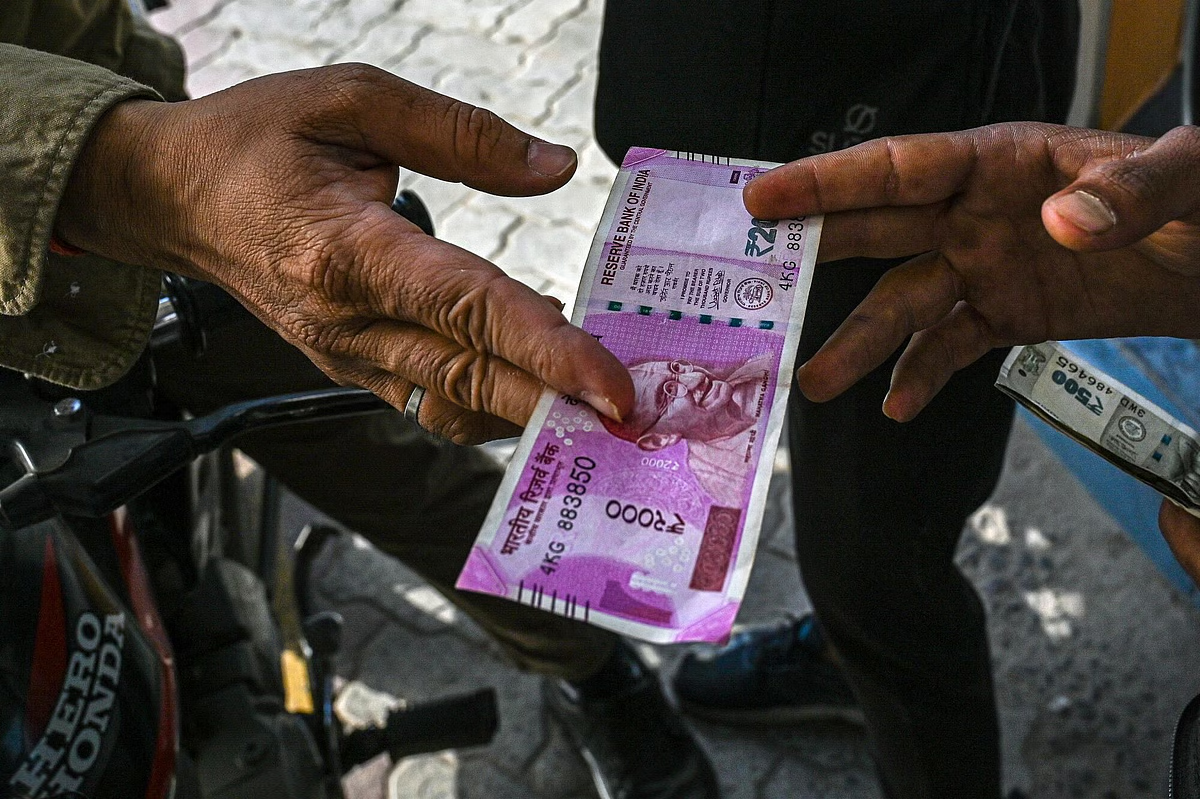

UAE expats are experiencing a significant boost in their remittance value as the rupee continues its downward trend against the dirham. The Indian rupee has weakened considerably in recent weeks, reaching new lows and offering a favorable exchange rate for the large Indian expatriate population in the UAE. This shift impacts crucial financial flows to India, particularly to states heavily reliant on remittances.
This immediate impact is being felt by those sending money home to cover essential expenses like education, healthcare, and housing. The weakening rupee translates to more Indian rupees for every dirham remitted, providing welcome relief amid rising costs of living. Early data suggests a surge in remittance activity as residents capitalize on the improved exchange rates.
Understanding the Rupee’s Decline
The sustained pressure on the rupee throughout 2024 stems from a complex combination of international and domestic economic factors. While the US dollar has seen some softening, the rupee has underperformed against major currencies, including the dollar, due to unique challenges faced by the Indian economy.
One major contributing factor has been the imposition of aggressive tariffs by the United States on several Indian exports. This has curtailed trade expectations and negatively affected India’s balance of trade. Additionally, foreign investors have withdrawn approximately $16.3 billion from Indian equities, citing concerns over trade disputes, high valuations, and slowing earnings growth.
The Reserve Bank of India (RBI) intervened intermittently by selling over $30 billion in foreign exchange reserves to stabilize the currency. However, the recent November drop signaled a change in policy, with the RBI seemingly opting for a less active approach to managing the rupee’s value.
RBI’s Shifting Policy
The RBI has consistently stated it intervenes primarily to manage volatility, not to defend a specific exchange rate. The appointment of a new governor in December 2024 appears to have ushered in a more hands-off monetary policy regarding exchange rates than previous administrations.
Adding clarity, the International Monetary Fund (IMF) recently classified India’s exchange-rate regime as a “crawl-like arrangement,” which indicates a controlled float allowing the currency to adjust gradually to inflation differentials. Despite this shift, the central bank has demonstrated a willingness to intervene when market movements threaten to become disruptive, as evidenced by its actions in mid-October.
Analysts caution that continued defense of specific levels could prove unsustainable if India’s trade deficit widens or if substantial portfolio outflows persist. Maintaining a stable exchange rate will depend on navigating these economic headwinds effectively.
Why the Rupee Stands Out Among Asian Currencies
The rupee’s decline is particularly notable when compared with other Asian economies. Unlike India, several countries in the region, including Thailand and Taiwan, have seen their currencies strengthen despite the dollar’s recent dip.
These economies benefit from fewer trade restrictions imposed by the United States and maintain current account surpluses. In contrast, India consistently runs a current account deficit and relies heavily on imports of essential goods like oil, fertilizers, and electronics, making it more vulnerable to currency fluctuations.
The RBI governor argued the depreciation is aligned with India’s inflation gap relative to advanced economies. However, traders suggest the rupees vulnerability will remain until trade issues are resolved and inflows improve.
Remittance Surge in the UAE
Exchange houses throughout the UAE have reported a noticeable increase in remittance volumes since mid-November. Salaried workers are sending a larger portion of their income, while families supporting relatives in India are accelerating their transfer schedules to maximize returns.
Some residents are proactively settling larger, pre-planned payments – such as school fees, home improvements, or loan repayments – anticipating that the current favorable exchange rate may not last. This reflects a shift towards securing value rather than attempting to time the market.
The increasing remittances are a significant piece of India’s economy, and provide crucial financial support for families and economic activity.
Implications of a Prolonged Weak Rupee
A weaker rupee provides immediate financial benefits to UAE-based remitters. Recipients in India experience increased purchasing power, and remitters gain a larger financial buffer for savings or investment goals. However, this benefit comes with trade-offs for the Indian economy.
Rising import costs, a direct consequence of a weak rupee, contribute to inflationary pressures within India, increasing the price of fuel, fertilizers, consumer goods, and industrial materials. The World Bank, noting India’s record $137 billion in remittances last year, suggests that while the currency weakness boosts short-term inflows, the long-term effects will depend on whether rising inflation offsets these gains.
Looking ahead, the currency exchange will remain sensitive in December. Market reactions will be closely tied to developments in US-India trade negotiations, the RBI’s reaction to further volatility, and global investor sentiment surrounding US interest rate expectations. For UAE expats, the question is whether the rupee has further room to fall, or if this represents a peak advantage. Currently, the rate offers a substantial benefit, but its longevity remains dependent on factors beyond the control of individuals in the Emirates.