

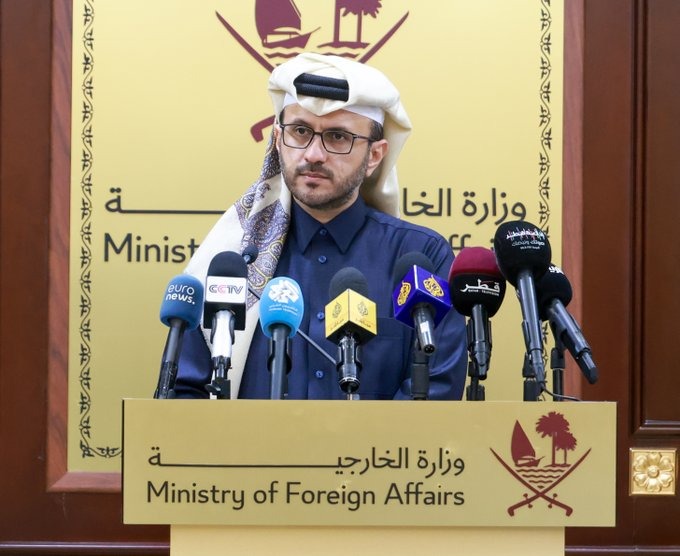

Doha, Qatar – Despite facing criticism from Israeli officials, Qatar reaffirmed its unwavering commitment to supporting the Palestinian people and its role in ongoing mediation efforts in the Gaza Strip. This pledge came during a press briefing held by the Ministry of Foreign Affairs on Tuesday, where officials emphasized that Qatar’s involvement in the region is not contingent on approval from any single party and will continue regardless of political rhetoric. The focus remains on delivering humanitarian aid and working towards a lasting ceasefire in Gaza.
Qatar’s Commitment to Gaza Remains Firm
Advisor to the Prime Minister and Official Spokesperson for the Ministry of Foreign Affairs, Dr. Majid bin Mohammed Al Ansari, stated that recent statements from Israeli parties would not deter Qatar from its support for Palestinians in Gaza. This support encompasses both humanitarian assistance and its established role as a key mediator in conflicts involving the region. According to the ministry, Qatar views its presence in Gaza as integral to the ongoing peace process, not a temporary measure.
Mediation Efforts and International Collaboration
Qatar is actively communicating with the United States to clarify its position and highlight the internationally recognized importance of its mediation role. The country is involved in all aspects of resolving the conflict, including facilitating the release of hostages and Palestinian prisoners, providing crucial humanitarian aid, and supporting the twenty-point plan developed with US involvement. The appointment of Ali Al Thawadi as Qatar’s representative in the Gaza Executive Council underscores this dedication, building on previous ceasefire efforts and the agreements reached in Sharm El Sheikh.
However, the implementation of the second phase of the agreement, which includes the formation of the Gaza Executive Council, the Peace Council, and a Technocrat Committee, is currently stalled. Qatar is urging the international community to pressure Israel to adhere to the previously agreed-upon terms. The refusal to allow the technocratic committee access to Gaza is a key point of contention, hindering progress towards a stable administrative structure.
The ministry clarified that the structure of these councils is not a unilateral Qatari initiative, but rather a framework agreed upon by numerous countries, led by the United States, to facilitate the ceasefire and implement the broader plan. Qatar emphasizes it is not acting independently, but as part of a collective international effort.
Regional Tensions and De-escalation
Beyond the situation in Gaza, Qatar addressed escalating tensions between the United States and Iran. Dr. Al Ansari stressed that any further escalation in the region would have severe consequences, recalling the instability experienced in the past year. Qatar strongly supports diplomatic solutions and is maintaining open communication channels with both Washington and Tehran to de-escalate the situation. Diplomacy is seen as the only viable path forward.
The recent avoidance of a potential US strike on Iran is viewed as a positive sign, demonstrating the importance of reason and dialogue. Qatar is continuing to engage with all relevant parties to ensure that further escalation is avoided, building on its past success in mediating between Iran and the US on several issues. The Prime Minister and Minister of Foreign Affairs, Sheikh Mohammed bin Abdulrahman bin Jassim Al-Thani, has been directly involved in these communications, speaking with both Iranian and American counterparts, as well as regional leaders.
Syria and Regional Stability
Qatar also welcomed the recent agreement regarding the integration of the Syrian Democratic Forces into the Syrian National Army. The ministry believes this represents a positive step towards stability in Syria, emphasizing the need for all components of the Syrian people to be included in the state and for weapons to be consolidated under state control. Qatar remains committed to supporting Syria both economically and politically. The broader goal is to foster regional stability.
Looking ahead, the successful implementation of the second phase of the Gaza agreement remains a critical focus. The international community’s continued pressure on all parties to adhere to the agreed-upon terms will be crucial. Qatar will continue to play its mediating role, working with the US and other partners to address obstacles and facilitate a lasting ceasefire and a sustainable future for the Palestinian people. The situation remains fluid, and further developments are expected in the coming weeks as negotiations continue.