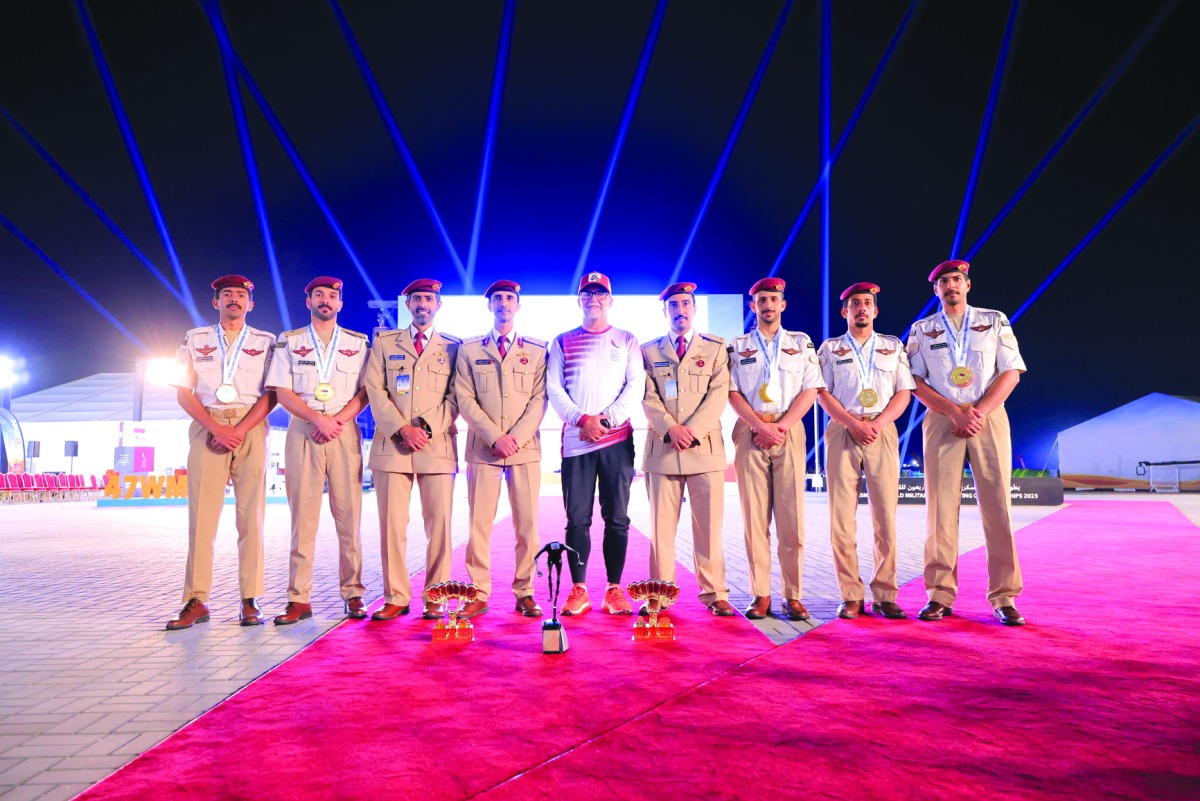

Qatar’s national team achieved significant success at the 47th CISM World Military Parachuting Championship 2025 in Doha, securing gold medals in both the team and individual target accuracy competitions. The event, which concluded recently at Umm Shakhout Airport, saw participation from 320 athletes representing 30 countries. This victory underscores Qatar’s growing prominence in international air sports and its commitment to fostering athletic excellence within its armed forces.
The championship, organized by the Qatar Air Sports Committee (QASC), was praised for its high standards and seamless execution. Qatar’s triumph comes as the nation continues to invest in sports infrastructure and training programs, aiming to become a leading hub for international sporting events. The success of the Qatari team is a testament to their dedication and the effectiveness of these initiatives.
Qatar Dominates Target Accuracy at CISM Championship
Khaled Shajaa clinched the individual gold medal in target accuracy with a remarkable performance, demonstrating precision and skill. Mohammed Saeed Al-Marri added to the Qatari haul by taking home the bronze in the same category. Their achievements highlight the individual talent nurtured within the Qatari military parachuting program.
The Qatari team, comprised of Shajaa, Abdulaziz Al-Hajjaji, Saleh Al-Obaidli, and Mohammed Al-Attas, further cemented their dominance by winning the team gold. According to reports, the team’s victory was built on flawless coordination and consistently accurate landings. This performance placed them ahead of strong teams from nations with long-standing parachuting traditions, like the Czech Republic, Switzerland, and Germany.
International Recognition of the Event
Col Nilton Gomes Filho, President of the International Military Sports Council (CISM), lauded Qatar for hosting a “model championship”. He emphasized the exceptional organization and hospitality extended to all participating athletes, noting it allowed for outstanding performances throughout the competition. This positive feedback reinforces Qatar’s reputation as a capable and welcoming host for large-scale international events.
The event also fostered cultural exchange and camaraderie among the participating nations, strengthening relationships through friendly competition. The combination of high-level sport and cultural understanding is a key objective of the CISM World Military Parachuting Championship.
Meanwhile, the women’s competitions saw China emerge as leaders. China’s team secured the top spot in the accuracy landing competition with 66 points, followed by France (84 points) and South Korea (112 points). China’s Yong Miao also claimed the individual gold in the women’s category, further showcasing Asian strength in the sport.
Delegations from various countries expressed their admiration for Qatar’s facilities and meticulous attention to detail. This includes the state-of-the-art infrastructure at Umm Shakhout Airport, and the comprehensive logistical support provided throughout the championship. Such positive feedback is likely to encourage future bids from Qatar to host similar international sporting events.
The closing ceremony featured a captivating display by the Qatari Armed Forces and aerobatic parachuting teams, adding a spectacular finale to the championship. A significant media presence, with numerous photographers and social media specialists, ensured global coverage of the event, according to Salem Al-Fahida, Head of Media Affairs at QASC. The Peninsula Qatar provided extensive coverage of the event.
Brigadier General Mohammed bin Zayed Al-Otaibi, Commander of the Joint Special Forces and Chairman of the QASC, dedicated the victories to the Amir H H Sheikh Tamim bin Hamad Al Thani and Deputy Prime Minister and Minister of State for Defense Affairs, H E Sheikh Saoud bin Abdulrahman bin Hassan Al-Thani. This gesture highlights the national importance placed on sporting achievements and the support provided by the country’s leadership.
Looking ahead, the Qatari Air Sports Committee will likely conduct a post-event analysis to identify areas for improvement and build on the success of the championship. The report will probably cover athlete performance evaluations and infrastructural assessments. Future events and further development of the national team’s parachuting skills will depend on the findings and subsequent investment decisions.