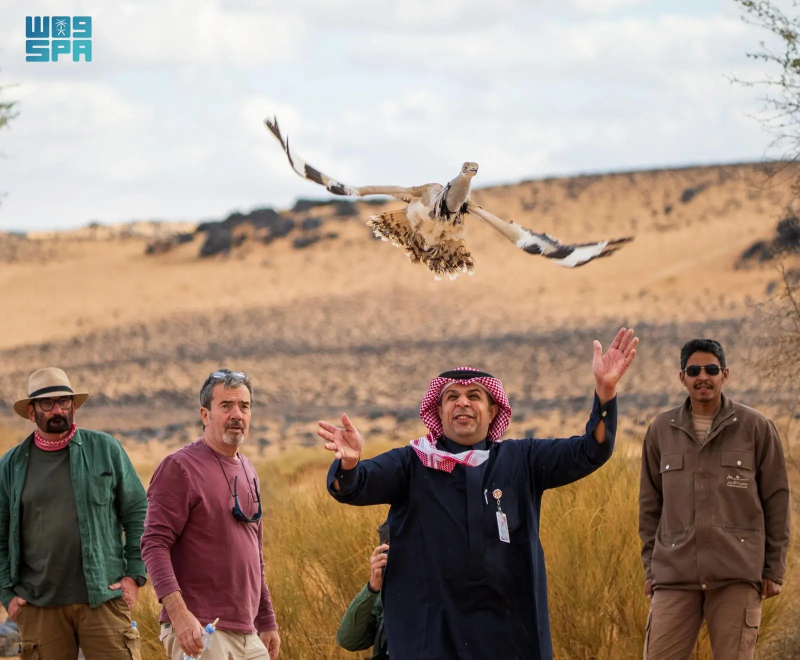

TABUK — After a 35-year absence, the Asian houbara bustard has been reintroduced to the Prince Mohammed bin Salman Royal Reserve in Saudi Arabia, marking a significant step in the Kingdom’s ambitious “ReWild Arabia” program. The reintroduction, a collaborative effort between the reserve, the National Center for Wildlife, and the Prince Mohammed bin Salman Houbara Conservation Foundation, aims to restore viable wild populations of this culturally significant bird.
Twenty Asian houbara were released within the reserve, with ten equipped with satellite tracking devices to monitor their survival, movement, and habitat use. This initiative underscores Saudi Arabia’s commitment to biodiversity conservation and the goals outlined in Vision 2030 and the Saudi Green Initiative.
The Return of the Asian Houbara: A Conservation Milestone
The Asian houbara (Chlamydotis macqueenii) once thrived across a vast range from Egypt to China, with substantial breeding populations in Saudi Arabia and widespread wintering grounds throughout the Arabian Peninsula. However, the species has faced a dramatic decline, now classified as Critically Endangered across the region by the IUCN. Factors contributing to this decline include habitat loss, unsustainable hunting practices, and poaching.
Historical Significance and Cultural Impact
The Asian houbara holds deep cultural importance in the Arabian Peninsula, particularly within the tradition of falconry. Recognized by UNESCO in 2021 as an Intangible Cultural Heritage of Humanity, falconry historically coexisted with the houbara, with nomadic communities practicing sustainable hunting methods. The decline of the houbara therefore represents a loss not only of biodiversity but also of a vital cultural practice.
According to Olivier Combreau, CEO of the Prince Mohammed bin Salman Houbara Conservation Foundation, the release is a crucial opportunity to test rewilding techniques and gather data for future conservation strategies. The satellite tracking data will be instrumental in understanding the challenges faced by reintroduced birds and refining release protocols.
Rewilding Efforts and Habitat Restoration
The Prince Mohammed bin Salman Royal Reserve’s comprehensive management framework focuses on large-scale habitat restoration across its 24,500 km². This includes an advanced ranger program and robust community engagement, creating an environment conducive to rewilding. The Asian houbara is the 13th species to be reintroduced as part of the reserve’s broader effort to return 23 native species to their historical range.
The reserve’s unique biodiversity is noteworthy; despite covering only 1% of the Kingdom’s land area and 1.8% of its marine area, it harbors over 50% of Saudi Arabia’s species. This makes it a critical protected area within the Middle East. The reserve connects key development projects like NEOM, Red Sea Global, and AlUla, integrating conservation efforts with economic growth.
Historically, captive breeding programs have produced large numbers of houbara, but establishing self-sustaining wild populations has proven difficult. Andrew Zaloumis, CEO of the Prince Mohammed bin Salman Royal Reserve, emphasized that the next frontier in houbara conservation is achieving the survival rates necessary for long-term population recovery. The reserve’s collaboration with the Houbara Conservation Foundation is central to this effort.
The reintroduction program builds upon decades of scientific research into houbara breeding, initiated by the late Prince Saud Al-Faisal with the establishment of a breeding and research center in Taif in 1985. Today, multiple breeding centers operate across the Gulf region, contributing to the ongoing conservation efforts. Houbara conservation remains a priority for the Kingdom.
The success of this reintroduction will depend on continued monitoring, adaptive management, and addressing ongoing threats to the houbara population. The reserve’s program is aligned with Saudi Arabia’s wider sustainability initiatives, including the Saudi Green and Middle East Green Initiatives, which aim to protect 30 percent of the Kingdom’s land and sea by 2030. Wildlife conservation in Saudi Arabia is undergoing a period of significant investment and innovation.
Looking ahead, the Royal Reserves Council, chaired by Crown Prince and Prime Minister Mohammed bin Salman, will continue to oversee the program. Future releases of Asian houbara are anticipated, contingent on the data collected from the currently tracked birds. The long-term viability of the reintroduced population remains uncertain, and ongoing monitoring will be crucial to assess the program’s effectiveness and adapt strategies as needed.