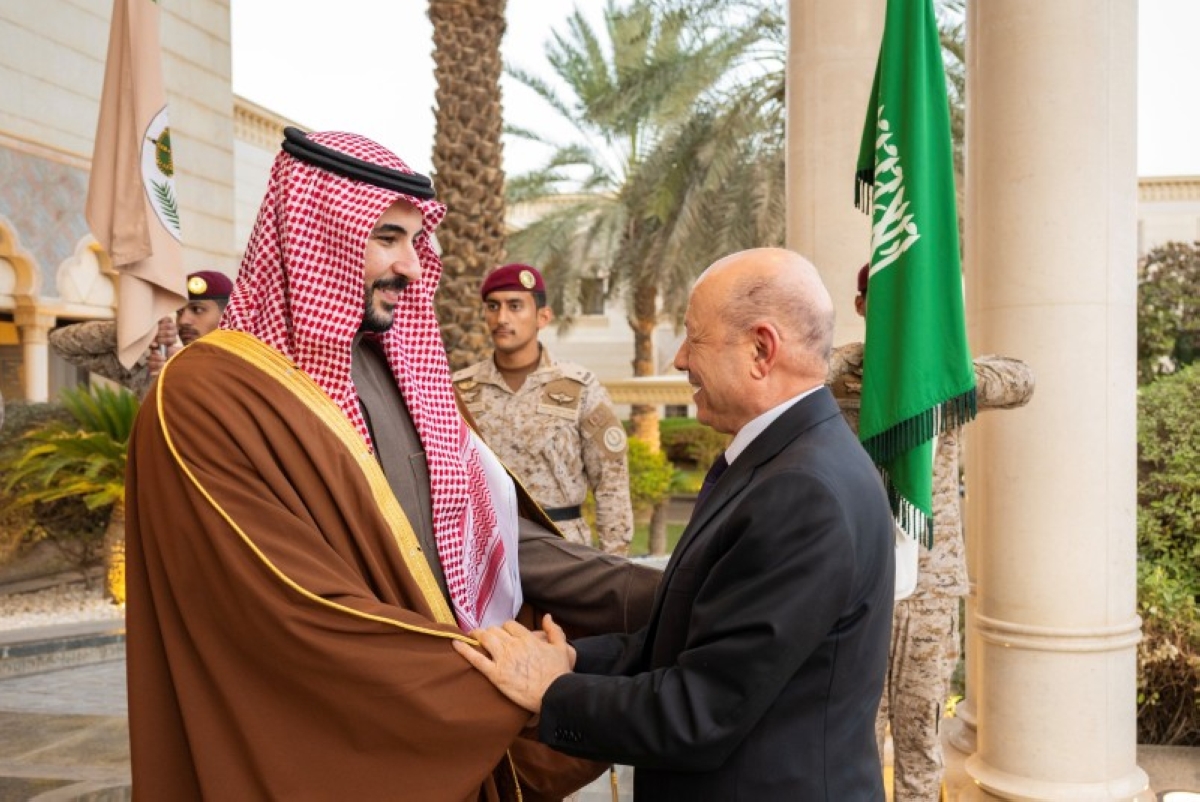

RIYADH — Saudi Arabia reaffirmed its commitment to supporting Yemen’s stability and economic recovery during a meeting between Defense Minister Prince Khalid bin Salman and the Yemeni Presidential Leadership Council (PLC), led by Dr. Rashad Al-Alimi. Discussions centered on the ongoing Yemen crisis and the pursuit of a comprehensive political resolution, with a particular focus on addressing the complex situation in southern Yemen. The meeting, held in Riyadh, signals continued Saudi engagement in efforts to end the protracted conflict.
Prime Minister of Yemen Salem bin Braik also attended the talks, which addressed both immediate humanitarian needs and long-term development plans for the war-torn nation. Prince Khalid bin Salman emphasized Saudi Arabia’s dedication to providing economic assistance and initiating development projects across Yemeni governorates, according to a statement released on his official X account. This support is intended to bolster security and contribute to a more prosperous future for Yemen.
The Path Forward for Yemen: Addressing the Southern Issue
A key component of the discussions involved the future of southern Yemen, with Prince Khalid bin Salman highlighting the importance of continuing deliberations through the Riyadh Conference. This conference, initiated earlier in 2024, aims to forge a comprehensive vision for just and lasting solutions to the grievances and political aspirations of the south. The southern question has been a significant factor complicating peace efforts in Yemen for years.
Historical Context of the Southern Yemen Conflict
Southern Yemen has a distinct history, having been a separate nation – the People’s Democratic Republic of Yemen – until unification with the north in 1990. Following unification, many southerners felt marginalized and discriminated against, leading to a secessionist movement. This movement gained momentum after the outbreak of the civil war in 2014, with the Southern Transitional Council (STC) emerging as a major player.
The Riyadh Conference represents an attempt to reconcile the various factions and interests within southern Yemen, including those of the STC, and integrate them into a broader national framework. Finding a resolution acceptable to all parties is crucial for achieving a sustainable peace in Yemen. The Saudi government has been actively mediating between the PLC and the STC to facilitate these discussions.
Beyond the southern issue, the meeting addressed the broader context of the Yemeni civil war, which began with the Houthi movement seizing control of Sanaa in 2014. This led to a Saudi-led coalition intervening in 2015 to restore the internationally recognized government. The conflict has resulted in a devastating humanitarian crisis, with millions of Yemenis facing food insecurity, displacement, and limited access to healthcare.
According to the United Nations, Yemen remains one of the world’s worst humanitarian crises. The ongoing conflict has severely damaged the country’s infrastructure and economy, hindering efforts to provide essential services to the population. Saudi Arabia has been a major provider of humanitarian aid to Yemen, but officials acknowledge that a political solution is the only way to address the root causes of the crisis.
The Saudi Defense Ministry stated that the Kingdom’s support for Yemen extends beyond economic assistance and includes efforts to strengthen the country’s security institutions. This support is intended to help Yemen combat terrorism and maintain stability in the region. However, the effectiveness of these efforts is contingent on the establishment of a unified and legitimate government.
The meeting also touched upon the importance of inclusive governance and power-sharing arrangements in Yemen. A key challenge facing the country is ensuring that all segments of society, including women and marginalized groups, have a voice in the political process. The Presidential Leadership Council is tasked with representing these diverse interests and working towards a consensus-based solution.
The international community has consistently called for a ceasefire and a resumption of peace talks between the warring parties in Yemen. The United Nations Special Envoy for Yemen, Tim Lenderking, has been actively engaged in mediation efforts, but progress has been slow. The involvement of regional powers, such as Saudi Arabia and Iran, is considered essential for achieving a lasting peace. Recent diplomatic efforts have focused on de-escalation and confidence-building measures between Saudi Arabia and Iran, which could potentially create a more favorable environment for peace talks in Yemen.
The situation remains fluid, and the success of the Riyadh Conference and broader peace initiatives is far from guaranteed. The Houthis have not yet been directly involved in the conference, and their participation is seen as crucial for any meaningful progress. Furthermore, the complex web of alliances and rivalries within Yemen presents a significant obstacle to reaching a comprehensive agreement. The ongoing political instability in the region also adds to the uncertainty.
Looking ahead, the next steps will likely involve continued negotiations within the Riyadh Conference, with a focus on reaching a consensus on the future of southern Yemen. The UN Special Envoy is expected to continue his efforts to engage the Houthis in peace talks. The international community will be closely monitoring the situation, hoping to see a de-escalation of violence and a renewed commitment to finding a peaceful resolution to the Yemen conflict. A deadline for significant progress in the Riyadh Conference has not been publicly announced, but observers anticipate a push for tangible outcomes in the coming months.
The long-term stability of Yemen will depend on addressing the underlying causes of the conflict, including economic grievances, political marginalization, and regional interference. Continued international support and a genuine commitment to inclusive governance will be essential for building a more peaceful and prosperous future for the country.