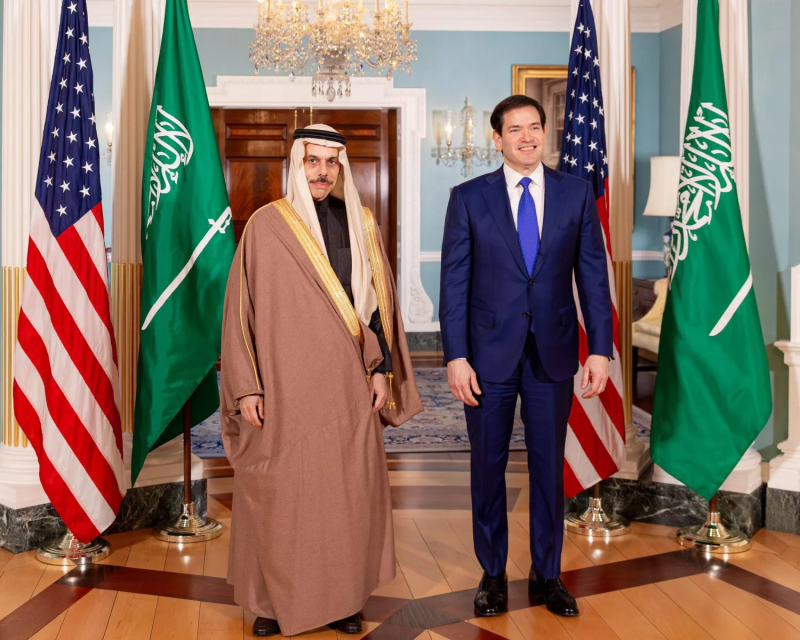

RIYADH — Saudi Arabian Foreign Minister Prince Faisal bin Farhan Al Saud held discussions with key U.S. lawmakers in Washington, D.C., this week concerning regional security, bilateral relations, and current events impacting the Middle East. The meetings, which occurred on Wednesday, focused on strengthening the strategic partnership between Saudi Arabia and the United States. Discussions included ongoing efforts to promote stability and address shared concerns regarding geopolitical challenges.
Prince Faisal met separately with U.S. Secretary of State Antony Blinken and Senator Marco Rubio, along with Chairman of the U.S. Senate Foreign Relations Committee Jim Risch. These high-level interactions underscore the importance both nations place on maintaining open communication and coordinated strategies regarding a complex and evolving international landscape, influenced by factors such as the war in Ukraine and tensions with Iran. Princess Reema bint Bandar, the Saudi Ambassador to the United States, and Advisor to the Minister of Foreign Affairs Mohammed Alyahya also attended the meetings.
Strengthening Saudi-U.S. Ties and Pursuing Regional Security
The visits come at a crucial time as the United States seeks to recalibrate its foreign policy priorities in the Middle East. The Biden administration has emphasized a focus on human rights and de-escalation of conflicts, sometimes leading to friction with Saudi Arabia, a long-standing strategic ally. However, the ongoing need for collaboration on energy security, counterterrorism, and containing Iranian influence necessitates continued dialogue.
According to statements released by both governments, a central theme of the discussions was the importance of deterring regional threats. This likely included conversations about Iran’s nuclear program and its support for proxy groups throughout the region, as well as the ongoing conflicts in Yemen and Syria. The principle of collective security was emphasized by both sides as crucial to maintaining peace and prosperity.
Yemen Peace Talks and Saudi Arabia’s Role
The situation in Yemen was reportedly a focal point during the meetings. Saudi Arabia has been actively involved in peace negotiations with the Houthi rebels, mediated by Oman, and has recently shown a willingness to compromise on certain conditions to secure a lasting ceasefire. The United States has consistently supported a diplomatic resolution to the conflict, and the discussions likely centered on how best to facilitate those efforts.
The Saudi government’s commitment to funding humanitarian aid in Yemen was also likely discussed. Reports indicate a significant increase in Saudi aid to the country in recent months, in an effort to alleviate the widespread suffering caused by the conflict. This aligns with the Biden administration’s emphasis on addressing humanitarian crises.
Expanding Economic Cooperation
Beyond security concerns, the meetings also addressed opportunities for expanding economic cooperation between the two countries. Saudi Arabia is undertaking a massive economic diversification plan under its Vision 2030 initiative, seeking to reduce its reliance on oil revenues. This plan aims to attract foreign investment and develop new industries, including tourism, technology, and renewable energy.
The United States has expressed interest in being a key partner in Vision 2030, with American companies potentially playing a significant role in infrastructure projects and technology transfers. Discussions likely involved ways to streamline investment procedures and overcome potential obstacles to increased trade and economic partnerships, particularly in areas related to defense cooperation.
Furthermore, the meetings likely touched upon energy market stability. Saudi Arabia, as a leading oil producer, maintains a significant influence on global energy prices. The United States has repeatedly urged Saudi Arabia to increase oil production to help offset the economic impact of the war in Ukraine and to moderate rising inflation. The extent to which these concerns were addressed remains unclear.
This trip by Prince Faisal follows recent diplomatic efforts focused on de-escalating tensions throughout the Middle East. The establishment of diplomatic relations between Saudi Arabia and Iran, brokered by China in March, has been cautiously welcomed by the United States as a potential positive development. U.S. officials, believe focusing on diplomatic solutions can create a more secure atmosphere for all parties involved.
Meanwhile, the U.S. continues to monitor the ongoing negotiations surrounding the Iran nuclear deal. While the deal itself remains stalled, the possibility of a revived agreement could significantly impact the regional security landscape and alter the dynamics of Saudi-U.S. relations. The Saudi government has consistently maintained that any agreement with Iran must address its destabilizing activities and include robust verification mechanisms.
In contrast to previous administrations which often prioritized defense sales, the current U.S. approach appears to be placing greater emphasis on broader strategic alignment including economic diversification and human rights. This shift has prompted some reassessment within Saudi Arabia, and Prince Faisal’s visit can be viewed as an attempt to bridge the perceived gap in priorities.
Looking ahead, observers anticipate continued high-level engagement between Saudi Arabia and the United States. Further discussions are expected to focus on implementing concrete measures to enhance regional security, fostering closer economic ties, and managing disagreements over issues such as human rights and the Iran nuclear deal. The success of these efforts will be crucial in shaping the future of the strategic partnership and the overall stability of the Middle East.