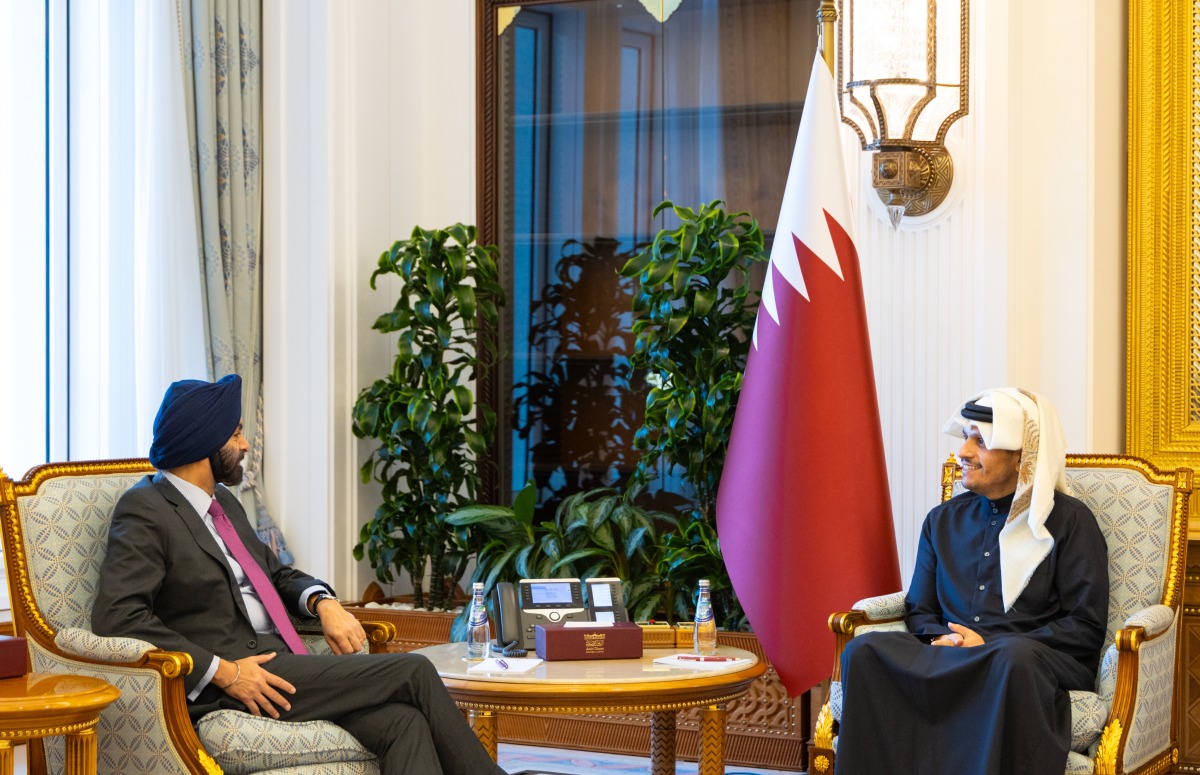

Doha, Qatar – Prime Minister and Minister of Foreign Affairs of Qatar, Sheikh Mohammed bin Abdulrahman bin Jassim Al-Thani, met with World Bank Group President Ajay Banga in Doha on Sunday to discuss strengthening Qatar-World Bank relations and explore avenues for increased collaboration. The meeting focused on current projects and potential future partnerships between the nation and the global financial institution. Discussions also encompassed broader economic issues of mutual concern, according to a statement released by the Qatari Ministry of Foreign Affairs.
The talks took place at the Prime Minister’s office and represent a continuation of ongoing dialogue between Qatar and the World Bank. While specific details of the discussions were not immediately disclosed, the meeting underscores Qatar’s commitment to international financial cooperation and its role in global economic development. The World Bank’s presence in Qatar primarily centers around technical assistance and knowledge sharing, rather than large-scale lending.
Strengthening Qatar-World Bank Relations
Qatar has been a member of the World Bank since 1972 and benefits from the organization’s expertise in areas such as economic diversification, private sector development, and sustainable finance. The country’s “National Vision 2030” aims to transform Qatar into a knowledge-based economy, and the World Bank provides support in achieving these long-term goals. This latest meeting signals a renewed focus on aligning these visions and identifying new opportunities for partnership.
Focus Areas for Collaboration
Analysts suggest several key areas likely featured in the discussions. These include Qatar’s preparations to host future international events, such as the Asian Games, and the associated infrastructure development. Additionally, the country’s investments in renewable energy and climate resilience are expected to be areas of mutual interest with the World Bank’s sustainability agenda.
Qatar’s sovereign wealth fund, the Qatar Investment Authority (QIA), is a significant global investor. The discussions may have touched upon how the QIA’s investment strategies can contribute to development goals in other countries, potentially leveraging World Bank expertise to maximize impact. The World Bank also offers advisory services on public-private partnerships, a model Qatar is increasingly exploring for infrastructure projects.
However, Qatar’s economic strength and relatively high income level mean it doesn’t typically rely on traditional World Bank loans. Instead, the relationship is characterized by knowledge exchange, technical assistance, and collaborative research. This differs significantly from the World Bank’s engagement with lower-income countries, where lending plays a more central role.
Meanwhile, the global economic landscape is facing increased uncertainty due to geopolitical tensions and rising interest rates. These factors likely formed part of the broader context for the discussions between Sheikh Mohammed and Banga. Qatar, as a major energy producer, plays a crucial role in global energy markets, and its economic stability is of interest to international institutions like the World Bank.
The World Bank has been increasing its focus on supporting countries in the Middle East and North Africa (MENA) region, particularly in addressing challenges related to climate change, digital transformation, and private sector growth. Qatar’s experience and resources in these areas could be valuable to the World Bank’s broader regional strategy. The country has also been a key mediator in regional conflicts, a role that may have been acknowledged during the talks.
In contrast to some nations, Qatar has maintained strong economic growth despite recent global headwinds. This resilience is partly attributed to its diversification efforts and prudent fiscal management. The World Bank’s assessment of Qatar’s economic policies and its recommendations for further improvements are likely to be highly valued by the Qatari government.
Looking ahead, the outcome of these discussions will likely be reflected in the World Bank’s Country Partnership Framework for Qatar, which is periodically reviewed and updated. It remains to be seen whether any specific new projects or initiatives will be announced in the coming months. Further details regarding the Qatar-World Bank collaboration are expected to emerge as the two parties finalize their plans and priorities. Monitoring the World Bank’s official publications and Qatari government statements will be key to understanding the evolving nature of this international partnership and its impact on Qatar’s economic development and sustainable development goals.
The next step will likely involve follow-up meetings between technical teams from both sides to explore specific areas of cooperation in greater detail. The timing of any concrete announcements will depend on the progress of these discussions and internal approval processes within both organizations. The ongoing global economic situation and regional developments will also influence the shape of future economic cooperation between Qatar and the World Bank.