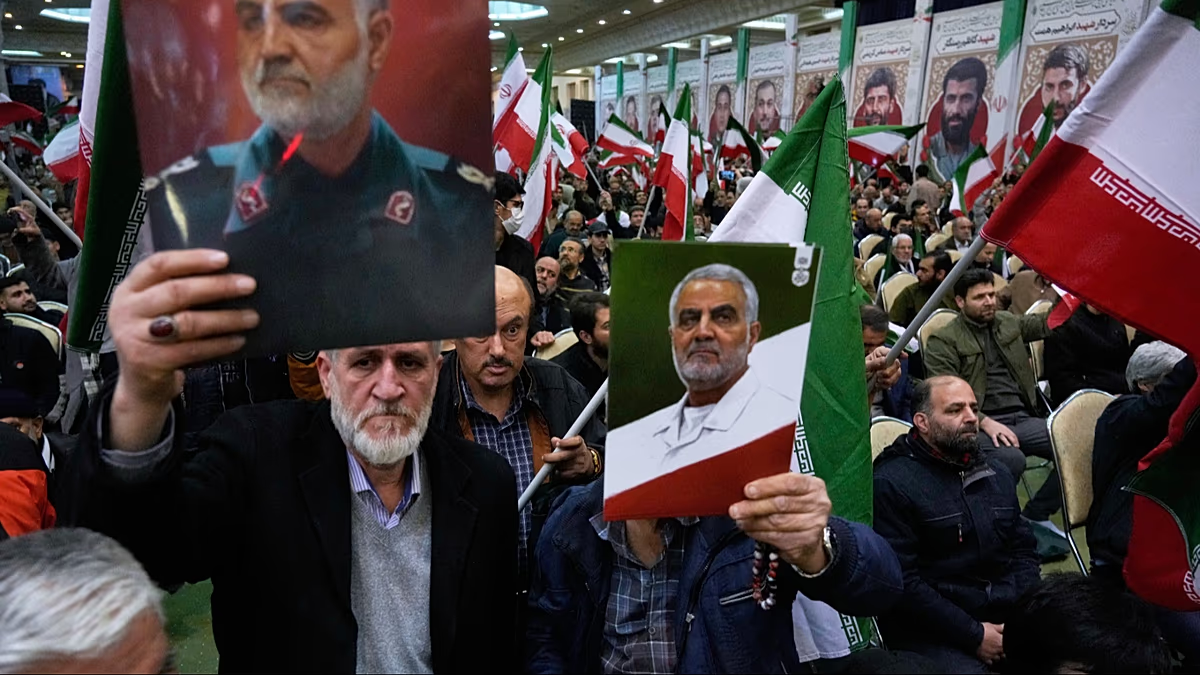

The European Union is once again debating whether to designate Iran’s Islamic Revolutionary Guard Corps (IRGC) as a terrorist organisation, following a violent crackdown on recent protests within the country. This move, long considered by some member states, has been reignited by escalating concerns over human rights abuses and the IRGC’s alleged role in regional destabilization. Placing the IRGC on the EU’s terrorist list would trigger asset freezes and travel bans for its members.
The potential designation comes as international pressure mounts on Iran over its handling of demonstrations sparked by social and political grievances. Several countries, including the United States, Canada, and Australia, have already designated the IRGC as a terrorist entity. The EU’s deliberations highlight a growing rift between those advocating for a firm stance against Tehran and those prioritizing diplomatic engagement.
Renewed Push to Designate the IRGC as a Terrorist Organisation
Diplomats in Brussels indicate that countries like Germany and the Baltic states are leading the charge to revisit the possibility of adding the IRGC to the EU’s terrorist list. This push follows what they describe as extreme violence used against protesters over the past two weeks. A meeting of ambassadors from the EU’s Political and Security Committee this week saw broad discussion on the matter, though no formal written proposals were presented.
Concerns about the scale of the repression are substantial. A US-based Iranian human rights group estimates that over 2,000 people may have been killed during the protests, with fears mounting that public executions could follow. These reports have fueled calls for stronger action from European leaders.
Dutch Foreign Affairs Minister David van Weel publicly urged the EU on X to “list the IRGC as a terrorist organisation.” Similarly, French MP Pieyre-Alexandre Anglade argued that Europe “could not remain silent” in the face of civilian deaths attributed to the IRGC’s actions.
The IRGC’s Activities and Accusations
Founded in 1979 by Ayatollah Ruhollah Khomeini, the IRGC is a powerful and highly influential branch of Iran’s armed forces, directly accountable to the Supreme Leader. It encompasses ground, naval, and air forces, as well as a significant intelligence apparatus.
The group has faced numerous accusations of destabilizing activities, including leading crackdowns on protests within Iran, supplying weapons to Russia in the context of the war in Ukraine, and launching ballistic missile attacks against Israel. Additionally, the IRGC is accused of maintaining close ties with non-state actors such as Hezbollah in Lebanon, Hamas in the Palestinian territories, and the Houthi rebels in Yemen.
Recently, the IRGC accused “terrorists” of attacking military and law-enforcement facilities in Iran, as reported by state television. US President Donald Trump has condemned the potential execution of protesters, referring to Iranian leadership as “monsters.”
European Parliament President Roberta Metsola has also voiced strong support for a terror designation in an interview with Euronews, stating that the parliament supports such a move and that other EU institutions should follow suit. MEP Hannah Neumann, chair of the European Parliament’s Delegation for relations with Iran, described the IRGC’s actions as “shooting people in the face” and emphasized the symbolic importance of a terror designation.
Legal and Political Obstacles
Under EU rules, adding an entity to the terrorist list requires a prior decision by a competent authority in a member state or a third country, followed by unanimous approval from all EU member states. This unanimity requirement presents a significant hurdle.
A recent ruling by a German court, which found that an attack on a synagogue was orchestrated by an Iranian state agency, raised hopes of establishing sufficient legal grounds for a designation. However, political considerations continue to play a crucial role. Some countries, like Italy and Spain, are reportedly still weighing their options.
Furthermore, some diplomats suggest that France and Italy have been hesitant to fully sever ties with Tehran, citing concerns for their nationals detained in Iran. Greece, with its significant maritime interests, also faces complexities due to its engagement in safeguarding commercial vessels in the Red Sea and past tensions with Iran over tanker seizures. Some officials also argue that existing sanctions against the IRGC may be sufficient, and a terror designation could escalate tensions without providing significant additional leverage.
The debate surrounding the IRGC designation is likely to continue in the coming weeks. EU foreign ministers are expected to discuss the issue at their next meeting, and the decision will ultimately depend on achieving consensus among all member states. Observers will be watching closely to see if the growing evidence of repression and regional destabilization will be enough to overcome the political and legal obstacles and lead to a formal designation.