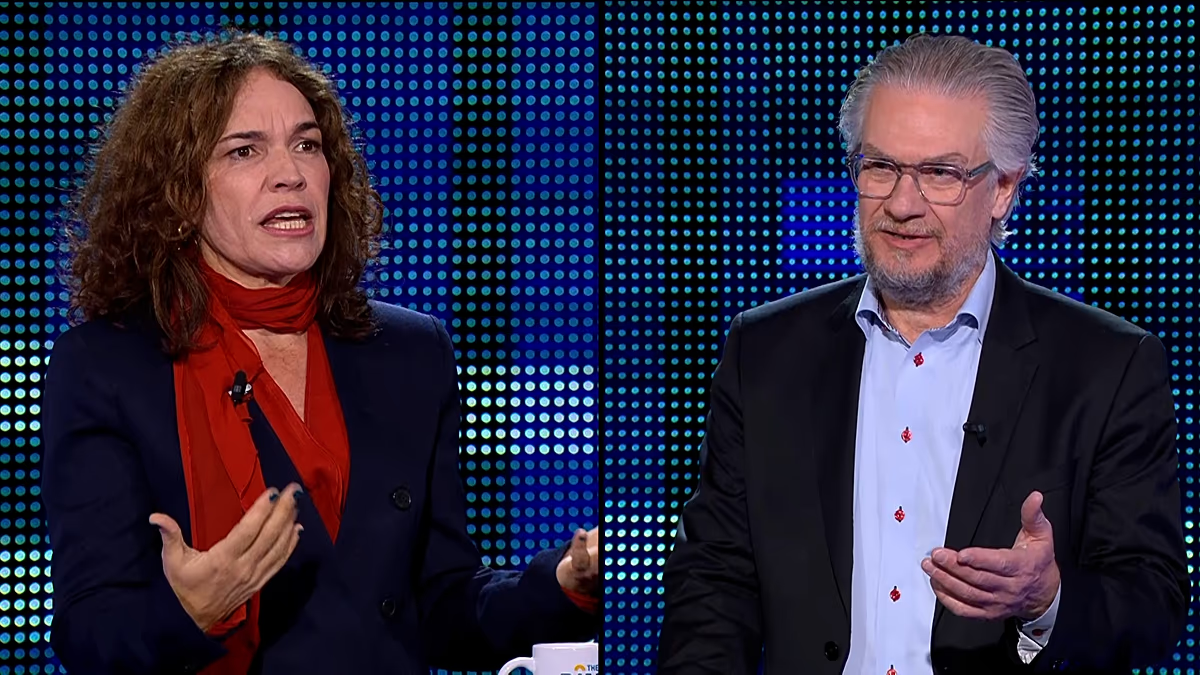

European geopolitical ambition and the EU’s internal challenges were the focus of a recent debate between Danish MEP Henrik Dahl and Spanish MEP Lina Gálvez, as reported by Euronews. The discussion, featured on the program “The Ring,” highlighted diverging views on the effectiveness of the European Union’s foreign policy and its future role on the world stage. The core of the disagreement centered on whether the EU is adequately equipped to assert its influence in a shifting global power dynamic, and the importance of EU foreign policy in navigating these changes.
The exchange, which took place on January 14, 2026, touched upon critical issues including the reliance on NATO, the EU’s response to international crises like Venezuela, and the complex security arrangements surrounding Greenland. Both MEPs acknowledged the need for Europe to actively secure its position, though they differed significantly on the methods and underlying principles required to do so.
The Debate Over Effective EU Foreign Policy
Henrik Dahl, representing the European People’s Party (EPP), presented a pragmatic view, arguing that the concept of a “rules-based international order” is largely illusory. He believes that power, rather than adherence to principles, is the primary driver of global events. According to Dahl, the EU’s influence is constrained by its dependence on the North Atlantic Treaty Organization (NATO) for security and a tendency towards declarative statements rather than concrete action.
He specifically questioned the impact of resolutions and strongly worded letters, suggesting they hold little sway with actors like Russia. Dahl pointed to the example of Greenland, noting that while an attack on the territory would likely trigger a NATO response under Article 5, the situation is different if the aggressor were the United States.
In contrast, Lina Gálvez, from the Progressive Alliance of Socialists and Democrats (S&D), criticized the EU for failing to consistently uphold its stated values. She argued that if the EU champions multilateralism and international law, it must demonstrate this commitment through its actions. Gálvez cited the EU’s response to the crisis in Venezuela as an example of incoherence, implying a disconnect between rhetoric and reality.
NATO and European Security
The discussion highlighted the ongoing tension between European strategic autonomy and the security umbrella provided by NATO. Dahl’s comments suggest a skepticism about the EU’s ability to independently guarantee its security, reinforcing the importance of the transatlantic alliance. This perspective aligns with ongoing debates about NATO’s future role in a changing geopolitical landscape.
However, Gálvez’s emphasis on the EU acting in accordance with its principles implies a desire for a more assertive and independent European foreign policy, potentially reducing reliance on external actors. This viewpoint reflects a growing sentiment within some EU member states regarding the need for greater European sovereignty.
The Role of Power in International Relations
A key point of contention was the relative importance of power versus principles in international relations. Dahl’s assertion that “the new currency is raw power” underscores a realist perspective, suggesting that states prioritize their own interests and security above all else. This view challenges the traditional emphasis on international cooperation and the rule of law.
Meanwhile, Gálvez’s critique suggests that abandoning principles in the pursuit of power would ultimately undermine the EU’s credibility and influence. She argued that the EU’s strength lies in its ability to act as a unified political and economic force, grounded in shared values. The need for internal unity within the EU to effectively project power was a recurring theme.
Both MEPs ultimately agreed on the necessity of proactive engagement to maintain Europe’s relevance. Dahl warned that relevance isn’t guaranteed and requires a willingness to confront the realities of power politics. Gálvez echoed this sentiment, emphasizing the need for EU structures to adapt to global changes and for member states to overcome internal divisions.
The debate serves as a stark reminder of the complex challenges facing the EU as it seeks to define its role in a multipolar world. The future of EU foreign policy will likely be shaped by the ongoing tension between these competing perspectives. Observers should watch for further developments in the EU’s strategic autonomy discussions and its responses to emerging global crises, as these will provide further insight into the direction of European foreign affairs. The evolving relationship between the EU and the United States, and the implications for international security, also remain critical areas to monitor.
You can watch the full discussion on Euronews to gain a deeper understanding of the nuances of this important debate.
The Ring is anchored by Méabh Mc Mahon, produced by Luis Albertos Altarejos and Amaia Echevarria, and edited by Zacharia Vigneron.