




For Philip Johnston, entrepreneurship has never been about incremental gains. It has been about systems, how they scale, where their limits lie, and what happens when those limits are reached. Over the past decade, the British entrepreneur has moved deliberately from abstract mathematics and global finance to building companies that operate at the edges of modern infrastructure. That trajectory now places him at the center of one of the most ambitious questions facing the technology industry: how and where the world will compute in the age of artificial intelligence.
Born on December 18, 1986, in Guildford, England, Philip Johnston grew up between continents. After spending his earliest years in Cape Town, where his father served with the British Foreign Service, he returned to the UK and was educated in Surrey before pursuing a first-class degree in Mathematics and Physics at the University of Nottingham. That quantitative foundation carried him to the United States at the age of 22, where he studied Applied Mathematics at Columbia University, and later into the financial sector. For five years, Johnston worked as an algorithmic trader at BNP Paribas, rotating between London, New York, and Singapore, immersed in highly automated markets where computation, speed, and efficiency dictate outcomes. Yet finance, for all its scale, proved to be a waypoint rather than a destination.
By the mid-2010s, Johnston had shifted toward venture capital and strategy, first at Knife Capital in Cape Town and later through advanced graduate studies in the United States. He completed a joint MBA at Wharton and a Master of Public Administration in National Security and Technology at Harvard’s Kennedy School, where he was elected student body president. The combination of business training and exposure to public-sector technology policy shaped a broader view of how infrastructure, capital, and national priorities intersect. That perspective deepened further during his time at McKinsey & Company, where, beginning in 2019, he worked with government institutions and space agencies on large-scale strategic projects. In 2021, Johnston applied those lessons to entrepreneurship, co-founding Opontia, an e-commerce brand aggregator focused on the CEEMEA region. As CEO, he led the company through rapid growth in a highly competitive market, before Opontia was acquired in 2023, closing a chapter centered on consumer technology and operational execution.
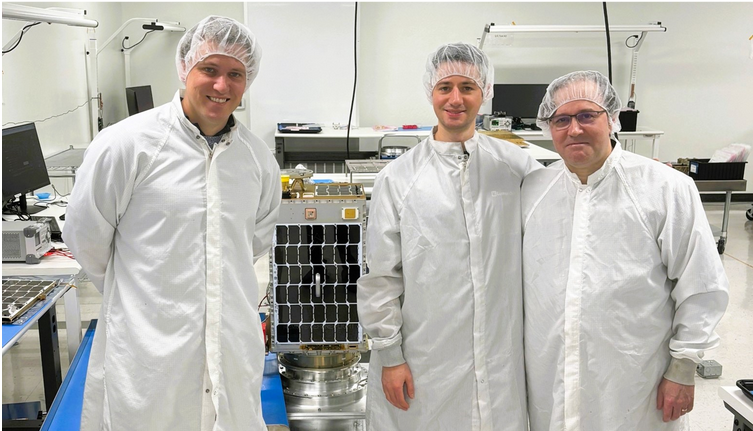
What followed marked a decisive shift. In early 2024, Johnston co-founded Starcloud (previously known as Lumen Orbit) a company that has since drawn significant global media attention for its unconventional premise: building data centers in space. At a moment when artificial intelligence is pushing terrestrial computing infrastructure toward physical limits in power, cooling, and land use, Starcloud’s thesis is that orbit offers a long-term alternative. By placing high-performance computing systems above the Earth, the company aims to leverage near-unlimited solar energy, natural cooling, and the absence of many constraints that bind ground-based data centers. Backed by Y Combinator, Nvidia, and scout funds associated with Sequoia and Andreessen Horowitz, Starcloud has quickly positioned itself within the emerging conversation about the future of AI infrastructure.
The company’s first satellite, Starcloud-1, has become a focal point of that discussion. Equipped with an Nvidia H100 GPU, a level of computational power unprecedented for an orbital payload, the satellite has already been used to train a language model and to run large open-source models in space, including DeepMind’s Gemma. While still experimental, the demonstration has been widely cited as a proof of concept for off-planet computation, raising questions about how AI workloads might one day be distributed beyond Earth. For Johnston, Starcloud is not a short-term play but a long-horizon infrastructure bet, one that aligns space technology with the exponential demands of artificial intelligence.
Seen as a whole, Philip Johnston’s career reads less like a series of pivots than a steady widening of scope: from equations to markets, from companies to systems, and now from Earth-bound infrastructure to orbital platforms. As governments, investors, and technologists grapple with the future limits of computation, Starcloud has placed Johnston among a small group of founders willing to test those limits far beyond the planet itself.