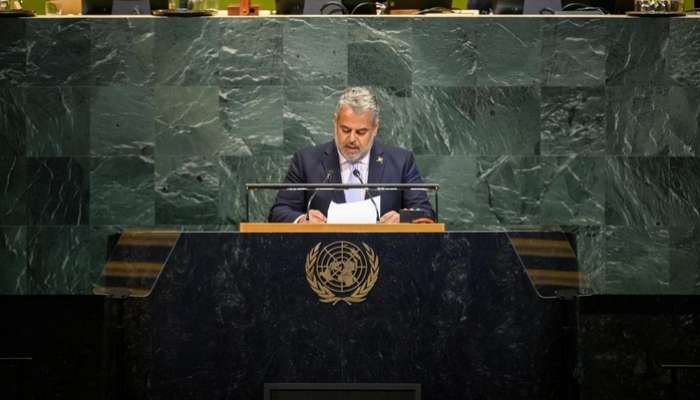

Oman has reaffirmed its commitment to global efforts in eliminating human trafficking, participating in a high-level meeting at the United Nations in New York dedicated to reviewing the UN Global Plan of Action. The nation’s active engagement underscores its dedication to protecting vulnerable populations and upholding international law, notably with recent updates to its own national legislation. This participation signals Oman’s continued prioritization of human rights and sustainable development on the world stage.
Oman at the UN: Advancing the Fight Against Human Trafficking
Ambassador Omar Alkathiri, Oman’s Permanent Representative to the United Nations, highlighted the significance of the meeting, stating that Oman was “honoured to take part in this meeting dedicated to advancing the implementation of the United Nations Global Plan of Action to Combat Trafficking in Persons.” He powerfully emphasized that human trafficking is a grave violation of human dignity, undermining the rule of law and representing a direct threat to lasting peace and equitable development worldwide. This stance reflects a growing global consensus on the severity and multi-faceted impact of this heinous crime.
The meeting focused on collaborative strategies to counter human trafficking, and Oman’s delegation warmly welcomed the launch of the updated UN Global Plan. Ambassador Alkathiri specifically noted that the revised plan takes into account evolving challenges, including the increasingly sophisticated use of technology and artificial intelligence by traffickers, the heightened risks faced by migrants, and the disproportionate impact on women, girls, and children.
Oman Vision 2040 and National Legislative Reforms
Oman’s commitment to combating human trafficking isn’t merely rhetorical; it’s embedded within the framework of its national development strategy, Oman Vision 2040. This vision places people at the core of all development initiatives, recognizing that human security is a fundamental prerequisite for progress. Accordingly, Oman has been systematically strengthening its domestic infrastructure and policies.
A pivotal step in this process has been the recent update of Oman’s national legislation. Recognizing the need for modern and effective tools to prosecute traffickers and protect victims, the country issued the revised Anti-Trafficking in Persons Law under Royal Decree No. 78/2025. This new law broadens the definition of trafficking in persons to encompass various forms of exploitation, including forced labour.
Key Provisions of the Revised Law
The updated legislation significantly strengthens victim protection mechanisms. It explicitly outlines the medical, psychological, and legal care to which victims are entitled and streamlines procedures to ensure swift assistance. Crucially, the law allows victims to cooperate with investigations without fear of prosecution for crimes they may have been compelled to commit as a direct result of their trafficking situation – a provision intended to encourage reporting and facilitate justice. Furthermore, a dedicated chapter focuses on enhancing international judicial cooperation to address the cross-border nature of people smuggling and trafficking networks.
Raising Awareness and Strengthening Response Mechanisms
Beyond legal reforms, Oman is investing heavily in preventative measures and public awareness campaigns. The National Committee for Combating Human Trafficking (NCCHT) has been instrumental in leading nationwide initiatives, with the most recent being the “Aman” campaign. This multifaceted campaign aims to educate the public about the various forms and subtle signs of human trafficking, empowering communities to identify and report suspected cases.
The “Aman” campaign utilizes a multi-pronged approach, leveraging the reach of social media platforms and traditional media outlets to disseminate information. Materials are available in seven widely used languages, reflecting Oman’s diverse population and its commitment to inclusivity. The campaign is further reinforced through community events, workshops, and exhibitions designed to raise awareness and foster dialogue.
Oman understands that responding to migrant exploitation requires a collaborative effort. By promoting reporting mechanisms and providing clear guidance on how to handle potential trafficking cases, the NCCHT is actively encouraging public participation in the fight against this crime.
Commitment to International Cooperation
Ambassador Alkathiri concluded Oman’s address by reaffirming the nation’s unwavering commitment to international cooperation. He highlighted Oman’s continued support for the vital work of the United Nations Office on Drugs and Crime (UNODC), recognizing its central role in coordinating global anti-trafficking efforts. Oman believes that a coordinated, multi-national approach is essential to dismantling trafficking networks and achieving a world free from this abhorrent practice.
Oman’s participation in the UN meeting, coupled with its internal reforms and awareness campaigns, demonstrates a robust and evolving strategy to combat human trafficking. This comprehensive approach underscores the nation’s dedication to protecting its citizens and contributing to a more just and equitable world for all. Stay informed about the ongoing efforts to combat trafficking by visiting the UNODC website and learning more about the resources available to report suspected cases.