
European Union leaders are grappling with a shifting transatlantic relationship, marked by increasing skepticism towards the United States under the renewed leadership of Donald Trump. Discussions at a recent EU summit revealed a growing consensus on the need for greater EU-US relations independence, particularly in economic and security matters. This shift comes after a week of diplomatic maneuvering surrounding Trump’s unexpected interest in Greenland and the unveiling of his controversial Gaza Board of Peace.
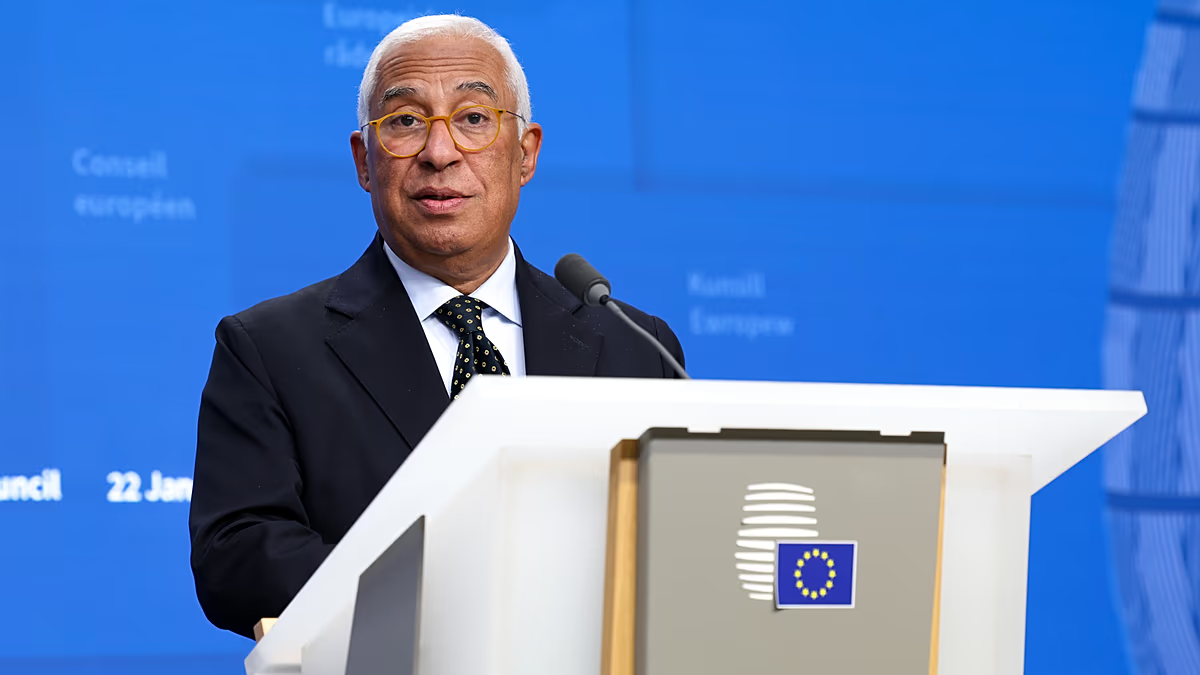
The abrupt change in tone was evident during a dinner meeting of EU leaders in Brussels. While there was some relief at Trump backing down from potential tariffs on Greenland, a Danish territory, concerns about the predictability and respectfulness of the US approach were widespread. António Costa, President of the European Council, emphasized the importance of “cordial and respectful” partnerships, signaling a clear departure from recent experiences.
The Push for EU Independence
Ursula von der Leyen, President of the European Commission, directly addressed the need for a more self-reliant Europe. She called for strengthening the EU’s “economic power,” diversifying supply chains, and reducing dependence on the United States. This sentiment reflects years of discussion about strategic autonomy, but now appears to be driven by a perceived urgency stemming from recent US actions.
The situation with Greenland highlighted the potential for unpredictable US foreign policy. Reports indicate the US proposal involved seeking sovereignty over parts of the territory and restricting mining access for countries like Russia. However, NATO allies were reportedly not fully informed about the details of these discussions, raising questions about transparency and coordination. Spain’s Foreign Minister José Manuel Albares noted the bilateral nature of talks between Trump and NATO Secretary-General Mark Rutte, suggesting a circumvention of traditional alliance consultation.
Adding to the complexity, EU leaders expressed “serious doubts” about Trump’s Gaza Board of Peace, questioning its compatibility with the UN Charter and its potential to undermine the international framework for peace in the region. Concerns were also raised about the board’s composition, particularly the inclusion of Russian President Vladimir Putin, making participation politically difficult for many EU member states given the ongoing war in Ukraine.
Ukraine Recovery Framework Gains Momentum
Despite the tensions, cooperation continues on other fronts. The EU and the US are reportedly “close” to finalizing a Ukraine Prosperity Framework, a long-term plan for the country’s post-war recovery through 2040. This framework, built around five pillars – boosting productivity, EU integration, investment, donor coordination, and fundamental reforms – aims to provide a comprehensive roadmap for Ukraine’s future. Ukraine’s President Zelenskyy estimates the total reconstruction cost will be between $700 billion and $800 billion.
Talks on the framework are gaining momentum, with Zelenskyy announcing trilateral discussions with the US and Russia in Abu Dhabi. A document outlining US security guarantees for Ukraine in the event of a peace deal is reportedly complete, awaiting the end of hostilities for formal signing.
Mercosur Trade Deal Faces Hurdles
The recently signed Mercosur trade agreement also remains a point of contention. While von der Leyen indicated interest in a provisional application of the deal, a move supported by countries like Germany and Spain, the European Parliament has challenged the agreement, potentially sending it to the European Court of Justice. Opponents argue the deal could create unfair competition for EU farmers. This legal challenge introduces significant uncertainty into the ratification process and could escalate tensions within the EU.
The situation highlights the delicate balance between pursuing new trade opportunities and addressing domestic concerns. The Commission’s decision on provisional application will likely be closely watched by both supporters and opponents of the agreement.
Looking ahead, the EU will continue to monitor the evolving situation in the US and assess the implications for its own strategic interests. The focus will remain on strengthening internal capabilities and diversifying partnerships to ensure greater resilience in a changing geopolitical landscape. The coming weeks will be crucial in determining the future trajectory of EU-US relations and the EU’s ability to navigate a more complex world.