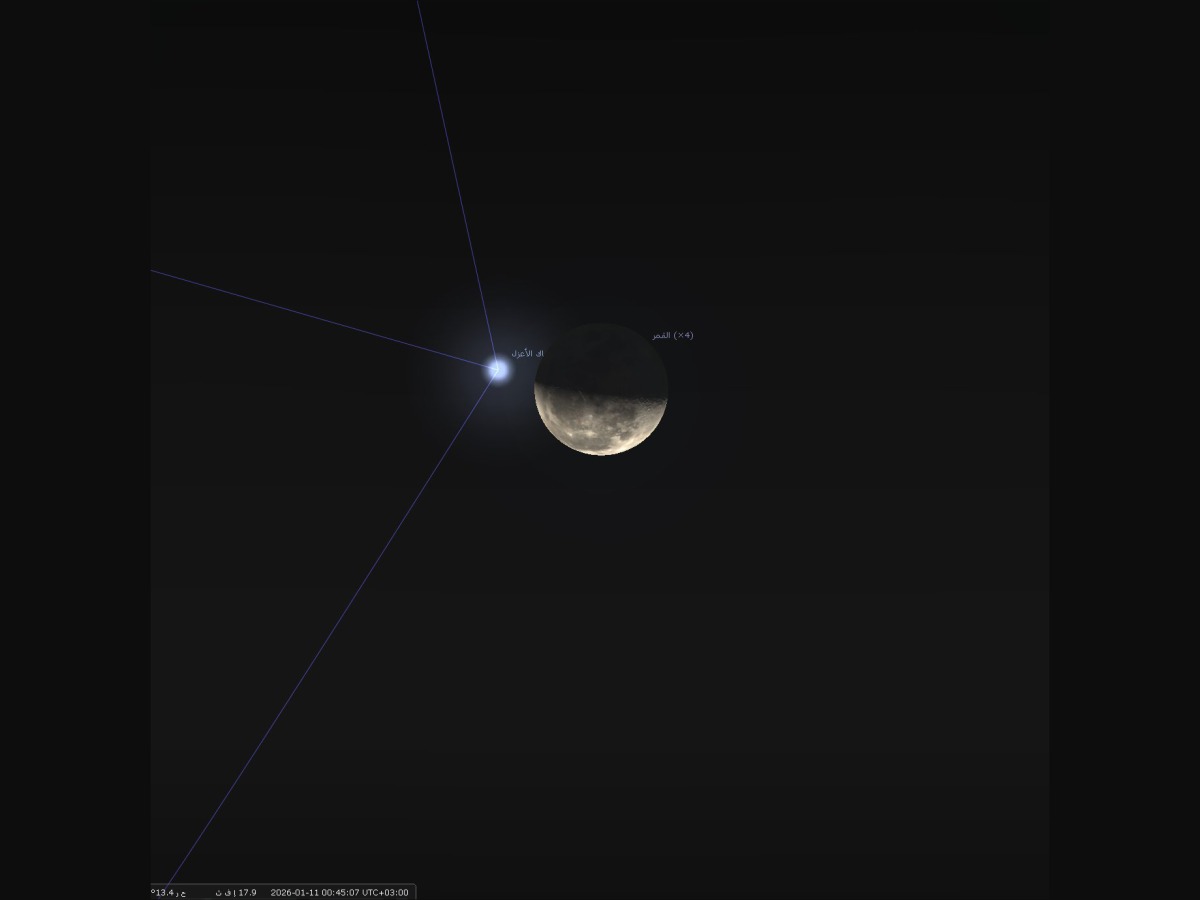

Skywatchers in Qatar and surrounding regions are in for a treat this week as a rare celestial alignment will occur shortly after midnight on January 11th. The event, a lunar conjunction with Spica, will see the bright star appear very close to the Moon in the night sky, offering a striking visual spectacle. This conjunction is expected to be visible without the aid of telescopes or binoculars, making it accessible to everyone.
Dr. Sheikh Salman bin Jabor Al-Thani, Head of the Qatar Astronomical Center, confirmed the event, noting that Spica, also known as Alpha Virginis or “the lonely star,” is particularly noteworthy for its brilliance. The conjunction will be best observed in areas with minimal light pollution, offering the clearest view of this astronomical phenomenon. Residents of Doha and other Qatari cities should have a good opportunity to witness the event, weather permitting.
Understanding the Lunar Conjunction with Spica
A lunar conjunction happens when the Moon and a star appear close together in the sky from our perspective on Earth. This isn’t a physical collision, but a line-of-sight effect created by the orbits of the Moon and the star. The term “conjunction” generally refers to any apparent close meeting of celestial bodies.
Spica is the brightest star in the constellation Virgo and holds significant historical importance. For centuries, sailors and navigators have used Spica as a guiding star due to its intense luminosity and consistent position in the night sky. Located approximately 250 light-years away, its light has traveled a vast distance to reach observers on Earth.
What Causes a Conjunction?
The Earth, Moon, and stars are constantly moving. These apparent alignments occur because of our vantage point. As the Moon orbits Earth, it passes in front of – or appears near – different stars along the ecliptic, the plane of Earth’s orbit around the Sun. This contributes to the relatively frequent occurrence of lunar conjunctions with various celestial objects.
The specific timing and closeness of the conjunction are dictated by the orbital mechanics of both the Moon and Spica. Astronomical calculations predict the precise moment of closest approach, allowing observers to plan their viewing. Conditions for viewing, such as minimal cloud cover, remain vital for successful observation of these events.
This particular alignment is noteworthy because of Spica’s brightness. While many conjunctions occur throughout the year, a conjunction involving a prominent star like Spica is considerably more visible and therefore more widely observed. It offers a relatively easy way for people to connect with the night sky and appreciate the movements of celestial bodies. Observing a star near the Moon can also help to orient oneself among other constellations, aiding in basic astronomical navigation.
Interestingly, the visibility of such events can also inspire interest in astronomy and related sciences. Educational institutions and astronomical societies often use conjunctions to promote public outreach programs and increase awareness about the universe. Additionally, this lunar event differs from a syzygy which involves the Sun, Earth, and Moon.
Looking ahead, astronomers will be monitoring other potential conjunctions and astronomical events in the coming months provided weather patterns stay consistent. Future events include possible meteor showers and planetary alignments, although the specifics remain dependent on orbital calculations and atmospheric conditions. The continued observation of these phenomena will contribute to a deeper understanding of the cosmos and our place within it.