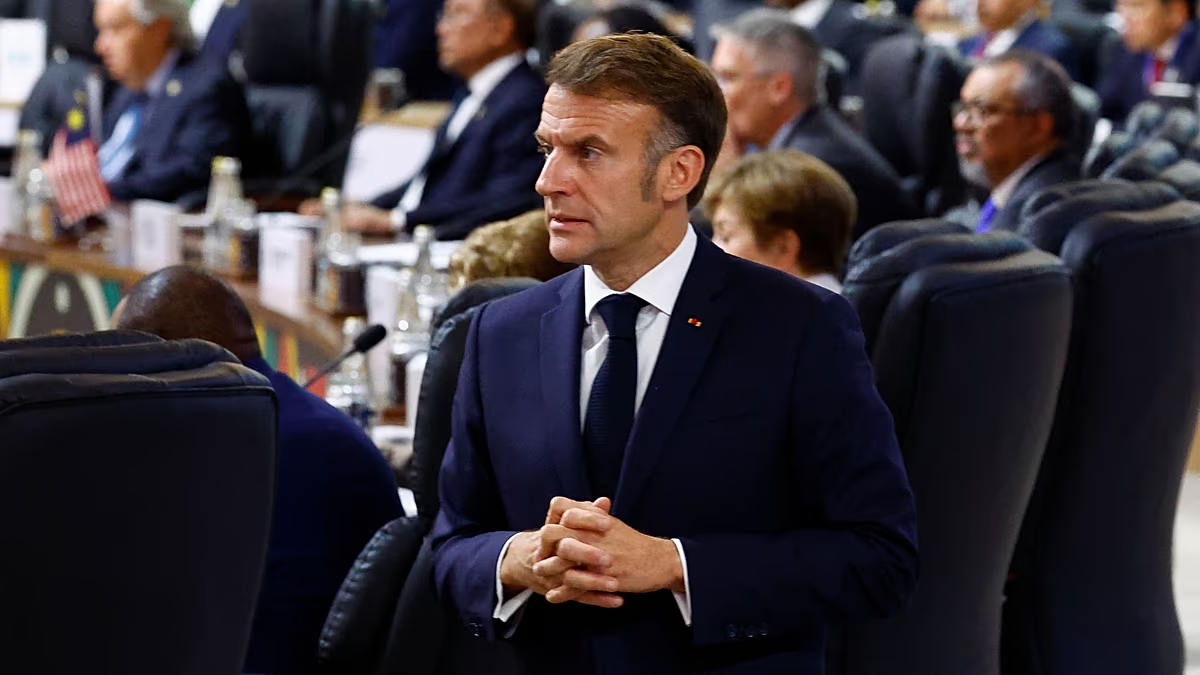

French President Emmanuel Macron is facing criticism after a proposal to certify media outlets with “labels” to combat disinformation was misrepresented, sparking accusations of authoritarianism. The controversy, fueled by conservative commentators and political parties, centers on concerns that the government intends to control the narrative and stifle free press. The debate highlights the growing tension between efforts to address disinformation and safeguarding democratic principles.
The dispute began following remarks Macron made during a November 19th meeting with readers of La Voix du Nord newspaper. Reports quickly emerged, particularly from outlets owned by media mogul Vincent Bolloré, alleging Macron sought to impose a state-controlled definition of “truth” in the news. On November 30th, Journal du Dimanche published a front-page story claiming Macron aimed to “control the media,” while commentator Pascal Praud referenced “Pravda,” the former Soviet newspaper, in a December 1st broadcast.
The Controversy Surrounding Media Certification
Macron’s proposal stemmed from a desire to differentiate between legitimate news sources and those profiting from advertising through the spread of false information. He advocated for a certification process, carried out by professionals, to identify outlets adhering to ethical standards. However, he explicitly stated that the government should not be the arbiter of truth, warning that doing so could lead to autocracy.
Origins of the Proposal
The President cited the Journalism Trust Initiative (JTI) as a potential model. Launched in 2021 by Reporters Without Borders, the JTI focuses on evaluating the ethical practices of news organizations, rather than the content itself. The JTI’s certification criteria were developed by a committee of 130 experts from journalism, regulatory bodies, and the tech industry.
Benjamin Sabbah, director of the JTI, explained to Euronews’ fact-checking team, The Cube, that the initiative aims to identify reliable sources of information for consumers navigating the digital landscape. Over 2,400 media outlets in 127 countries have participated in the JTI to date. Sabbah also noted that while not initially designed to combat misinformation, the JTI has become a valuable tool in that fight.
Despite Macron’s clarifications, conservative political parties seized on the initial reports. Les Républicains accused him of eroding democracy by attempting to establish “an official truth,” while the Union des droites pour la République party alleged a plan to create a “Ministry of Truth.” Both parties launched petitions, garnering over 42,000 and 41,000 signatures respectively.
The Elysée Palace responded with a social media post contrasting misleading headlines and commentary with footage of Macron’s original statements, highlighting the distortion of his message. The post questioned the comparison to “Pravda” and the “Ministry of Truth” accusations, labeling them as disinformation.
The Broader Context of Disinformation
This incident occurs against a backdrop of increasing concern over the spread of fake news and its impact on democratic processes. Governments worldwide are grappling with how to address this challenge without infringing on freedom of the press. The debate in France underscores the difficulty of finding a balance between protecting the public from harmful misinformation and upholding the principles of a free and independent media.
The controversy is likely to continue as France prepares for upcoming elections. It remains to be seen whether Macron will pursue the media certification proposal further, and how he will address the concerns raised by critics. Observers will be watching closely to see how this debate shapes the future of media regulation and the fight against disinformation in France and beyond.