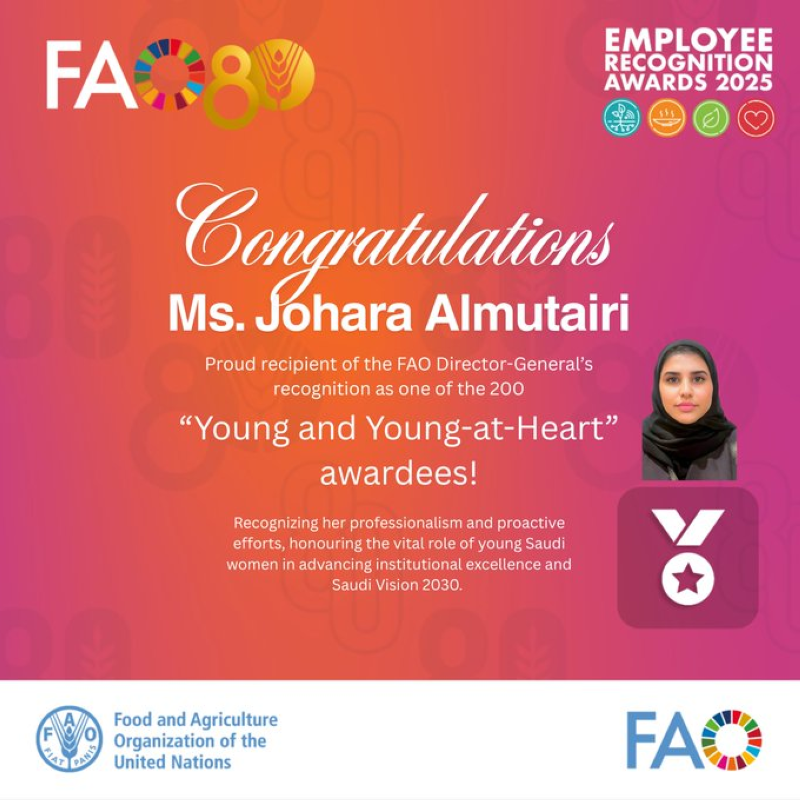

RIYADH — Johara Almutairi, a professional at the Food and Agriculture Organization of the United Nations (FAO) Office in Saudi Arabia, has been recognized as one of the organization’s Top 200 young leaders globally. The honor, presented through the “Young and Young-at-Heart” award, acknowledges Almutairi’s contributions to improving efficiency and effectiveness within the FAO’s operations in the Kingdom. This recognition highlights Saudi Arabia’s growing commitment to Saudi Vision 2030 and the empowerment of women in professional roles.
The announcement was made this week by the FAO Office in Saudi Arabia, celebrating Almutairi’s dedication to upholding quality standards and proactively identifying solutions for operational improvements. Her recommendations specifically focused on optimizing spending while maintaining strong on-the-ground engagement, directly supporting the FAO’s core objectives. The award signals a broader trend of increasing Saudi national participation in international organizations.
Johara Almutairi’s Contributions to the FAO and Saudi Vision 2030
Almutairi’s work with the FAO has centered on enhancing internal processes and maximizing the impact of resource allocation. Her insights were particularly valuable in streamlining operations within the Kingdom, according to a statement released by the FAO. This led to increased efficiency in the implementation of food security initiatives and agricultural development projects.
Improving Operational Effectiveness
The FAO routinely evaluates its internal mechanisms to ensure optimal performance, particularly in diverse operational environments like Saudi Arabia. Almutairi’s work built on this process by pinpointing specific areas for improvement and proposing data-driven solutions. The organization has emphasized the importance of utilizing local expertise to address regional challenges.
Her recommendations weren’t limited to purely administrative changes. They also addressed the practical challenges of maintaining effective partnerships and engagement with stakeholders on the ground. According to the FAO statement, this balance between cost efficiency and field presence was pivotal to her commendation.
The recognition also reflects a wider initiative within the Saudi government to elevate the role of women in contributing to national development. Recent labor reforms have expanded opportunities for Saudi women across several sectors, including those related to international collaboration.
The FAO’s Focus on Women’s Empowerment and Sustainable Development
The “Young and Young-at-Heart” award isn’t solely about individual achievement; it’s also a demonstration of the FAO’s commitment to fostering a diverse and inclusive workforce. FAO Program Director Dr. Nizar Haddad stressed that Almutairi’s success serves as an example of the growing influence of Saudi women within international organizations.
The FAO Office in the Kingdom has declared its intention to further support women’s empowerment initiatives. This includes providing training and mentorship opportunities, as well as promoting equal access to resources and leadership positions. These efforts align with the United Nations’ Sustainable Development Goals, specifically Goal 5, which addresses gender equality.
Meanwhile, the wider FAO strategy in Saudi Arabia focuses on several key areas, including water resource management, sustainable agriculture, and improving food security. These initiatives are increasingly reliant on collaborative partnerships with local entities and the integration of innovative technologies.
In contrast to previous approaches, recent FAO programs prioritize knowledge transfer and capacity building within Saudi Arabia. This aims to ensure long-term sustainability and reduce reliance on external support. Almutairi’s contributions are believed to have significantly aided in these localized strategy adjustments.
The focus on efficient resource allocation also ties into the Kingdom’s broader fiscal considerations. With an increasing emphasis on diversifying the Saudi economy, optimizing spending in crucial sectors like agriculture and food security is paramount. Almutairi’s suggestion for optimizing expenses while upholding engagement quality reflects this national imperative.
Looking Ahead
The FAO plans to further integrate the outcomes of Almutairi’s recommendations into its ongoing projects in Saudi Arabia. The organization will continue monitoring the effectiveness of these changes and adapting its strategies as needed. It remains to be seen how these internal improvements translate into tangible outcomes for food security and agricultural development within the Kingdom.
Further, the success of this initiative may encourage similar efforts to identify and nurture local talent within other international organizations operating in Saudi Arabia. The Saudi government is expected to continue advocating for increased representation of its citizens in these roles as part of its Vision 2030 objectives. A comprehensive evaluation of the FAO’s current programs is scheduled for completion in the fourth quarter of 2024, which will likely reveal further details on implementation and impact.