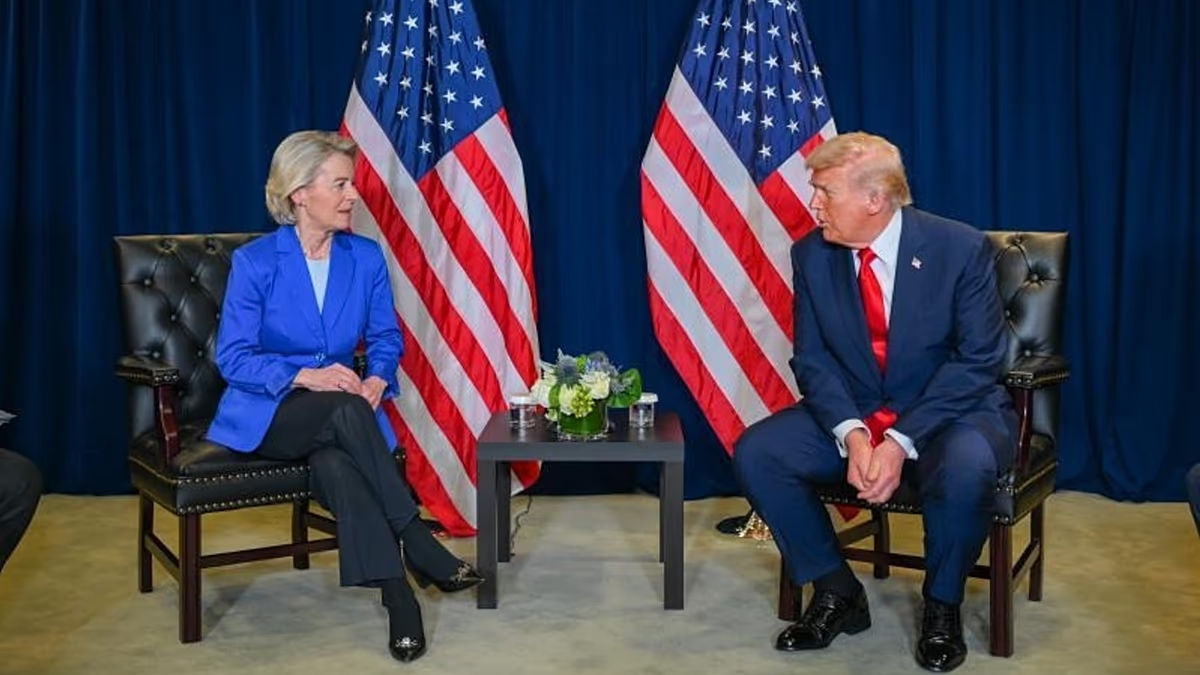

European leaders face a complex diplomatic challenge as they navigate escalating tensions with the United States over President Donald Trump’s unexpected proposal regarding Gaza Board of Peace membership. The issue, surfacing amidst ongoing disagreements about trade tariffs, is forcing the European Union to consider its response to invitations for permanent seats on the board, which come with a $1 billion price tag. A crucial summit is scheduled for Thursday to address the matter, adding another layer of difficulty to already strained transatlantic relations.
The invitations, extended to several EU member states including France, Germany, Italy, and Hungary, request participation in a board ostensibly designed to administer post-war Gaza. However, the board’s charter, which reportedly lacks specific mention of Gaza and grants significant authority to President Trump, has raised serious concerns within European diplomatic circles. This development coincides with a separate dispute between the US and Europe over Greenland, further complicating the geopolitical landscape.
The Dilemma of the Gaza Board of Peace
The core of the issue lies in the perceived ambiguity of the Gaza Board of Peace’s mandate and governance structure. Diplomats worry the board is intended to circumvent or rival the United Nations, rather than complement existing international efforts. According to Belgian Foreign Minister Maxime Prévot, speaking at the World Economic Forum in Davos, Trump appears to be seeking to “replace the United Nations’ system” with a “personal board.”
France has already signaled its intention to decline a seat, citing fears that the board’s charter undermines the principles of the UN. This decision was swiftly met with a threat from President Trump of a 200% tariff on French wine and champagne, demonstrating the potential for rapid escalation. The European Commission, responsible for the EU’s common foreign and security policy, is now tasked with coordinating a unified response.
Concerns Over Representation and Funding
A key point of contention is the limited representation of Palestinians on the board’s senior panels, despite the stated goal of rebuilding Gaza. While a Palestinian-led technocratic committee is managing daily affairs, critics argue that a lack of direct Palestinian input into the board’s overarching decisions is unacceptable. The European Commissioner for the Mediterranean has called for the “inclusion of all key stakeholders” in the board’s operations.
Additionally, the $1 billion cost of permanent membership is drawing scrutiny. The funds are purportedly earmarked for Gaza’s reconstruction, but questions remain about the transparency and accountability of their allocation. Some officials privately express concern that the financial commitment could be seen as tacit approval of the board’s broader, and potentially problematic, agenda. Reuters reported on the initial 20-point peace plan last year.
Meanwhile, the inclusion of Russian President Vladimir Putin on the invitation list further complicates matters for Europe. Accepting a seat alongside Russia could be politically damaging for many EU member states, given existing tensions over Ukraine and other geopolitical issues. This creates a difficult balancing act for nations seeking to maintain both transatlantic alliances and their own independent foreign policies.
In contrast to the hesitation from some quarters, Hungary has already accepted its seat on the Gaza Board of Peace. Hungarian Foreign Minister Péter Szijjártó stated that Prime Minister Viktor Orbán is “honoured” by the invitation. This divergence in approach highlights the existing rifts within the EU on foreign policy, which are likely to be amplified by this latest development. The board is intended to oversee the implementation of a peace plan presented by Trump last September, which includes provisions for international security forces and the disarmament of Hamas.
The situation is unfolding rapidly, and the upcoming EU summit will be critical in determining a coordinated response. The debate is expected to be intense, reflecting the deep divisions within Europe regarding the best way to engage with the Trump administration and address the complex challenges facing Gaza. The future of the Gaza Board of Peace, and its impact on broader international efforts, remains uncertain.
As the summit approaches, observers will be watching closely to see if the EU can forge a unified position on the board, and whether it can successfully navigate the delicate balance between maintaining its relationship with the US and upholding its commitment to a multilateral, UN-centered world order. Stay informed on this developing story and its potential implications for international diplomacy.