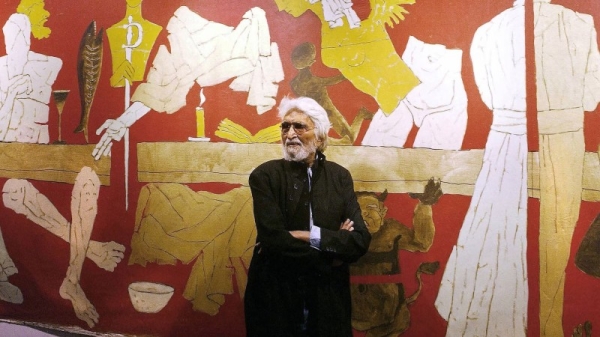

The legacy of M.F. Husain, a pioneering Indian artist, has been marked by controversy and celebration in equal measure this year. In March, one of his monumental paintings, “Untitled (Gram Yatra),” fetched a record-breaking $13.75 million at Christie’s in New York, while in June, a Mumbai auction of 25 of his long-lost works was met with protests and police presence due to concerns over their depiction of Hindu deities.
The contrasting reactions to Husain’s work highlight the complexities surrounding his art and legacy. As Dr. Diva Gujral, an art history fellow at the University of Oxford’s Ruskin School of Art, noted, the reception of Husain’s work serves as a “litmus test for Indian cultural politics.”
The Artistic Legacy of M.F. Husain
Husain was known for his bold and colorful explorations of folk and pop culture, often incorporating icons from Hindu mythology, Bollywood, and Indian politics into his work. Born in 1915 in Pandharpur, India, Husain was exposed to both Hindu and Islamic art from a young age, which later influenced his unique style.
He was a key figure in the Bombay Progressive Artists’ Group, which sought to forge a new visual language for India after independence. Husain’s work was characterized by its Cubist-inspired style, which was rooted in Indian art traditions.
Controversy and Criticism
However, Husain’s depictions of nude Hindu deities have been accused of offending religious sentiments, sparking protests and legal action against him. The Hindu Janajagruti Samiti, a right-wing group, opposed the Mumbai auction, stating that Husain’s portrayals of goddesses were “vulgar and obscene.”
Gujral suggested that the backlash against Husain’s work is also linked to his Muslim heritage, with some viewing his depictions of Hindu deities as a “desacralizing act.” The controversy surrounding Husain’s work has been seen as a reflection of the rising tide of Hindu nationalism in India.
The Impact of Husain’s Work on Indian Art
Nishad Avari, head of South Asian modern and contemporary art at Christie’s, noted that Husain’s early work, including “Untitled (Gram Yatra),” played a critical role in defining Indian modern art. The painting, which depicts rural life in vibrant colors, is seen as a representation of Husain’s ability to capture the essence of Indian culture.
Abhishek Poddar, a collector and founder of the Museum of Art & Photography in Bangalore, recalled Husain’s love for India and his desire to return home. Despite facing numerous legal cases and death threats, Husain continued to produce art until his death in 2011.
The Qatar Foundation’s recent announcement of plans to open a museum dedicated to Husain’s work is a testament to his enduring legacy. As the art world continues to grapple with the complexities surrounding Husain’s art, it remains to be seen how his legacy will be reevaluated in the years to come.