
The world of robotics was on full display at this year’s Consumer Electronics Show (CES) in Las Vegas, showcasing advancements ranging from practical applications to futuristic concepts. From Boston Dynamics’ production-ready Atlas humanoid to a variety of demonstration models, the event offered a glimpse into the evolving capabilities of automated systems. CES 2024 highlighted not only technological progress but also the increasing commercial interest in deploying robots across diverse sectors, including retail, hospitality, and manufacturing.
The annual tech trade show featured numerous companies unveiling their latest robotic creations, attracting significant attention from industry professionals and the public alike. While some demonstrations focused on entertainment value, others pointed toward tangible solutions for labor shortages and efficiency gains. The sheer volume of robotic exhibits underscored the growing investment and innovation within the field, signaling a potential turning point in the widespread adoption of automated technologies.
The Rise of Humanoid Robots and Advanced Capabilities
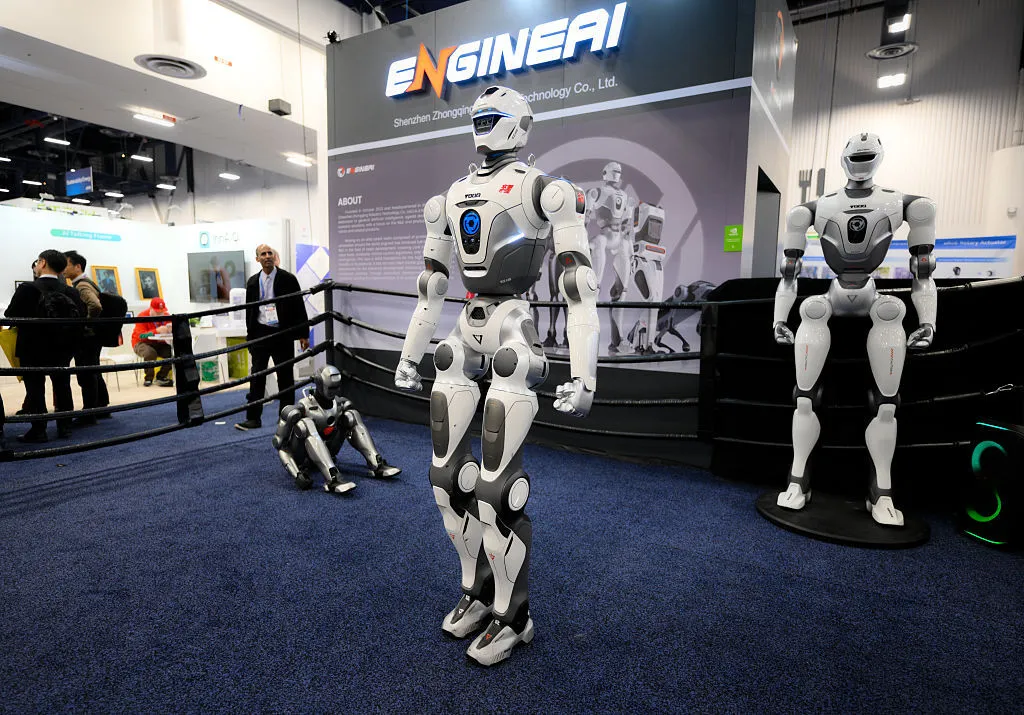
Humanoid robots were a prominent theme at CES 2024, with several companies showcasing their progress in creating machines that mimic human form and function. EngineAI’s T800 robots, inspired by the Terminator franchise, drew large crowds with their boxing demonstration, although their performance was somewhat unpredictable, occasionally stumbling or wandering into the audience. Meanwhile, Unitree, a Chinese robotics manufacturer, presented bots capable of running at speeds up to 11 mph, demonstrating advancements in locomotion and balance.
Robotics in Practical Applications
Beyond entertainment, CES showcased robots designed for specific tasks in real-world settings. Galbot, a Chinese company specializing in multi-modal large language models and robotics, demonstrated a convenience store clerk robot capable of fulfilling customer orders. The bot successfully retrieved a box of Sour Patch Kids upon request, highlighting its potential for deployment in retail environments, and the company reports existing deployments in Chinese pharmacies.
Additionally, Dyna Robotics presented a robotic laundry folding system already in use at Monster Laundry in Sacramento, California, marking a significant step toward automating tasks in the hospitality and service industries. This system, which efficiently folds shirts and places them in a pile, has garnered substantial investment, including a $120 million Series A funding round with participation from major tech companies like Nvidia, Amazon, and Samsung.
Entertainment and Novelty Robots
Not all robots at CES were focused on practical applications. Sharpa showcased a robot capable of playing ping pong, demonstrating the dexterity of its robotic hand technology. While the robot lost to a human competitor during the demonstration, the spectacle of a machine playing table tennis was nonetheless impressive. LG also unveiled its CLOid home robot, designed to assist with household tasks, though reviews suggest its performance is still developing.
The presence of these entertainment-focused robots, while not immediately commercially viable, serves as a valuable marketing tool for companies and provides a glimpse into potential future applications. They also capture public imagination and contribute to the broader acceptance of robotic technology.
Challenges and Future Outlook for Robotics
Despite the impressive advancements on display, several challenges remain before widespread robotics adoption becomes a reality. Concerns regarding cost, reliability, and safety continue to be significant hurdles. Furthermore, ethical considerations surrounding job displacement and the potential for misuse of robotic technology require careful attention. Unitree, for example, has faced scrutiny regarding potential ties to the Chinese military, highlighting the need for transparency and responsible development.
Looking ahead, the robotics industry is expected to continue its rapid pace of innovation. The integration of artificial intelligence and machine learning will likely lead to more sophisticated and adaptable robots capable of performing increasingly complex tasks. The next year will be crucial for observing the scaling of pilot programs like the one at Monster Laundry and the continued development of humanoid robots like Atlas. The industry will also be watching for regulatory developments and public discourse surrounding the ethical implications of advanced automation. Further advancements in battery technology and materials science will also be key to unlocking the full potential of these emerging technologies.
The continued investment and innovation showcased at CES 2024 suggest that the future of robotics is bright, but realizing that potential will require addressing the remaining technical, ethical, and societal challenges.