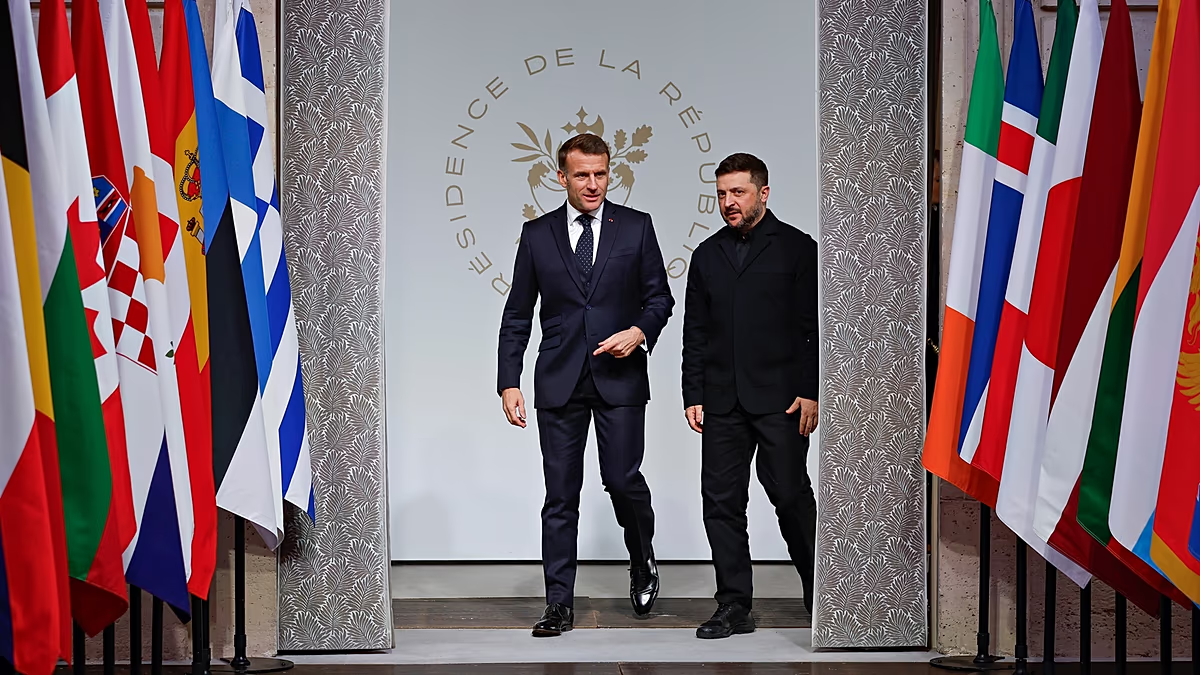

European leaders are navigating a delicate diplomatic tightrope, prioritizing maintaining the support of the United States for Ukraine even as Washington raises concerns about its foreign policy actions, including threats regarding Greenland. For the past year, securing the favor of former President Donald Trump has become paramount, influencing decisions from trade agreements to responses to potential territorial disputes. The need for US military aid and diplomatic involvement in resolving the conflict in Ukraine is driving this cautious approach.
The situation highlights a strategic calculus where European security interests are increasingly intertwined with maintaining a positive relationship with the US, despite disagreements. This has led to concessions, such as accepting unfavorable trade tariffs, and a reluctance to publicly criticize US actions, even when they conflict with international norms. The latest challenge centers on Trump’s expressed interest in acquiring Greenland, a semi-autonomous territory within the Kingdom of Denmark.
The Greenland Dilemma and US Support for Ukraine
The potential for the US to pursue the acquisition of Greenland, even by force, has placed European nations in a precarious position. They must balance their obligation to defend the territorial integrity of Denmark, a NATO ally, with the fear of provoking a negative reaction from the US that could jeopardize aid to Ukraine. This tension was evident during a recent meeting in Paris focused on security guarantees for Ukraine, where representatives appointed by Trump, Steve Witkoff and Jared Kushner, participated.
Despite the presence of Trump’s negotiators, French President Emmanuel Macron and British Prime Minister Keir Starmer publicly emphasized the “operational convergence” achieved with the US regarding Ukraine. However, questions from journalists quickly revealed the underlying anxieties. Macron and Starmer deflected inquiries about the US threats to Greenland, focusing instead on the continued commitment of the United States to supporting Ukraine.
European Responses and Concerns
A joint statement released by France, Germany, Italy, Poland, Spain, the UK, and Denmark reaffirmed the principles of sovereignty and territorial integrity, subtly reminding the US of its obligations under the UN Charter. However, the statement stopped short of explicitly condemning any potential annexation of Greenland or outlining any retaliatory measures. This muted response mirrors a similar pattern observed following US actions in Venezuela, where European nations largely refrained from criticism.
Officials privately acknowledge that confronting Trump over Venezuela or Greenland could be counterproductive, potentially hindering efforts to secure continued US support for Ukraine. According to Markus Ziener, a senior fellow at the German Marshall Fund, Europeans are in a “double-bind,” needing US assistance in Ukraine while fearing that criticism could lead to a premature or unfavorable peace deal. This has created a perceived credibility gap for the European Union.
Danish Prime Minister Mette Frederiksen has warned that an annexation of Greenland would undermine the entire post-World War II security architecture, potentially emboldening Russia in its ongoing aggression in Ukraine. The concern is that prioritizing a relationship with Trump above all else could have catastrophic consequences for European security and the broader international order. The situation underscores the growing reliance on NATO and transatlantic security cooperation.
Meanwhile, the broader geopolitical landscape continues to shift, with implications for European security and the ongoing conflict in Ukraine. The US presidential election later this year adds another layer of uncertainty, as a change in administration could significantly alter the dynamics of transatlantic relations.
Looking ahead, European leaders will likely continue to tread carefully, attempting to balance their security needs with the complexities of navigating a relationship with a potentially unpredictable US administration. The situation with Greenland serves as a stark reminder of the challenges facing Europe as it seeks to assert its strategic autonomy while remaining reliant on US support.