

MENA is scaling fast. In 2024, the Middle East forex market was estimated at $38.09B, with projections reaching $81.59B by 2033. For brokers, that growth creates a narrow window: launch quickly, localize correctly, and scale without platform economics eating your margins.
That’s where trading infrastructure for brokers becomes a bottleneck. Custom builds can take 12–18 months and cost $300K–$1M+ before you accept a single deposit. Cloud platforms reduce time-to-market, but often introduce vendor lock-in, pricing that compounds as you scale, and data residency complications — especially relevant for UAE (DFSA/ADGM) and Saudi (CMA) licensing paths.
Modern self-hosted trading platform models change the equation: brokers can deploy a production-ready stack — trading terminals, CRM, risk tools, payments, and compliance modules — in 14 days. Not a demo environment. A launch-ready trading platform for brokers capable of onboarding clients, accepting deposits, executing trades, and processing withdrawals from day one.
The real problem in MENA: speed is nothing without regulatory fit
Most platforms are designed around EU/US defaults. MENA brokers face fragmented frameworks (DFSA vs ADGM FSRA vs CMA and others), plus operational expectations that are region-specific. The result is a hidden delay: even after “platform selection,” brokers spend months adapting workflows, controls, and reporting.
What typically slows launches down isn’t one big blocker — it’s a collection of small ones that compound:
- jurisdiction-specific leverage and client classification logic
- Islamic (swap-free) account requirements
- audit-friendly reporting formats
- data residency expectations and documentation
- AML/KYC workflows aligned to local practice
With legacy approaches, each new market often means a new development cycle — and broker platform deployment becomes a multi-month project rather than a controlled rollout.
How ScaleTrade solves it: ScaleTrade’s self-hosted trading model includes modular compliance controls that brokers configure during deployment rather than build from scratch. Jurisdiction settings, account types (including Islamic), reporting logic, and language support are handled as configuration — not engineering work — so licensing and go-live timelines stay aligned for a modern UAE broker and for multi-jurisdiction operators expanding across the Gulf.
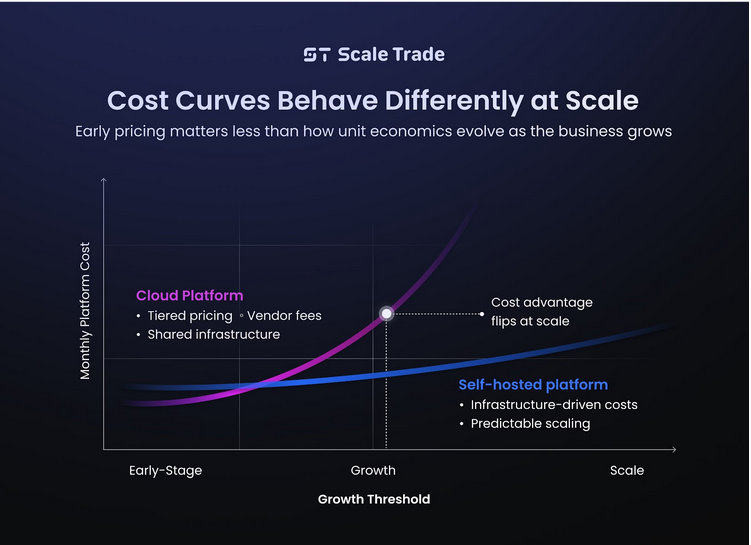
Cost predictability: why cloud “speed” becomes expensive at scale
MENA licensing already absorbs capital. Infrastructure spend shouldn’t become the second runaway line item — yet that’s what happens when platform costs scale through vendor tiers instead of infrastructure consumption.
source ScaleTrade
Custom development has a high upfront cost and ongoing maintenance. Cloud platforms often look attractive early, then become a margin problem as client counts and volumes grow. The critical question isn’t whether cloud is cheaper in month one, but how unit economics behave as the business scales — especially for broker trading infrastructure built to grow beyond early-stage volumes.
How ScaleTrade solves it: self-hosted economics are infrastructure-driven, not vendor-tier-driven. Brokers pay for predictable compute and operations rather than escalating subscription brackets. That structure makes scaling more sustainable as trading infrastructure for brokers grows from launch to expansion.
Data sovereignty isn’t “nice to have” anymore
Regulators increasingly expect brokers to clearly demonstrate where data lives, who controls it, and how incidents are handled. With typical cloud deployments, data location and operational control can be tied to vendor architecture and policy — not the broker’s compliance needs.
That creates friction in audits and makes cross-border expansion harder. Instead of deploying where the regulator expects, brokers end up negotiating what the vendor can offer — if anything.
How ScaleTrade solves it: self-hosted deployment gives brokers direct control over infrastructure location (e.g., UAE-based deployment for UAE clients, Saudi deployment for Saudi clients) and clean documentation for examinations. It also reduces exposure to shared-tenant incidents that affect multiple platform users — a practical advantage for regulated broker trading infrastructure.
Go-to-market reality: payments, mobile, and product breadth
In MENA, “platform readiness” is often measured by client experience more than feature checklists.
Payments: Clients expect regional options and low-friction deposits. If deposits take days, conversion suffers immediately.
Mobile: Mobile trading is primary, not secondary — especially for retail flow.
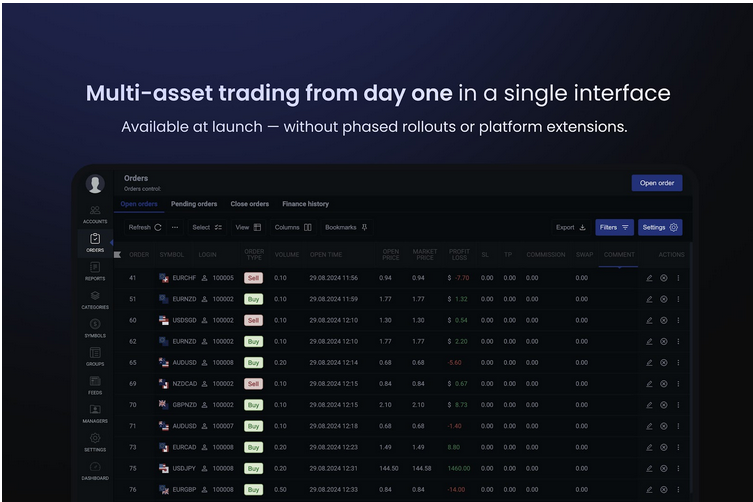
Multi-asset: Many traders benchmark brokers against competitors offering forex + crypto + indices + commodities from a single account.
The operational risk is launching with gaps you “plan to add later,” then discovering those gaps are conversion killers.
How ScaleTrade solves it: ScaleTrade’s model is built as a complete operational stack — payments, mobile applications, and multi-asset trading platform readiness are part of the deployment package rather than a second phase project. Brokers launch with the baseline expectations already covered and then iterate on growth rather than rebuilding fundamentals.
What 14-day deployment actually looks like
A 14-day deployment works when infrastructure delivery is treated like a rollout process.
- Days 1-3: infrastructure foundation (deployment, security hardening, core installation)
- Days 4-7: business configuration (LPs, payments, compliance settings, branding, Islamic accounts)
- Days 8-10: team enablement (admin training, risk workflows, support and reporting)
- Days 11-13: pre-launch testing (end-to-end deposit/withdrawal, mobile checks, load testing, compliance validation)
- Day 14: production launch
source ScaleTrade
This approach keeps broker platform deployment predictable, especially when licensing is already in progress and the operational team is ready to launch.
Why MENA brokers choose self-hosted
For most brokers in the Gulf region, the decision comes down to three compounding advantages:
- Regulatory alignment: data control + configuration-driven compliance workflows.
- Economic sustainability: predictable operating costs as the business scales.
- Operational independence: fewer vendor bottlenecks, clearer incident ownership, and more control over expansion.
Before committing to your next growth phase, it’s worth evaluating whether your current trading infrastructure for brokers supports the trajectory you’re building — economically, operationally, and strategically.
About ScaleTrade
ScaleTrade provides a self-hosted trading platform designed as complete trading infrastructure for brokers across MENA markets. The platform supports multi-asset trading, regional payment integrations, and jurisdiction-specific compliance requirements, with deployments typically completed in 14 days