
Hong Kong marked the arrival of 2024 with a subdued New Year’s celebration, notably absent of its traditional fireworks display over Victoria Harbour. The decision to forgo the spectacular pyrotechnics came after a devastating fire in November claimed the lives of at least 161 people in the Tai Po district, prompting a city-wide period of mourning and reflection. Instead of fireworks, a music show and light display were offered, marking a significant departure from customary festivities.
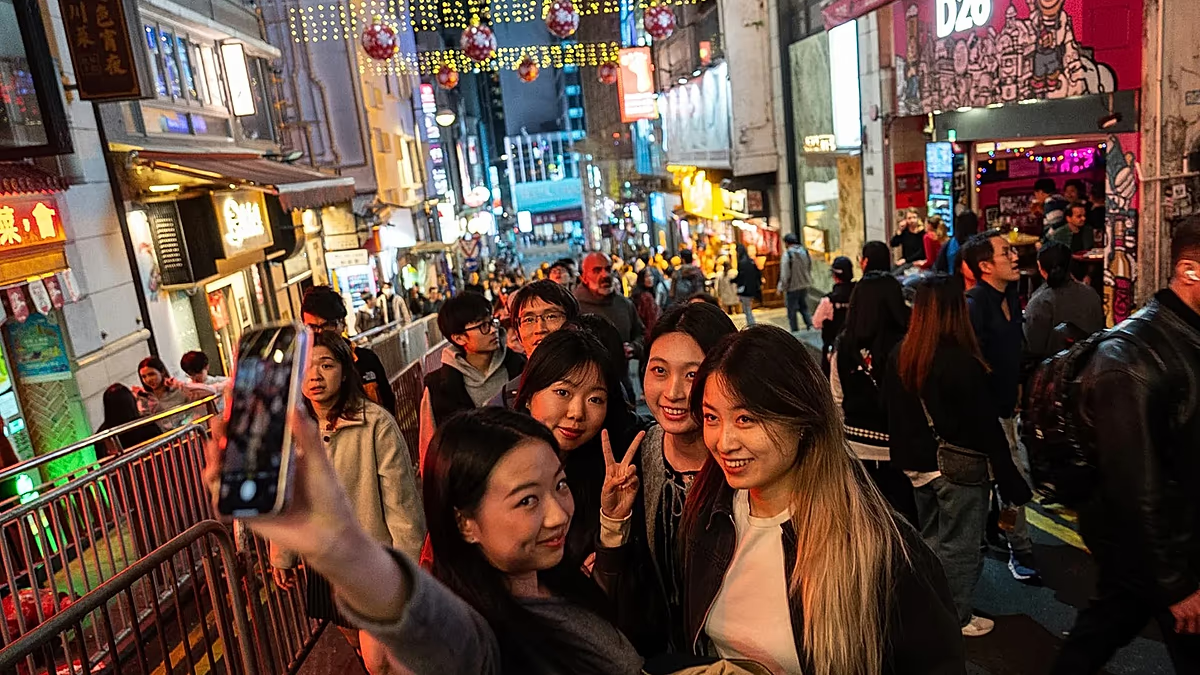
The cancellation impacted New Year’s Eve celebrations across the city, affecting tourist plans and businesses. While the usual crowds anticipated for a harbour fireworks show were diminished, revellers still gathered, but at alternative venues like Central, where the Hong Kong tourism board hosted performances by Air Supply and other artists.
The Absence of Hong Kong’s Traditional Fireworks
For decades, fireworks have been synonymous with New Year’s, Lunar New Year, and National Day celebrations in Hong Kong. The dazzling displays, launched over the iconic skyline, routinely attract hundreds of thousands of people, including a substantial number of tourists, to the harbourfront. However, the gravity of November’s tragedy prompted authorities to prioritize sensitivity and respect for the victims and their families.
Rosanna Law, the Secretary for Culture, Sports and Tourism, acknowledged the economic impact of the cancellation on the hotel and restaurant sectors. Despite this, many residents and visitors expressed understanding and support for the decision. Annie Wang, a tourist from Shanghai, stated she understood the city’s stance, expressing her heartbreak over the fire.
A City in Mourning
The November blaze at Wang Fuk Court was the worst fire Hong Kong has seen since the 1940s. The apartment complex was undergoing extensive renovations, and the fire is believed to have spread rapidly due to substandard netting and foam boards used during the construction process. Authorities are currently investigating the incident and assessing building safety regulations.
Thousands of residents have been displaced, seeking refuge in transitional housing, hotels, and youth hostels, grappling with the loss of their homes and loved ones. The long-term consequences of the fire are still unfolding, and the community faces a difficult path to recovery.
This isn’t the first time celebrations have been scaled back in response to tragedy. Similar cancellations occurred after a fatal vessel collision in 2012 and a bus crash in 2018. Political unrest in 2019 and the COVID-19 pandemic also led to the suspension of public displays in recent years.
The tradition of fireworks, originating in ancient China, holds deep cultural significance. According to the American Pyrotechnics Association, the first firecrackers emerged in the second century BC from bamboo exploding in flames. Later, Li Tian of the Tang dynasty, between the 7th and 10th centuries, refined the process by using gunpowder in bamboo tubes, creating the forerunners of modern fireworks, historically used to ward off evil spirits.
Looking ahead, the focus remains on supporting the affected communities and ensuring building safety standards are rigorously enforced. While the skies above Victoria Harbour remained dark this New Year’s Eve, the spirit of Hong Kong endures as it continues to navigate recovery and rebuild. Travelers considering a visit to Hong Kong should stay informed about ongoing recovery efforts and any adjustments to public events.
Additional sources • AP