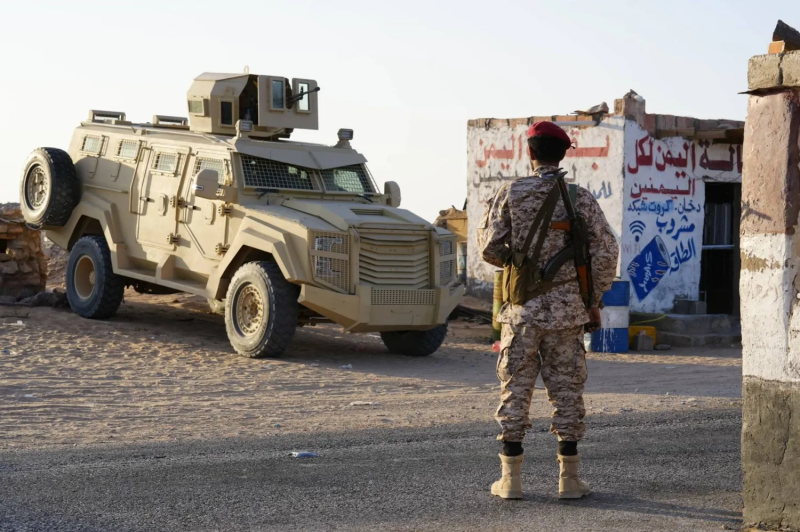

ADEN, Yemen – A recent decree from Yemen’s Presidential Leadership Council has appointed Hadramout Governor Salem al-Khunbashi as the commander of the Homeland Shield Forces in the eastern governorate, escalating tensions with the Southern Transitional Council (STC). The move aims to restore order and stability in Hadramout, a region vital to Yemen’s oil production and strategic interests. The appointment comes amid accusations of obstructionism from the STC and growing concerns over potential instability.
The Presidential Leadership Council granted al-Khunbashi full military, security, and administrative authority in Hadramout, with the mandate remaining in effect until conditions prompting the decision are resolved or a new directive is issued. This action follows a declaration by the Homeland Shield Forces indicating their readiness to take control of military positions previously held by STC forces in both Hadramout and Al-Mahra governorates.
Escalating Tensions in Hadramout and the Role of the Homeland Shield
The appointment of al-Khunbashi and the subsequent launch of “Receiving the Camps” operation – intended to peacefully assume control of military sites – represent a significant escalation in the ongoing power struggle between the internationally recognized government and the STC. Al-Khunbashi, in a televised address, directly accused the STC of rejecting de-escalation efforts and preparing to destabilize Hadramout. He maintained the operation is a preventative measure, not a declaration of war, and will not target civilians.
Background on the Southern Transitional Council
The STC, a separatist movement with significant support in southern Yemen, has long sought autonomy or independence from the north. It previously controlled much of Aden, the interim capital, and parts of southern Yemen. While nominally part of the anti-Houthi coalition, the STC has clashed with government forces on multiple occasions, complicating efforts to end Yemen’s civil war.
However, the STC’s actions have drawn criticism from regional powers, particularly Saudi Arabia, which has been a key mediator in the conflict. Saudi Ambassador to Yemen, Mohammed Al Jaber, publicly stated that STC leader Aidarus al-Zubaidi refused landing clearance for a Saudi aircraft carrying an official delegation to Aden on Thursday. This refusal, Al Jaber said, undermines de-escalation efforts and threatens Yemen’s stability.
Operation “Receiving the Camps” and Concerns Over Instability
The “Receiving the Camps” operation is designed to transfer control of military installations from STC forces to the Homeland Shield, a force intended to operate under the authority of the Presidential Leadership Council. Al-Khunbashi emphasized the operation’s focus on a peaceful and orderly transition, aiming to avoid clashes. He appealed to all political and social forces in Hadramout to act responsibly and prevent the governorate from becoming a battleground.
Additionally, local authorities and state institutions, in coordination with Saudi Arabia, have reportedly been working to maintain open channels for political dialogue. Despite these efforts, al-Khunbashi stated that all political avenues have been closed, and preparations for chaos are underway. The situation raises concerns about a potential resurgence of violence in a region already grappling with economic hardship and the lingering effects of the civil war.
Regional Implications and Saudi Arabia’s Role
The escalating tensions in Hadramout are occurring against the backdrop of broader efforts to achieve a lasting peace in Yemen. Saudi Arabia has been actively mediating between the Yemeni government and the Houthi rebels, with talks progressing towards a potential ceasefire and political settlement. The instability in the south, however, threatens to derail these efforts.
The refusal to allow the Saudi delegation to land in Aden is a particularly concerning development. According to Al Jaber, it represents a dangerous precedent that undermines de-escalation efforts. Saudi Arabia has invested heavily in Yemen’s stability and has a vested interest in preventing a further fragmentation of the country. The kingdom’s continued efforts to mediate between the warring parties will be crucial in the coming days.
The situation also impacts Yemen’s oil production, as Hadramout is a key oil-producing region. Any disruption to oil flows could exacerbate the country’s economic crisis and further complicate efforts to provide humanitarian assistance to the population. The security of critical infrastructure, including oil facilities, is a major concern.
In contrast to the STC’s actions, the Presidential Leadership Council is attempting to consolidate its authority and establish a unified security apparatus. The appointment of al-Khunbashi is part of this broader strategy. However, the success of this strategy will depend on the ability to maintain the support of local tribes and communities, as well as the continued backing of Saudi Arabia and other regional allies.
Looking ahead, the next steps will likely involve continued diplomatic efforts by Saudi Arabia to mediate between the Yemeni government and the STC. The outcome of these negotiations will determine whether the situation in Hadramout escalates into full-scale conflict or whether a peaceful resolution can be reached. The international community will be closely monitoring the situation, and further intervention may be considered if the situation deteriorates. The timeline for a resolution remains uncertain, and the potential for further instability remains high.