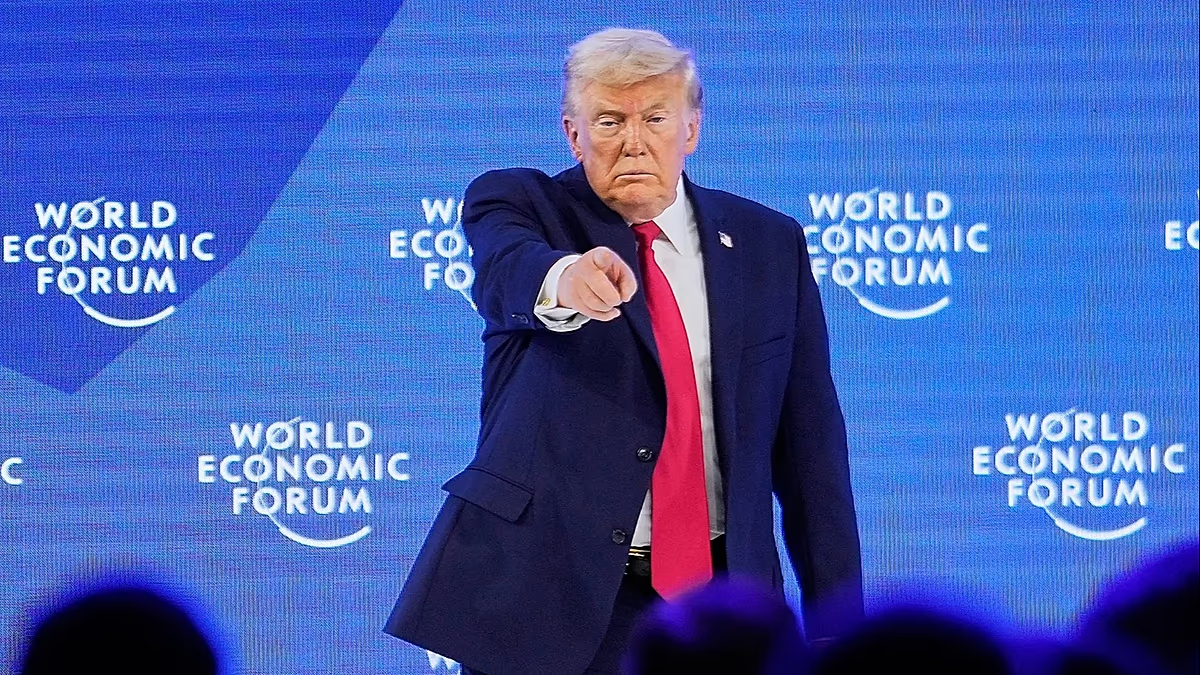

During his Wednesday speech at the World Economic Forum in Davos, US President Donald Trump made a series of assertions about international relations, economic performance, and historical events. Several of these claims have been disputed or lack supporting evidence, prompting fact-checkers to examine their accuracy. This article focuses on verifying key statements made by President Trump, particularly regarding NATO and its role in global security, as well as claims about energy prices and historical events.
Trump’s remarks sparked immediate scrutiny, with organizations like Euronews’ The Cube analyzing the factual basis of his statements. The core of the debate centers on whether his pronouncements accurately reflect the current state of affairs and historical realities.
Is Trump’s Criticism of NATO Justified?
President Trump repeatedly criticized NATO, alleging that the US receives little benefit from the alliance and questioning whether member states would come to its defense in the event of an attack. He claimed the US has “never got anything out of NATO” and was previously paying “virtually 100%” of its budget.
However, these claims are demonstrably false. The US has, in fact, invoked Article 5 – NATO’s collective defense clause – following the September 11th attacks, triggering assistance from other member nations. NATO details the support provided, including enhanced intelligence sharing and the launch of Operation Eagle Assist.
Regarding funding, the US currently contributes approximately 15.9% of NATO’s common budget, alongside Germany. While US defense spending represented 71% of the total among all NATO members in 2016, this figure has decreased to around 66% in recent years. Furthermore, many NATO members are increasing their defense spending, aiming to meet a target of 2% of GDP, a goal Trump previously emphasized.
NATO Defense Spending Trends
Recent data shows Poland leading in defense spending as a percentage of GDP (4.48%), followed by Lithuania and Latvia. The US currently ranks sixth at 3.22%, indicating a shift in financial contributions within the alliance.
Energy Prices and Renewable Energy Policies
Trump also asserted that Germany’s electricity prices are 64% higher than they were in 2017, attributing this increase to renewable energy policies. He characterized these policies as a “New Green Scam” and criticized windmills as “losers.”
While German electricity prices have increased, the claim of a 64% rise is inaccurate. Data from the German Association of Energy and Water Industries shows an increase of around 29% between 2017 and 2025. Similarly, data from Germany’s Federal Statistics Office and Eurostat indicate an increase of approximately 31% during the same period.
The spike in electricity prices was largely driven by the collapse of gas supplies following Russia’s invasion of Ukraine in 2022, rather than solely by renewable energy policies. While renewable energy does contribute to long-term system costs, it wasn’t the primary factor in the recent price surge.
Other Claims and Historical Assertions
Trump also made claims about the UK’s energy production, stating it has fallen to one-third of its 1999 levels. UK government data confirms a 66% decrease in energy production since 1999, largely due to the natural decline of North Sea oil and gas reserves.
Regarding his claim of ending eight wars, the situation is more nuanced. While Trump has been involved in mediation efforts, the extent of his impact is debatable. Conflicts continue in several regions he cited, and some agreements remain incomplete.
Finally, Trump incorrectly stated that the US “returned” Greenland to Denmark after World War II. The US never held sovereignty over Greenland; it assumed responsibility for its defense during the war while Denmark retained ownership.
As President Trump’s statements continue to shape the global political discourse, it remains crucial to critically evaluate the factual basis of his claims. Ongoing scrutiny from fact-checking organizations will be essential to ensure informed public debate and a clear understanding of international affairs. Readers are encouraged to consult reputable sources for further information on these topics and to stay informed about evolving geopolitical developments.