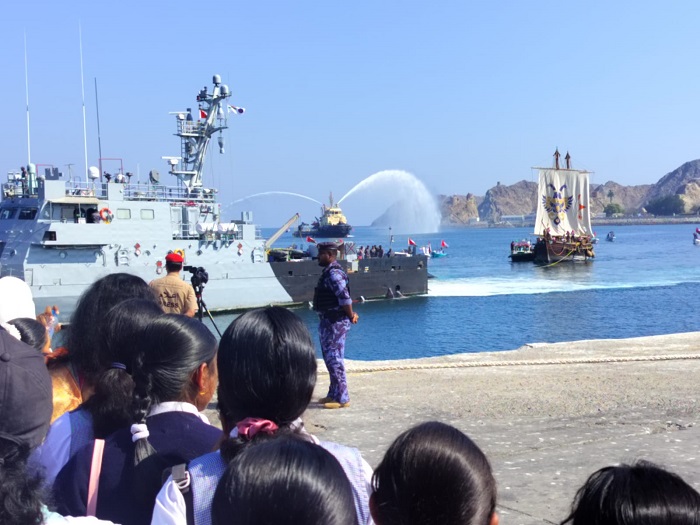

A historic moment unfolded at Port Sultan Qaboos in Muscat, Oman, on Wednesday as the Indian Navy’s indigenously built traditional stitched sailing vessel, INSV Kaundinya, received a grand welcome. The arrival marks the successful completion of its maiden voyage from Porbandar, Gujarat, a testament to India’s revived maritime heritage and strengthening ties with Oman. This remarkable journey highlights a commitment to both historical preservation and modern naval capabilities.
INSV Kaundinya: A Symbol of India’s Maritime Revival
The INSV Kaundinya isn’t just a ship; it’s a floating museum and a powerful symbol of India’s rich shipbuilding past. Escorted into port by a Royal Navy of Oman vessel, the Kaundinya was greeted with a spectacular water salute and a warm reception from Omani citizens gathered in small boats. The arrival was further celebrated with a performance by an Omani military band and traditional Indian dance troupes, creating a vibrant and festive atmosphere.
A Voyage Rooted in History
This voyage is particularly significant as the INSV Kaundinya is a recreation of a 5th-century CE ship, inspired by the ancient vessels depicted in the Ajanta Caves paintings. The project, initiated in July 2023, is a collaborative effort between the Ministry of Culture, the Indian Navy, and M/s Hodi Innovations, funded by the Ministry of Culture. It represents a deliberate effort to reconnect with and showcase India’s ancient maritime prowess.
The Construction of a Traditional Marvel
The construction of the INSV Kaundinya was a painstaking process, relying entirely on traditional shipbuilding techniques. Skilled artisans from Kerala, led by master shipwright Babu Sankaran, meticulously stitched wooden planks together using coir rope, coconut fibre, and natural resin – a method unchanged for centuries. The keel was laid in September 2023, and the vessel was launched in February 2024 at Goa. This commitment to authentic methods distinguishes the Kaundinya from modern shipbuilding.
Naval Expertise and Modern Validation
While built using ancient techniques, the project wasn’t solely reliant on historical knowledge. The Indian Navy played a crucial role in the design and technical validation. With no surviving blueprints, the Navy collaborated with the shipbuilder, inferring the design from iconographic sources and validating it through hydrodynamic model testing at the Department of Ocean Engineering, IIT Madras. This blend of tradition and technology ensured the vessel’s seaworthiness and historical accuracy.
Strengthening India-Oman Ties
The maiden voyage to Oman is more than just a demonstration of shipbuilding skill; it’s a celebration of the long-standing relationship between India and Oman. Indian Union Minister of Ports, Shipping & Waterways, Sarbananda Sonowal, hailed the mission as a “shining example” of Prime Minister Narendra Modi’s vision to revive India’s maritime legacy. He emphasized the Prime Minister’s commitment to showcasing India’s ancient shipbuilding genius to the world.
Tavishi Behal Pandey, Deputy Chief of Mission of India, echoed this sentiment, stating the voyage was a tribute to the “age-old relationship” between the two nations. She highlighted the importance of the journey, especially as both countries celebrate 70 years of diplomatic relations. The recent Comprehensive Economic Partnership Agreement (CEPA) between India and Oman, described by Prime Minister Modi as ‘Maitri’ (friendship), further underscores the deepening partnership. This voyage serves as a tangible representation of that trust and brotherhood.
The Crew and the Journey
The INSV Kaundinya was skippered by Commander Vikas Sheoran, with Commander Y Hemant Kumar, who has been instrumental in the project since its inception, serving as the Officer-in-Charge of the expedition. The crew comprised four officers and thirteen naval sailors, all of whom faced the challenges of a demanding sea voyage. Sanjeev Sanyal, a member of the Prime Minister’s Economic Advisory Council and part of the crew, provided daily updates on the ship’s progress via social media, captivating audiences with insights into the journey.
Pandey described the voyage as “difficult,” noting the lack of breaks and the harsh conditions faced by the sailors, including strong winds and stormy seas. However, she emphasized their successful arrival and their upcoming participation in events, hinting at a “boxing ring” appearance – likely a metaphorical reference to a competitive event.
A Legacy Embodied
The INSV Kaundinya is named after Kaundinya, a legendary Indian mariner credited with sailing across the Indian Ocean to Southeast Asia. The vessel is adorned with culturally significant motifs, including the Gandabherunda and the Sun on its sails, a sculpted Simha Yali on its bow, and a Harappan-style stone anchor on its deck. These details are not merely decorative; they are deliberate evocations of India’s rich maritime traditions and historical connections.
The successful completion of this voyage and the warm welcome received in Muscat demonstrate the enduring power of cultural exchange and the importance of preserving India’s maritime heritage. The INSV Kaundinya is poised to become a symbol of national pride and a valuable asset in promoting India’s historical and contemporary naval capabilities. We can expect to see this magnificent vessel participate in future maritime events and continue to inspire a new generation of sailors and shipbuilders.