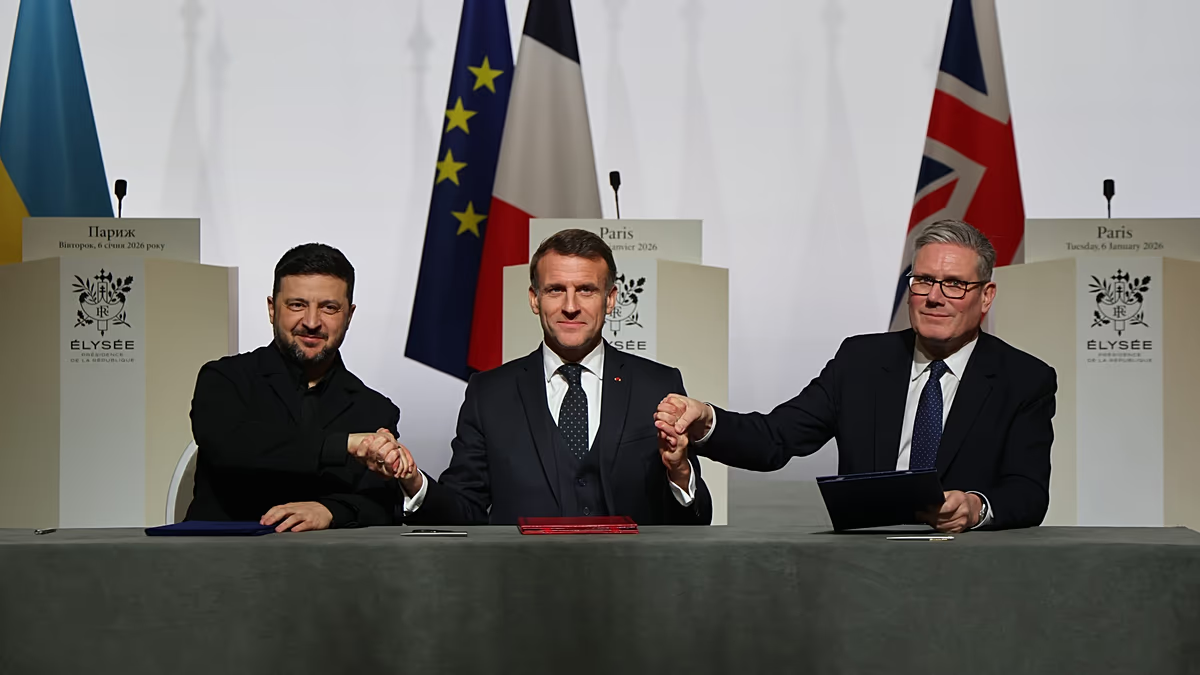

France and the United Kingdom have solidified plans to deploy troops to Ukraine following a potential ceasefire, marking a significant escalation in Western support for Kyiv. This commitment, part of a broader effort to establish long-term security guarantees for Ukraine, aims to deter future Russian aggression and provide a framework for lasting peace. The agreement was reached at a meeting in Paris on Tuesday, bringing together leaders from nearly 30 countries to discuss bolstering Ukraine’s defenses.
Ukrainian President Volodymyr Zelenskyy joined French President Emmanuel Macron and British Prime Minister Keir Starmer in signing the declaration, outlining a multi-faceted approach to safeguarding Ukraine’s future. The initiative comes as Ukraine continues to defend against Russia’s ongoing invasion and seeks assurances against renewed attacks, particularly given evolving geopolitical dynamics and uncertainty surrounding continued aid.
Strengthening Ukraine’s Security: A New Framework
The proposed security guarantees extend beyond simple military aid. According to statements from the meeting, the UK and France will establish military hubs within Ukraine, complete with protected facilities for weapons and equipment, once a ceasefire is in effect. These hubs will be positioned away from the active conflict zone to provide support for Ukraine’s defensive capabilities. Turkey is also expected to contribute, offering maritime support to the overall security arrangement.
A key component of the plan involves a US-led, high-tech monitoring mechanism designed to verify adherence to a ceasefire agreement. This system, utilizing advanced sensors along the contact line, will aim to identify and attribute any breaches of the agreement, triggering a response from the allied nations. The intention is to create a clear and verifiable deterrent to prevent Russia from re-initiating hostilities.
A Collective Defense Obligation
Perhaps the most significant aspect of the agreement is a legally binding commitment from participating nations to assist Ukraine in the event of a renewed Russian attack. This obligation, modeled after Article 5 of the NATO treaty, could encompass military assistance, logistical support, economic aid, and diplomatic pressure. However, unlike Article 5, triggering this assistance would be a political decision, not an automatic one, according to European officials.
The implementation of this commitment hinges on ratification by national parliaments, a process that could prove challenging in some countries where public support for Ukraine is waning. In the United States, approval would require a vote in Congress. Germany’s Chancellor Friedrich Merz indicated his country’s contribution would require Bundestag approval and may be limited to deployments in neighboring countries, but added, “We fundamentally don’t rule anything out.” Spain’s Prime Minister Pedro Sánchez announced plans to initiate discussions with political parties regarding Spain’s potential contribution, including the possibility of deploying troops.
The meeting also saw participation from key international figures, including European Commission President Ursula von der Leyen and NATO Secretary General Mark Rutte. Notably, the US delegation was led by Steve Witkoff and Jared Kushner, President Donald Trump’s appointed negotiators, who emphasized Trump’s desire for a peaceful resolution in Ukraine. NATO’s Article 5 outlines the principle of collective defence, a concept influencing these new security measures.
Zelenskyy described the outcome as “a huge step forward,” but cautioned that further action is needed, stating that the measures would be sufficient only “when the war in Ukraine will end.” Meanwhile, Russia has not demonstrated a willingness to compromise, continuing its drone and missile strikes against Ukrainian infrastructure and civilian populations.
Starmer underscored the necessity of genuine commitment from Russia, stating, “We can only get to a peace deal if Putin is ready to make compromises. For all Russia’s words, Putin is not showing he’s ready for peace.” The success of these security guarantees ultimately depends on a shift in Russia’s position and a move towards a negotiated settlement, a situation that remains uncertain. The primary goal is to avoid a repeat of the 2022 invasion and establish a stable and secure future for Ukraine. Discussions around long-term defense cooperation and military aid packages are still ongoing.
Looking ahead, the focus will be on translating these commitments into concrete action and securing parliamentary approval in key nations. Developments surrounding the ceasefire monitoring mechanism and the specific nature of military deployments will be crucial to watch in the coming months. For further updates on the ongoing conflict and international efforts to support Ukraine, continue to follow reputable news sources.