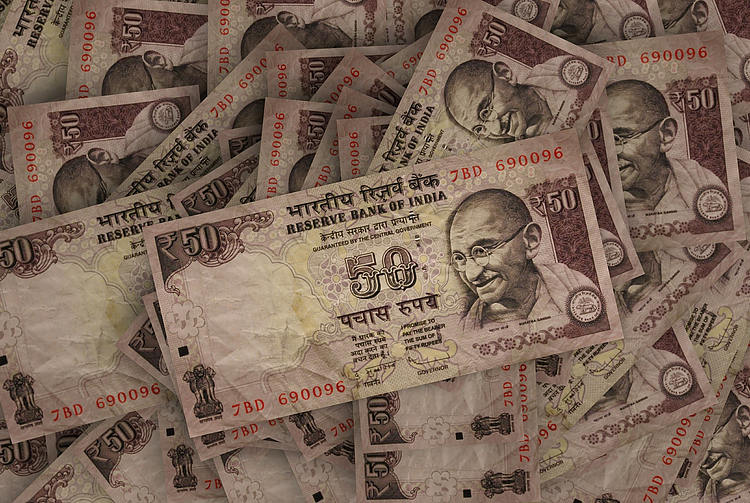

The Indian Rupee (INR) weakened in Tuesday’s Asian session due to significant foreign institutional investor outflows and higher US bond yields. This was driven by the rising odds of Donald Trump winning the US presidential election. However, the fall in crude oil prices could provide some support to the local currency. The Reserve Bank of India’s (RBI) foreign exchange intervention might help limit the losses of the INR. Traders will closely monitor key US economic data released this week, including the advanced US Gross Domestic Product (GDP) for the third quarter, the Personal Consumption Expenditures (PCE) Price Index for September, and the anticipated US Nonfarm Payrolls (NFP).
The RBI’s aim is to curb volatility in the INR in the run-up to and aftermath of the US elections. Foreign investors withdrew $10 billion from India’s equity and debt markets in October, the most significant monthly selling this year. Nomura reported that the Indian economy is experiencing a “cyclical growth slowdown,” and the RBI’s estimate of 7.2% GDP expansion is deemed overly optimistic. The Indian economy is projected to expand between 6.5% and 7.0% in the current financial year, as stated by the Department of Economic Affairs. Additionally, traders have priced in nearly 96.8% odds of a 25 basis points rate cut in November, with a similar move expected in the December meeting.
Technically, the USD/INR pair maintains a bullish outlook above the key 100-day Exponential Moving Average (EMA) on the daily chart. The 14-day Relative Strength Index (RSI) stands above the midline, indicating that the support is likely to hold. Bullish candlesticks and sustained trading above the trend channel’s upper boundary could set USD/INR on a path towards higher levels. Conversely, consistent trades under the lower limit of the trend channel could lead to a drop in the currency pair.
The Indian Rupee is influenced by various external factors such as the price of crude oil, the value of the US Dollar, and foreign investment. The Reserve Bank of India (RBI) intervenes in the forex market to maintain exchange rate stability and adjust interest rates to control inflation. Macroeconomic factors like inflation, interest rates, economic growth, trade balance, and foreign investment play a significant role in determining the value of the Rupee. Higher growth rates and lower trade deficits can lead to a stronger Rupee, while higher inflation may have a negative impact.
Inflation plays a crucial role in the Rupee’s value, as higher inflation compared to India’s peers can lead to currency devaluation. However, higher inflation can also lead to RBI raising interest rates, which may increase demand for the Rupee from international investors. Conversely, lower inflation can have the opposite effect on the currency. The Rupee is sensitive to both domestic and international factors, making it essential for traders and investors to closely monitor economic indicators and geopolitical events that could impact the currency’s value.
In conclusion, the Indian Rupee’s weakness is influenced by a combination of domestic and international factors, including foreign outflows, US bond yields, and economic data releases. The RBI’s interventions and market movements will play a crucial role in determining the local currency’s trajectory in the coming days. Traders and investors must stay informed about key developments to make informed decisions regarding their Rupee-related investments.