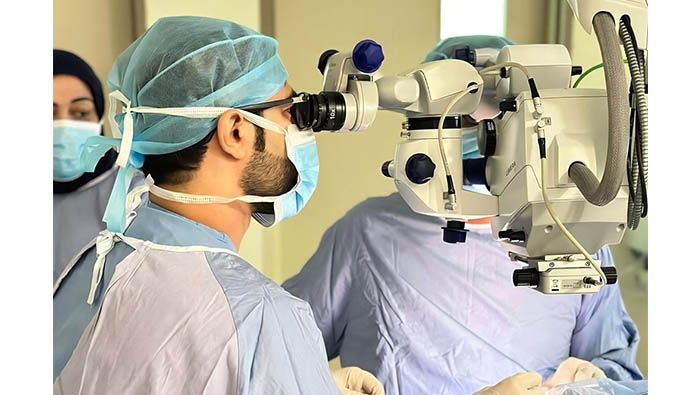

Oman’s healthcare sector has reached a significant milestone with the successful completion of the nation’s first DMEK (Descemet’s Membrane Endothelial Keratoplasty) cornea transplant at Al Nahdha Hospital. This groundbreaking procedure, performed by a specialized team in the Ophthalmology Department, represents a leap forward in the treatment of corneal endothelial diseases, offering hope for improved vision and quality of life for patients suffering from conditions like Fuchs’ endothelial dystrophy and corneal edema.
What is DMEK Cornea Transplant? A New Era in Vision Restoration
DMEK, considered the most precise cornea transplant technique available globally, differs significantly from traditional full-thickness corneal transplants. Instead of replacing the entire cornea, DMEK focuses on replacing only the innermost layer – the Descemet’s membrane and endothelial cells. These cells are crucial for maintaining corneal clarity, and their dysfunction leads to swelling and blurred vision. This minimally invasive approach offers numerous advantages over conventional methods, making it a preferred choice for eligible patients.
The Procedure: Precision and Minimally Invasive Techniques
Dr. Haitham bin Hilal Al Mahrouqi, Senior Specialist in Cornea Transplants, Cataracts, and Vision Correction at Al Nahdha Hospital, who led the operation, explained that the procedure took approximately one and a half hours. The surgery involves administering local anesthesia, carefully removing the damaged endothelial membrane, and then inserting the donor tissue through a remarkably small incision – less than three millimeters.
A key element of the DMEK procedure is the use of an air or gas bubble injected into the eye to hold the donor tissue in place while it adheres to the recipient cornea. This necessitates that patients remain lying flat for a period post-operation to ensure successful attachment. The incredibly thinness of the transplanted tissue – often less than 15 microns – is what allows for this precise, cell-replacement approach.
Benefits of DMEK Compared to Traditional Cornea Transplants
The advantages of DMEK corneal surgery are substantial. Patients typically experience rapid and significant improvement in visual acuity. Furthermore, the risk of immunological rejection is considerably lower due to the small amount of donor tissue used. Unlike traditional transplants, DMEK often doesn’t require surgical sutures, preserving the natural curvature of the cornea and minimizing visual aberrations.
Additionally, the recovery period is generally faster, allowing most patients to return to their daily activities within a few weeks. This is a significant improvement over the longer and more complex recovery associated with full-thickness transplants. The precision of the DMEK technique also contributes to better overall outcomes and patient satisfaction.
Who is a Suitable Candidate for DMEK?
While DMEK offers remarkable benefits, it’s not suitable for everyone. Dr. Al Mahrouqi emphasized that the procedure requires a high level of surgical skill due to the delicate nature of the tissue. It’s particularly well-suited for patients with endothelial cell diseases like Fuchs’ endothelial dystrophy. However, individuals with deep corneal scars or opacities may not be ideal candidates.
There is a small risk of the transplanted membrane detaching, which may require re-injection of an air bubble. A thorough evaluation by a qualified corneal specialist is crucial to determine if DMEK is the appropriate treatment option.
Al Nahdha Hospital’s Expanding Corneal Transplant Program
The successful implementation of DMEK at Al Nahdha Hospital marks a qualitative addition to the advanced surgical services available in Oman’s ophthalmology field. This achievement builds upon the hospital’s growing expertise in corneal restoration. Since the launch of the cornea transplant program in September 2023, in collaboration with the National Organ Transplant Programme, over 180 cornea transplant operations have been performed.
This impressive number demonstrates the hospital’s commitment to providing specialized care and achieving excellent therapeutic outcomes for patients with corneal diseases. The development of these services reflects Oman’s ongoing investment in healthcare infrastructure and its dedication to improving the health and well-being of its citizens.
Dr. Al Mahrouqi highlighted the consistently high success rates of DMEK transplants, exceeding 90-95 percent. This, combined with the rapid recovery times, makes it a truly transformative procedure for those suffering from corneal endothelial dysfunction.
The introduction of DMEK at Al Nahdha Hospital not only expands treatment options for Omani patients but also positions the hospital as a regional center of excellence for advanced corneal transplantation. For individuals experiencing vision loss due to corneal disease, consulting with an ophthalmologist to explore the potential benefits of DMEK is a crucial step towards regaining clear and healthy vision.