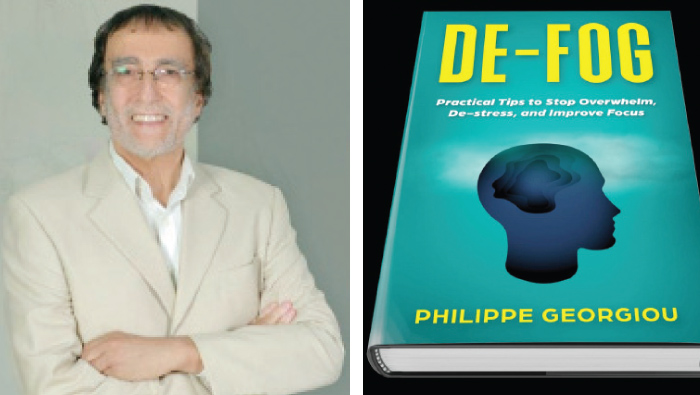

Do you ever find yourself starting a task, only to get pulled in a dozen different directions before losing track of your original intention? That feeling of being mentally scattered is increasingly common in today’s hyper-connected world. Fortunately, De-Fog: Practical Tips to Stop Overwhelm, De-Stress, and Improve Focus, the new book by Muscat-based author Philippe Georgiou, offers a compassionate and actionable path towards reclaiming your attention and finding clarity. This isn’t about striving for impossible productivity; it’s about understanding why we struggle with mental clarity and implementing realistic solutions.
Understanding the Modern Attention Crisis and ‘De-Fog’
Georgiou aptly diagnoses the core problem: we are not inherently flawed for struggling to focus, but rather profoundly overstimulated. The constant barrage of digital notifications, the erosion of boundaries between work and personal life, and the sheer volume of information we consume daily all contribute to a state of perpetual “fog.” This isn’t a new issue, but the intensifying pace of modern life means increasing numbers of people are seeking strategies for managing the resulting overwhelm. “De-Fog” isn’t positioned as a quick fix, but as a gradual process of recalibration, acknowledging the challenges while offering accessible tools for improvement.
As a seasoned coach and communications expert, Georgiou’s approach differs significantly from typical productivity literature. He avoids demanding routines or guilt-inducing self-improvement mantras. Instead, he adopts a conversational and empathetic tone, guiding readers through proven techniques with a gentle hand. He understands that the journey towards better focus is often non-linear and requires tailoring strategies to individual needs.
Practical Strategies for Reclaiming Your Focus
The book is smartly structured, mirroring the phases of recognizing and addressing attention deficit. The initial chapters delve into the underlying causes of mental fog – from the neuroscience of overwhelm to the impact of relentless digital connectivity. Georgiou doesn’t just identify the problems; he meticulously explains the *why* behind them, providing a solid foundation for understanding the proposed solutions.
Digital Detox: A Realistic Approach
One core component of “De-Fog” is addressing digital overload. However, Georgiou doesn’t advocate for complete disconnection. He realizes that’s often impractical and unsustainable. Instead, he presents “realistic digital detox plans” – strategies for mindful technology use, including setting boundaries, curating notifications, and scheduling dedicated “digital-free” time. These aren’t about deprivation, but about regaining control over your attention.
The Power of Practical Minimalism
A particularly insightful section explores “practical minimalism,” reimagining it not as a decluttering trend focused on possessions, but as a method for simplifying the mind. Georgiou argues that mental clutter—the endless stream of thoughts, worries, and unfinished tasks—is a significant obstacle to focus. His techniques for organizing thought processes and streamlining decision-making are extremely valuable in our current age of overwhelming choice.
Brain-Training for Daily Life
The book doesn’t shy away from incorporating science-backed techniques to improve cognitive function. But these aren’t presented as tedious exercises. Instead, Georgiou cleverly weaves brain-training activities into everyday routines, making them easy to adopt and maintain. This might involve mindful observation during mundane tasks, specific breathing exercises, or short bursts of focused work followed by restorative breaks.
A Humane Approach to Attention Management
What truly distinguishes “De-Fog” is its refusal to pathologize difficulties with attention. Georgiou frames a wandering mind not as a moral failing, but as a natural consequence of a demanding environment. He actively counters the pervasive “hustle culture” by advocating for designing days around periods of deep focus, actively protecting that time from interruptions and obligations. The influence of mindfulness practices is clear, but presented in an accessible format, devoid of any esoteric elements. It’s about practical tools that anyone can implement.
The book’s overall message isn’t about achieving constant, unwavering concentration. It’s about progress, not perfection. Georgiou provides readers with a toolbox of strategies to move from a scattered, overwhelmed state to a more centered and focused one. He acknowledges the inevitable setbacks while encouraging continued effort and self-compassion.
Reclaiming Mental Clarity: A Timely Guide
In a world that often equates busyness with worth, “De-Fog: Practical Tips to Stop Overwhelm, De-Stress, and Improve Focus” offers a refreshing counter-narrative. Philippe Georgiou’s book isn’t just another productivity manual; it’s a compassionate and practical guide to reclaiming your mental clarity and navigating the challenges of modern life. If you’re feeling constantly overwhelmed and struggling to focus, this book could be the reset you’ve been looking for, offering simple habits that can lead to profoundly positive change.
You can find the book at Amazon. For inquiries or to connect with the author, please email him at [emailprotected]